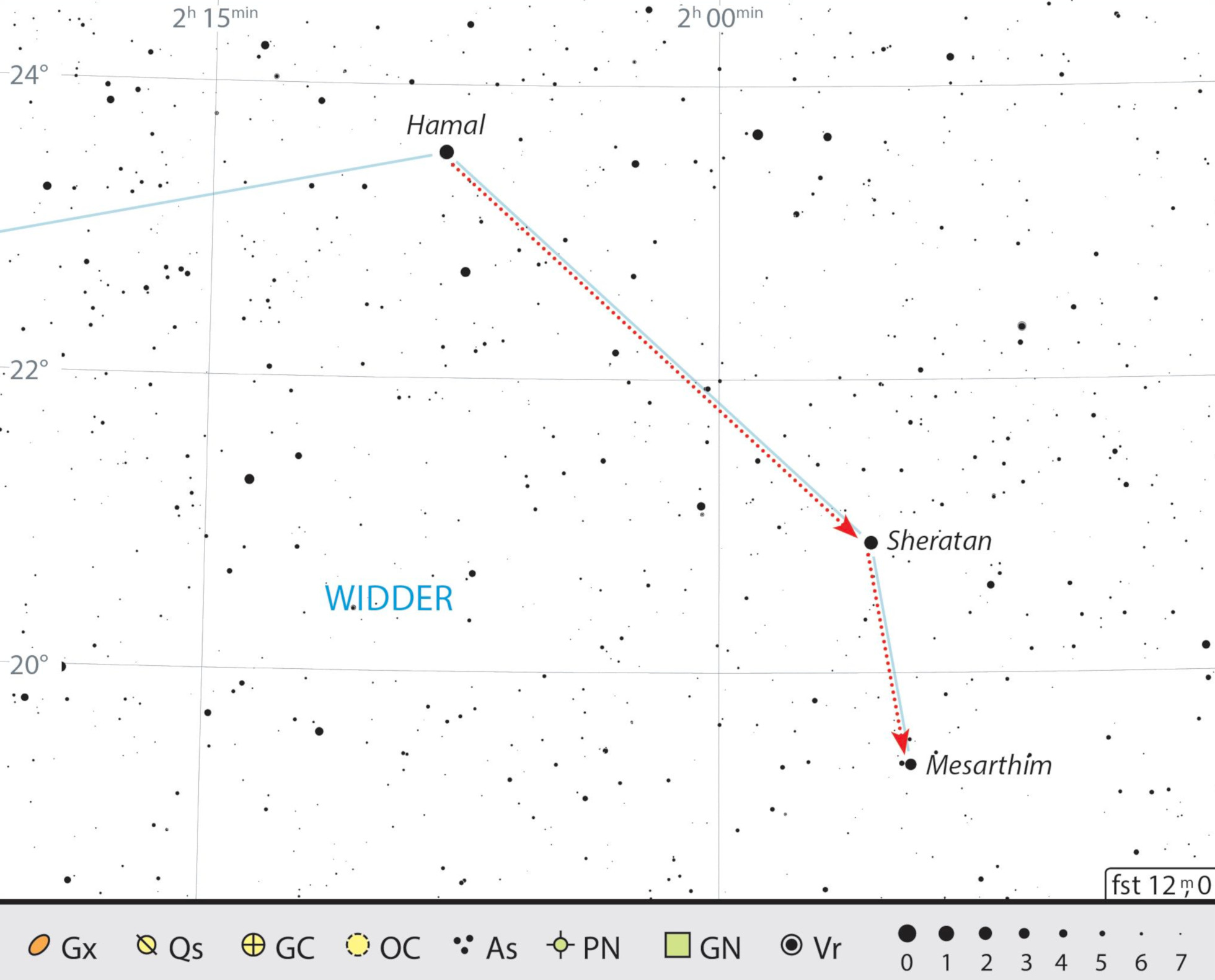
Gamma Arietis
ASTRONOMY LAB: GAMMA ARIETIS
RIGHT ASCENSION, DECLINATION & CONSTELLATION BOUNDARIES
Equatorial Coordinates & Position
Gamma Arietis, traditionally known as Mesarthim, is a striking binary star system situated in the northern constellation of Aries. It features precise equatorial coordinates mapped across standard J2000 epoch positioning.
Right Ascension coordinate for celestial navigation.
Angular distance north of the celestial equator.
Mesarthim (Gamma Arietis)
Stellar Introduction. Gamma Arietis, traditionally known as Mesarthim, is a prominent multiple star system situated within the northern constellation of Aries.
Astrological & Navigational Landmark: Famous as a bright white double star easily resolved through small telescopes, Mesarthim serves as an essential reference point for mapping celestial coordinates in the northern celestial hemisphere.
- ⭐ Located in the constellation Aries.
- 🔭 Striking double star system configuration.
Right Ascension
Celestial Longitude. Right Ascension (RA) measures the angular distance eastward along the celestial equator, serving as the sky's equivalent to terrestrial longitude.
Mesarthim's Position: The precise Right Ascension coordinate for Gamma Arietis is approximately 01h 53m 31.7s, placing it securely within the eastern sector of the Ram constellation.
- 🧭 RA: 01h 53m 31.7s (Epoch J2000).
- ⏱️ Measured in hours, minutes, and seconds eastward.
Declination
Celestial Latitude. Declination (Dec) measures angular distance north or south of the celestial equator, matching Earth's latitude system projected onto space.
Northern Positioning: Gamma Arietis features a Declination of approximately +19° 17' 45", ensuring clear visibility across the majority of the northern and mid-southern terrestrial latitudes.
- 🌐 Dec: +19° 17' 45" (Epoch J2000).
- 📐 Expressed in degrees, arcminutes, and arcseconds north.
Boundary Coordinates
Official IAU Sectors. The International Astronomical Union (IAU) defines strict polygon boundaries for every constellation to map the celestial sphere seamlessly.
Aries Sector Limits: Aries occupies a designated region bounded by right ascensions from roughly 01h 40m to 03h 29m and declinations spanning from +10° to +31°, enclosing Mesarthim securely within its southern-central domain.
- 🗺️ Bounded polygon layout defined by the IAU.
- 📍 Secures precise cartographic divisions of the night sky.
Epoch & Precession
Shifting Axes. Earth's axial precession causes coordinate grids to drift gradually over time, making epochs critical reference benchmarks for astronomers.
Modern Standards: While historical charts utilized B1950, modern astronomical databases rely on the J2000.0 epoch, requiring slight mathematical corrections when comparing historical observations of Gamma Arietis.
- ⏳ Accounts for Earth's 26,000-year precession cycle.
- 📊 Standardized to J2000.0 coordinates.
Binary Dynamics
Dual Stellar Core. Mesarthim is composed of two primary white main-sequence stars revolving around a shared barycenter within the Aries coordinate framework.
Resolving Components: Designated Gamma Arietis A and B, the system features a distinct angular separation that changes slowly over decades, making it a favorite benchmark for amateur double star observers.
- 👥 Composed of component stars A and B.
- 🔭 Easily split using moderate telescope apertures.
Observing Mesarthim
Seasonal Peak. Because of its coordinates in northeastern Aries, Gamma Arietis reaches its highest elevation in the autumn and winter night skies across the northern hemisphere.
Apparent Magnitude: With a combined apparent magnitude of roughly +3.88, Mesarthim is easily visible to the naked eye under dark skies and shines brilliantly through binoculars or telescopes.
- 🌟 Combined magnitude of +3.88.
- 🍂 Best viewed during autumn and winter evenings.
Spectral Profiles
Stellar Classification. Spectral analysis reveals the physical composition and surface temperature characteristics of the twin stars making up Gamma Arietis.
A-Type Stars: Both primary components fall under the A-class stellar designation, glowing with a brilliant white light indicative of stable hydrogen fusion processes.
- 🔬 Classified primarily as A-type main-sequence stars.
- 💡 Emits high-intensity white stellar radiation.
Cultural Heritage
Ancient Stargazing. The traditional name "Mesarthim" stems from ancient Middle Eastern and Arabic star lore, historically translated to refer to an attendant or sheep.
Historical Catalogs: Included across centuries of star catalogs, Gamma Arietis continues to bridge ancient mythologies with modern precision astrometry and coordinate mapping.
- 📜 Derived from historical Arabic star names.
- ✨ Documented across classic astrometric star charts.
Modern Astrometry
Catalog Databases. Gamma Arietis is cataloged extensively in modern astronomical databases such as the Hipparcos and Gaia catalogs under precise identifiers like HIP 8832.
High-Precision Tracking: Space-based observatories measure proper motions and parallax angles of stars like Mesarthim with milliarcsecond accuracy, mapping the dynamic geometry of our galactic neighborhood.
- 🛰️ Listed in Hipparcos (HIP 8832) and Gaia catalogs.
- 📊 Milliarcsecond-level proper motion tracking.

Gamma Arietis (Mesarthim) FAQs
Examining the precise right ascension, declination, and celestial boundary coordinates of the captivating binary star system in Aries
Gamma Arietis, traditionally named **Mesarthim**, is a stunning binary star system located in the northern constellation of Aries, famous for its striking white-colored stellar components.
The Right Ascension coordinate for Gamma Arietis is approximately **01h 53m 31.8s**, placing it precisely within the celestial coordinates of the Ram constellation.
The Declination coordinate for Mesarthim is roughly **+19° 17' 45"**, positioning it comfortably in the northern celestial hemisphere for observers worldwide.
Mesarthim sits squarely inside the official IAU boundaries of **Aries**, bordered by Triangulum to the north, Pisces to the south and west, and Taurus to the east.
The system is located at an approximate distance of **164 light-years** (about 50 parsecs) away from our solar system, making its light easily viewable through small telescopes.
Discovered by Robert Hooke in 1664, it was one of the earliest double stars ever found. Its components feature glowing white spectral types that are cleanly separated in amateur optics.
The combined apparent magnitude of the system is roughly **3.88**, allowing it to be clearly spotted with the naked eye under moderately dark suburban night skies.
Gamma Arietis reaches its highest point in the night sky during autumn and early winter evenings, particularly around the month of November.
Right Ascension acts like longitude projected onto the sky (measured in hours, minutes, seconds), while Declination acts like latitude (measured in degrees north or south of the celestial equator).
Key search terms include: Gamma Arietis right ascension and declination, Mesarthim star coordinates, Aries constellation boundaries, and binary star astrometry.
Recommended Tools
View AllLoading recommended tools...

Andromeda

Antlia

Apus

Aquarius

Aquila

Ara

Aries

Auriga

Bootes

Caelum
Camelopardalis

Cancer

Canes Venatici

Canis Major

Canis Minor

Ursa Major (The Big Bear)

Cassiopeia

Centaurus

Cepheus

Cetus (The Whale)

Chamaeleon

Circinus

Columba

Coma Berenices

Corona Australis

Corona Borealis

Corvus

Crater

Crux

Cygnus

Delphinus

Dorado

Draco

Equuleus

Eridanus

Fornax

Gemini

Grus (The Crane)

Hercules

Horologium (The Clock)

Hydra

Hydrus

Indus
Lacerta

Leo

Leo Minor

Lepus (The Hare)

Libra

Lupus (The Wolf)

Lynx

Lyra

Mensa

Microscopium

Monoceros (The Unicorn)

Musca (The Fly)

Norma
Octans

Ophiuchus

Orion (The Hunter)

Pavo (The Peacock)

Pegasus

Perseus

Phoenix

Pictor

Pisces

Piscis Austrinus

Puppis

Pyxis

Reticulum

Sagitta

Sagittarius

Scorpius

Sculptor

Scutum

Serpens

Sextans

Taurus

Telescopium

Triangulum

Triangulum Australe

Tucana

Ursa Minor

Vela (The Sails)

Virgo

Volans (Flying Fish)

Vulpecula (The Fox)
