Constellation Camelopardalis
CONSTELLATION CAMELOPARDALIS
THE CELESTIAL GIRAFFE & CIRCUMPOLAR SKIES
The Long-Necked Giraffe
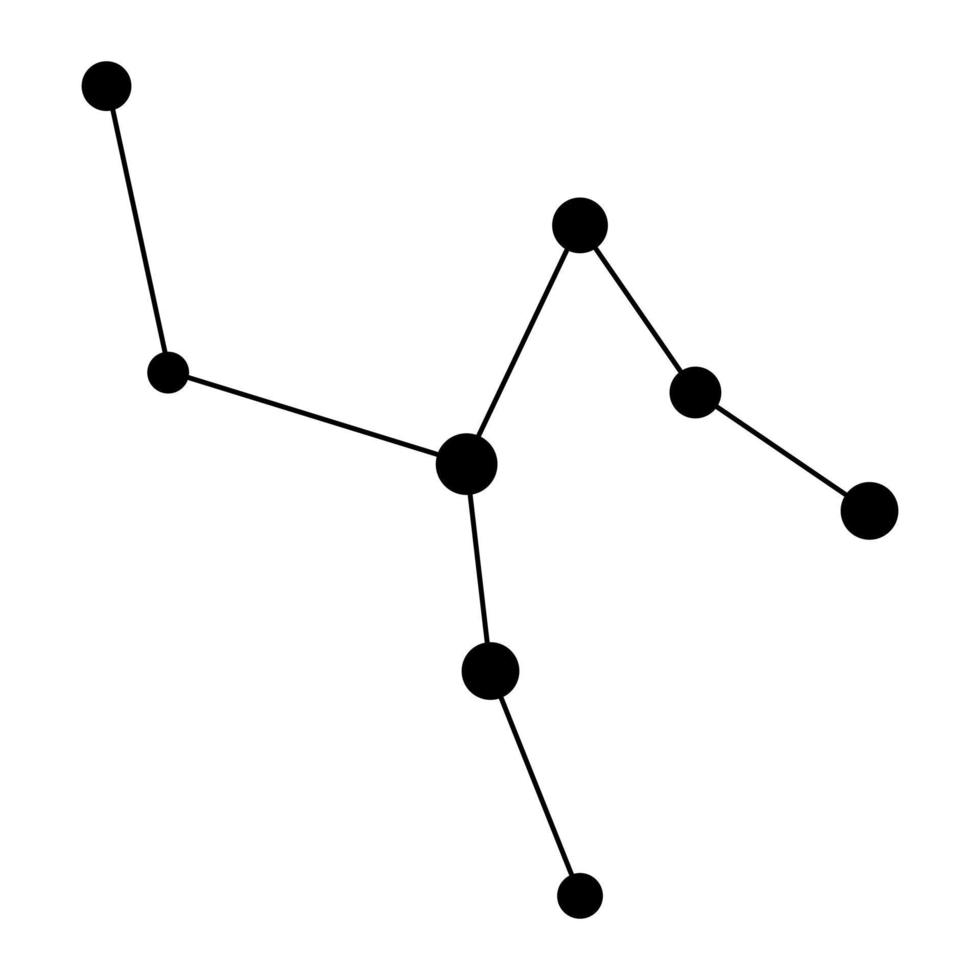
Camelopardalis is a large, sprawling northern constellation packed with faint stars. Formed in the 17th century to fill a gap in the night sky between Ursa Major and Cassiopeia, it never sets for observers across much of the northern hemisphere.
A luminous yellow-white supergiant star located roughly 990 light-years away.
Ranked as the 18th largest modern constellation by total sky coverage area.
Camelop Sync
Circumpolar Grid Mapping. Analyzing the sparse magnitude constant of the northern giraffe. New Horizons monitors the deep-sky voids to track this sprawling 17th-century vector.
- 🦒 Identity: The Giraffe (Camel Leopard).
- 🗺️ Origins: Petrus Plancius (1613).
- 🔭 Nature: 18th Largest yet faint Northern Vector.
Plancius Sync
Void-Filler Mapping. Analyzing the 1612 Plancius cartographic constant. New Horizons monitors the Ursa-Cassiopeia-Auriga gap to track this non-mythological northern vector.
- 📜 Origin: 1612 Petrus Plancius Celestial Globe.
- 📍 Buffer: Fills the void between Major Titans.
- 🦒 Mythology: Purely Descriptive Modern Construct.
Beacon Sync
High-Luminosity Node Mapping. Analyzing the Beta Camelopardalis supergiant constant. New Horizons monitors the Alpha blue-shift to track this 6,000 light-year northern vector.
- 🌟 Beta Cam: Primary Yellow Supergiant Node.
- 💠 Alpha Cam: Rare O-type Blue Supergiant.
- 🔭 Distance: Deep-Field Sync (6,000+ LY).
Cascade Sync
Deep-Sky Geometry Mapping. Analyzing the Kemble's Cascade linear constant. New Horizons monitors the NGC 2403 spiral rotation to track this 20-star binocular vector.
- 🌌 NGC 2403: H-II Rich Intermediate Spiral Node.
- 📉 Kemble's Cascade: 20-Star Linear Asterism.
- 🔭 Optics: High-Definition Binocular Sync.
Legacy of the Giraffe 📜
Sources
BETA CAMELOPARDALIS
The brightest star in this faint constellation is a yellow supergiant. It is roughly **870 light-years** away and is about 3,300 times more luminous than the Sun.
BETA DATANGC 2403
A magnificent intermediate spiral galaxy. It is an "outlying" member of the M81 group and was the first galaxy outside the Local Group to have a Cepheid variable discovered.
DEEP SKYKEMBLE'S CASCADE
A famous asterism consisting of a straight line of about 20 colorful stars ending near the open cluster NGC 1502. It looks like a waterfall through binoculars.
ASTERISM INFOAnnotated Chart

Visualization identifying Kemble's Cascade and the location of NGC 2403.
Primary Stars
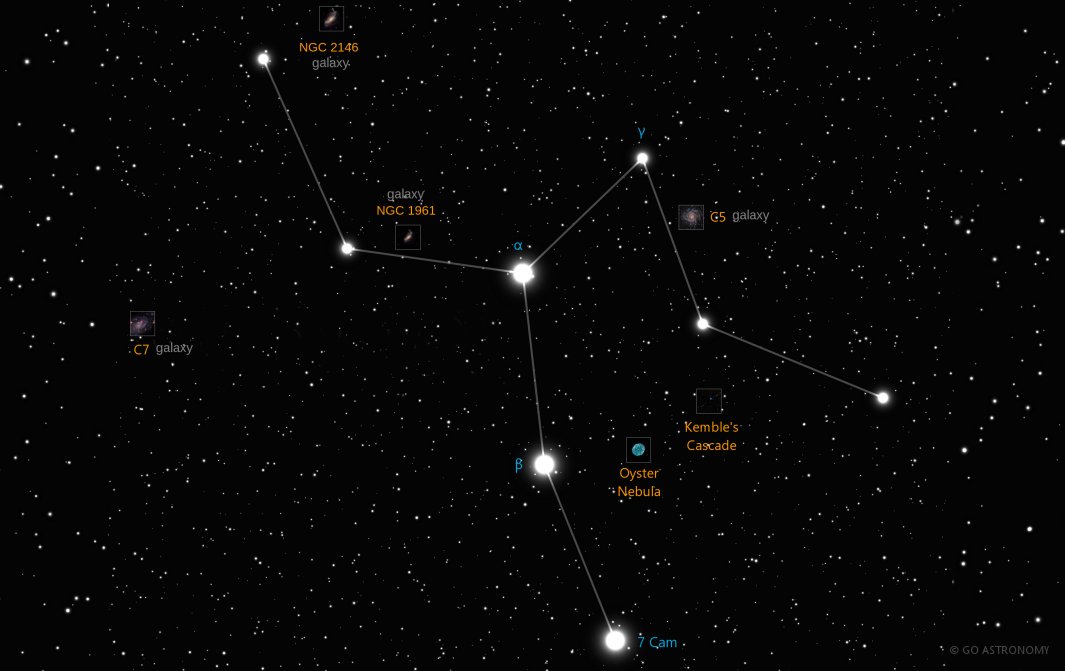
Highlighting Beta Camelopardalis, the brightest star in this sprawling constellation.
Celestial Position
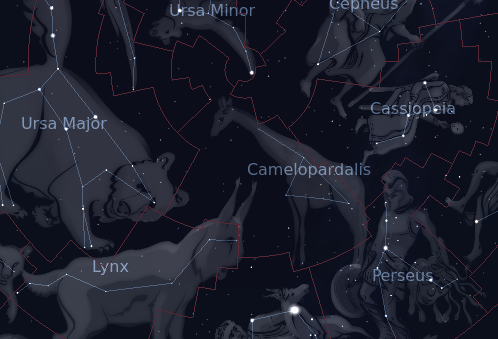
A wide-field map showing its proximity to the North Celestial Pole.
Camelopardalis Constellation • Bright Stars
The Giraffe • Main Stars Ranked by Apparent MagnitudeCamelopardalis is a large, faint northern circumpolar constellation. It has no stars brighter than magnitude 4.0 and is best observed year-round from mid-northern latitudes.
| Star | Magnitude | Distance |
|---|---|---|
|
Beta Camelopardalis β Cam
Brightest star in Camelopardalis
|
0 | 0 ly |
|
CS Camelopardalis
Second brightest
|
0 | 0 ly |
|
Alpha Camelopardalis α Cam
Distant blue supergiant
|
0 | 0 ly |
|
BE Camelopardalis
Red bright giant
|
0 | 0 ly |
|
7 Camelopardalis
White main-sequence
|
0 | 0 ly |
|
CE Camelopardalis
White supergiant
|
0 | 0 ly |
|
Gamma Camelopardalis γ Cam
White subgiant
|
0 | 0 ly |
|
BK Camelopardalis
Be star
|
0 | 0 ly |
|
3 Camelopardalis
Orange giant
|
0 | 0 ly |
|
11 Camelopardalis
Hot star
|
0 | 0 ly |
Recommended Tools
View AllLoading recommended tools...
Explore More!
Andromeda

Antlia

Apus

Aquarius

Aquila

Ara

Aries

Auriga

Bootes

Caelum
Camelopardalis

Cancer

Canes Venatici

Canis Major

Canis Minor

Ursa Major (The Big Bear)

Cassiopeia

Centaurus

Cepheus

Cetus (The Whale)

Chamaeleon

Circinus

Columba

Coma Berenices

Corona Australis

Corona Borealis

Corvus

Crater

Crux

Cygnus

Delphinus
Dorado
Draco

Equuleus

Eridanus

Fornax

Gemini

Grus (The Crane)

Hercules

Horologium (The Clock)

Hydra

Hydrus

Indus
Lacerta

Leo

Leo Minor

Lepus (The Hare)

Libra

Lupus (The Wolf)

Lynx

Lyra

Mensa

Microscopium

Monoceros (The Unicorn)

Musca (The Fly)

Norma
Octans

Ophiuchus
Orion (The Hunter)

Pavo (The Peacock)

Pegasus

Perseus

Phoenix
Pictor
Pisces

Piscis Austrinus

Puppis

Pyxis

Reticulum

Sagitta

Sagittarius

Scorpius

Sculptor

Scutum

Serpens

Sextans

Taurus

Telescopium

Triangulum

Triangulum Australe
Tucana

Ursa Minor

Vela (The Sails)

Virgo
Volans (Flying Fish)

Vulpecula (The Fox)
