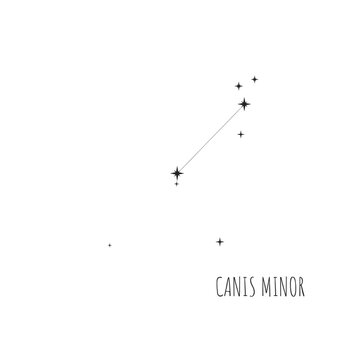
Constellation Canis Minor
CONSTELLATION CANIS MINOR
THE LESSER DOG & HOME OF PROCYON
The Lesser Hunting Dog
Canis Minor is a small northern winter constellation representing the smaller dog following Orion. Despite consisting of only two main stars, it anchors one of the most famous navigational asterisms in the sky alongside Sirius and Betelgeuse.
A luminous white-yellow subgiant star located roughly 11.46 light-years away.
Ranked as the 71st largest modern constellation by total sky coverage area.
The Lesser Dog
Celestial Canine. Canis Minor is a small constellation in the northern celestial hemisphere, historically depicted in star atlases as following the heels of Orion the hunter.
Compact Starlight: Despite spanning a relatively small area of the night sky, it contains some of the brightest and most studied stellar neighbors in our solar vicinity.
- 🐕 Historically linked to Orion's hunting dogs.
- ✨ Compact area with prominent stellar landmarks.
Procyon's Glow
Alpha Canis Minoris. Procyon is the eighth-brightest star in the entire night sky, shining with a distinct yellowish-white hue due to its F-type main-sequence classification.
Stellar Proximity: Located just 11.46 light-years away from Earth, it stands as one of our closest stellar neighbors in the solar neighborhood.
- ⭐ 8th brightest star in the night sky.
- 📍 Only 11.46 light-years from Earth.
Winter Triangle Asterism
A Cosmic Geometry. Procyon forms one of the three vertex points of the prominent Winter Triangle asterism, alongside Sirius in Canis Major and Betelgeuse in Orion.
Night Sky Navigation: Stargazers easily use this giant geometric pattern across the winter sky to locate major stellar coordinates and navigate constellations.
- 🔺 Vertex connecting Procyon, Sirius, and Betelgeuse.
- 🧭 Prominent winter navigation landmark.
Gomeisa's Light
Beta Canis Minoris. Gomeisa is a hot blue-white main-sequence star that acts as the second brightest luminary within the constellation boundaries.
Rapid Rotation: Like many fast-spinning B-type stars, Gomeisa features an equatorial bulge and surrounds itself with a circumstellar disk of ejected matter.
- 💫 Hot blue-white spectral class.
- 🌀 High rotational velocity profile.
Binary Companion
Procyon B. Orbiting the bright primary star is Procyon B, a dim, faint white dwarf star hidden in a tight gravitational binary dance.
Stellar Evolution: Once a massive, short-lived star, it exhausted its core nuclear fuel and collapsed into an ultra-dense stellar remnant.
- ⚪ Faint white dwarf stellar remnant.
- 🔄 Complex orbital binary dynamics.
Ancient Mythology
The Preceding Dog. In Greek mythology, Canis Minor represents one of the hunting dogs following Orion across the sky or chasing the hare (Lepus).
Etymology: The name Procyon itself derives from the ancient Greek meaning "before the dog," because it rises just before Sirius (the Dog Star) in the autumn sky.
- 📜 Classical Greco-Roman lore.
- 🐕 Pre-dog rising astronomical marker.
Stargazing Guide
Winter Skies. Canis Minor is best observed during winter evenings in the Northern Hemisphere, riding high in the southern sky during January and February.
Global Visibility: Because of its favorable celestial coordinates near the celestial equator, it is visible from almost all inhabited regions across both the northern and southern hemispheres.
- 🔭 Best viewed during winter months.
- 🌍 Visible across nearly worldwide latitudes.
Faint Deep-Sky Wonders
Sparse Neighborhood. Canis Minor sits away from the dense star clouds of the Milky Way plane, resulting in fewer bright nebulae or star clusters within its borders.
Faint Galaxies: Amateur astronomers using medium-to-large telescopes can hunt down faint, distant background spiral galaxies like NGC 2485 tucked away in deep space.
- 🌌 Sparse Milky Way stellar clutter.
- 🔭 Challenging faint background galaxies.
Modern Astrophysics
Stellar Research. Because Procyon is close and bright, astrophysicists use asteroseismology—studying starquakes on its surface—to probe the deep internal structure of sun-like stars.
Enduring Legacy: From ancient mythological tracking to cutting-edge stellar physics, Canis Minor remains an essential cornerstone of our mapping of the universe.
- 🔬 Asteroseismology and surface starquakes.
- ✨ Key benchmark for solar evolution models.
Legacy of the Lesser Dog 📜
Sources
PROCYON
The brightest star in Canis Minor and the 8th brightest in the night sky. A yellow-white binary system located only **11.46 light-years** away.
PROCYON DATAGOMEISA
Beta Canis Minoris is a hot blue-white main-sequence star about 162 light-years distant. Its name means “the bleary-eyed one” in Arabic.
GOMEISA DATANGC 2485
The brightest deep-sky object in Canis Minor—a spiral galaxy of magnitude 12.4 located about 3.5 degrees northeast of Procyon.
DEEP SKYWinter Sky View
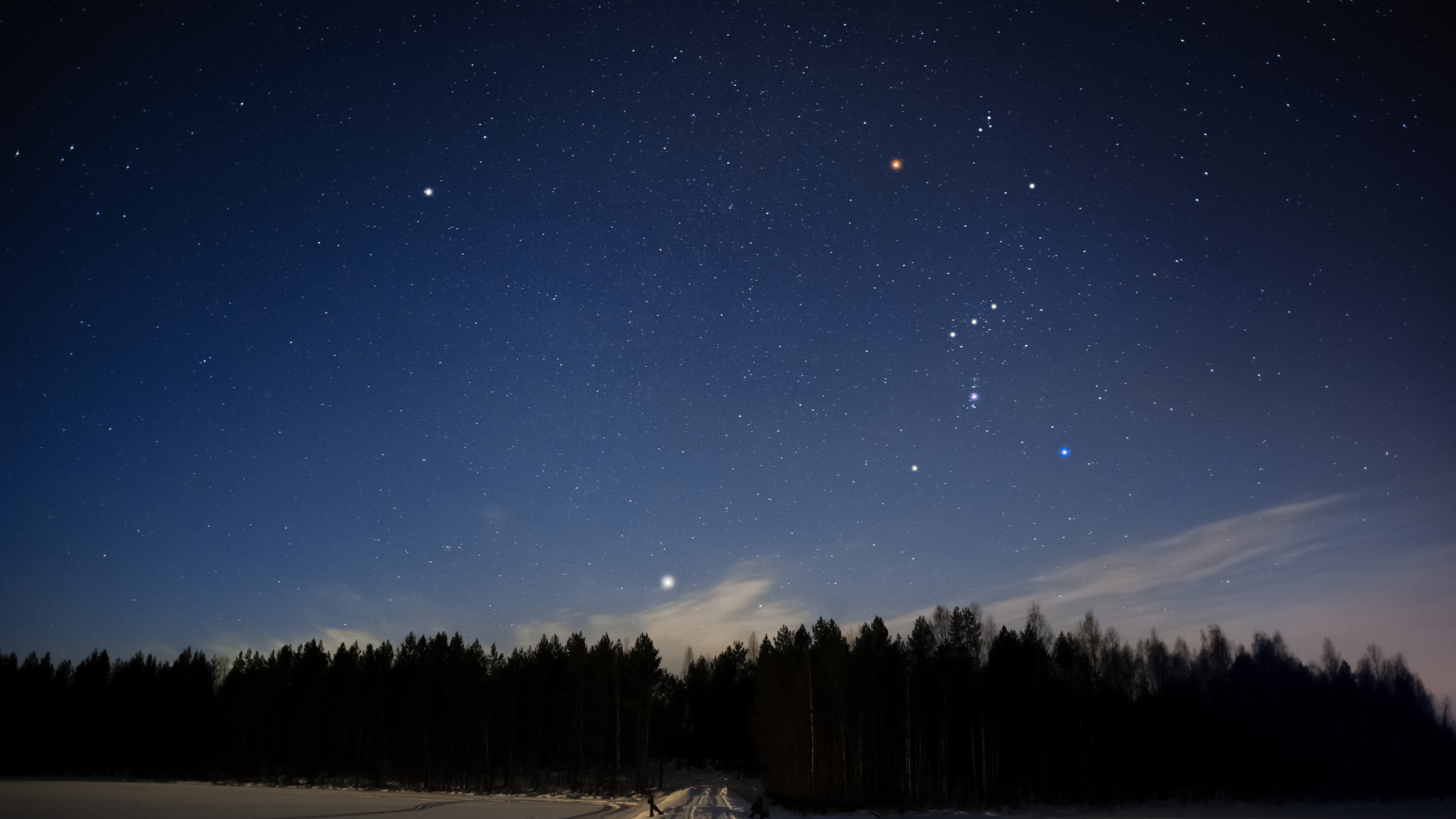
Locating Canis Minor near Gemini and Monoceros, with Procyon as its brilliant guide star.
Official Boundaries

Official IAU chart showing the constellation’s boundaries among Gemini, Cancer, Hydra and Monoceros.
Annotated Chart

Mapping of Procyon, Gomeisa and the surrounding field with constellation lines and labels.
Canis Minor Constellation • Bright Stars
The Lesser Dog • Main Stars Ranked by Apparent MagnitudeCanis Minor is a small constellation best known for Procyon, the eighth-brightest star in the night sky and one of the closest bright stars to Earth. It forms part of the Winter Triangle with Sirius and Betelgeuse.
| Star | Magnitude | Distance |
|---|---|---|
|
Procyon α CMi
Alpha Canis Minoris • 8th brightest star
|
0 | 0 ly |
|
Gomeisa β CMi
Beta Canis Minoris
|
0 | 0 ly |
|
Gamma Canis Minoris γ CMi
Orange giant
|
0 | 0 ly |
|
HD 66141
Double star
|
0 | 0 ly |
|
6 Canis Minoris
Variable star
|
0 | 0 ly |
|
Epsilon Canis Minoris ε CMi
Orange giant
|
0 | 0 ly |
|
Zeta Canis Minoris ζ CMi
White star
|
0 | 0 ly |
|
Delta¹ Canis Minoris δ¹ CMi
White star
|
0 | 0 ly |
|
Eta Canis Minoris η CMi
Double star
|
0 | 0 ly |
|
14 Canis Minoris
Multiple system
|
0 | 0 ly |
Recommended Tools
View AllLoading recommended tools...
Explore More!
Andromeda

Antlia

Apus

Aquarius

Aquila

Ara

Aries

Auriga

Bootes

Caelum
Camelopardalis

Cancer

Canes Venatici

Canis Major

Canis Minor

Ursa Major (The Big Bear)

Cassiopeia

Centaurus

Cepheus

Cetus (The Whale)

Chamaeleon

Circinus

Columba

Coma Berenices

Corona Australis

Corona Borealis

Corvus

Crater

Crux

Cygnus

Delphinus
Dorado

Draco

Equuleus

Eridanus

Fornax

Gemini

Grus (The Crane)

Hercules

Horologium (The Clock)

Hydra

Hydrus

Indus
Lacerta

Leo

Leo Minor

Lepus (The Hare)

Libra

Lupus (The Wolf)

Lynx

Lyra

Mensa

Microscopium

Monoceros (The Unicorn)

Musca (The Fly)

Norma
Octans

Ophiuchus
Orion (The Hunter)

Pavo (The Peacock)

Pegasus

Perseus

Phoenix

Pictor

Pisces

Piscis Austrinus

Puppis

Pyxis

Reticulum

Sagitta

Sagittarius

Scorpius

Sculptor

Scutum

Serpens

Sextans

Taurus

Telescopium

Triangulum

Triangulum Australe

Tucana

Ursa Minor

Vela (The Sails)

Virgo

Volans (Flying Fish)

Vulpecula (The Fox)
