
Constellation Columba
CONSTELLATION COLUMBA
THE CELESTIAL DOVE & STELLAR NAVIGATION
The Heavenly Dove
Columba is a small constellation located just south of Canis Major and Lepus. Formed in the late 16th century by Petrus Plancius, it represents the dove that returned to Noah with an olive branch.
A luminous blue-white subgiant star located roughly 268 light-years away.
Ranked as the 54th largest modern constellation by total sky coverage area.
Dove Sync
Avian Trajectory Mapping. Analyzing the Plancius 1592 magnitude constant. New Horizons monitors the southern horizon nodes to track this peaceful celestial vector.
- 🕊️ Identity: The Dove (Symbol of Peace).
- ⭐ Alpha Columbae: The Phact Magnitude Anchor.
- 🌌 Nature: Southern Sky Navigational Grid Node.
Phact Sync
Spectral Disk Mapping. Analyzing the Alpha Columbae magnitude constant. New Horizons monitors the Be-type gaseous vector to track this southern subgiant node.
- 🕊️ Al-Fakhita: The "Dove" Etymology Node.
- 🌀 Be-Type: Rapidly Rotating Star with a Gaseous Disk.
- 🛰️ Range: Subgiant Node at ~261 Light-Years.
Runaway Sync
Kinetic Trajectory Mapping. Analyzing the Mu Columbae velocity constant. New Horizons monitors the 117 km/s displacement vector to track this ejected southern node.
- 🚀 Velocity: High-Proper Motion Vector (~117 km/s).
- 🌌 Origin: Orion Nebula (M42) Birth-Node Ejection.
- 🛰️ Nature: O-type Blue Main-Sequence Traveler.
Cluster Sync
Gravitational Core Mapping. Analyzing the NGC 1851 density constant. New Horizons monitors the metal-poor stellar nodes to track this ancient spherical vector.
- 🌕 Class II: High-Concentration Spherical Star Array.
- ⏳ Age: Ancient Population (~9.2 Billion Years).
- 🔭 Visibility: Visible Node in Small Optical Vectors.
Legacy of the Dove 📜
Sources
PHACT (ALPHA)
A Be-type star located **261 light-years** away. It is a rapid rotator and is surrounded by a disk of expelled gas, making it slightly variable in brightness.
ALPHA DATARUNAWAY STAR
**Mu Columbae** is a "runaway" star, moving at over **100 km/s**. It likely originated in the Orion Nebula and was ejected by a supernova or binary interaction.
KINEMATICSNGC 1851
A compact globular cluster located in the southern part of the constellation. It is known for its high central density and contains many "blue straggler" stars.
DEEP SKYSymbolic Flight

Artistic depiction of the dove carrying an olive branch, situated south of Canis Major.
Deep Sky Chart
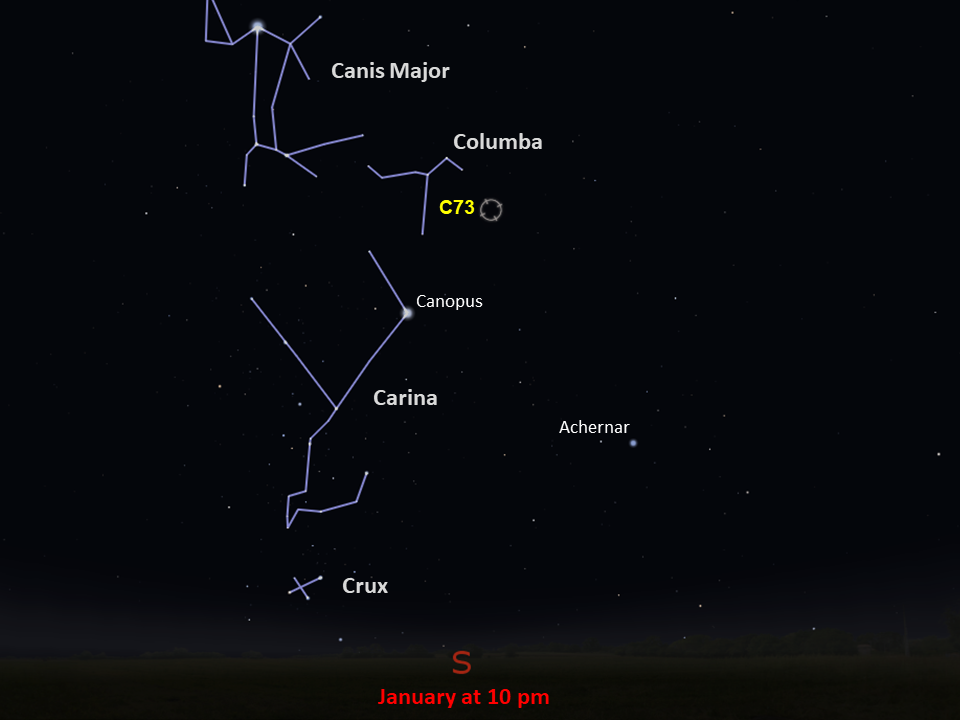
NASA survey identifying the globular cluster NGC 1851 and neighboring constellations.
Official Boundaries

Technical survey map showing its borders with Lepus, Caelum, and Puppis.
Columba Constellation • Bright Stars
The Dove • Main Stars Ranked by Apparent MagnitudeColumba is a small southern constellation introduced by Petrus Plancius. Its brightest star is Phact. It lies south of Canis Major and Lepus and is best observed from the Southern Hemisphere.
| Star | Magnitude | Distance |
|---|---|---|
|
Phact α Col
Alpha Columbae • Brightest in Columba
|
0 | 0 ly |
|
Wazn β Col
Beta Columbae
|
0 | 0 ly |
|
Delta Columbae δ Col
Yellow bright giant
|
0 | 0 ly |
|
Epsilon Columbae ε Col
Orange giant
|
0 | 0 ly |
|
Eta Columbae η Col
Orange giant
|
0 | 0 ly |
|
Gamma Columbae γ Col
Blue subgiant
|
0 | 0 ly |
|
Kappa Columbae κ Col
Yellow giant
|
0 | 0 ly |
|
Omicron Columbae ο Col
Orange star
|
0 | 0 ly |
|
Lambda Columbae λ Col
Blue star
|
0 | 0 ly |
|
Xi Columbae ξ Col
Orange giant
|
0 | 0 ly |
Recommended Tools
View AllLoading recommended tools...
Explore More!
Andromeda

Antlia

Apus

Aquarius

Aquila

Ara

Aries

Auriga

Bootes

Caelum
Camelopardalis

Cancer

Canes Venatici

Canis Major

Canis Minor

Ursa Major (The Big Bear)

Cassiopeia

Centaurus

Cepheus

Cetus (The Whale)

Chamaeleon

Circinus

Columba

Coma Berenices

Corona Australis

Corona Borealis

Corvus

Crater

Crux

Cygnus

Delphinus
Dorado
Draco

Equuleus

Eridanus

Fornax

Gemini

Grus (The Crane)

Hercules

Horologium (The Clock)

Hydra

Hydrus

Indus
Lacerta

Leo

Leo Minor

Lepus (The Hare)

Libra

Lupus (The Wolf)

Lynx

Lyra

Mensa

Microscopium

Monoceros (The Unicorn)

Musca (The Fly)

Norma
Octans

Ophiuchus
Orion (The Hunter)

Pavo (The Peacock)

Pegasus

Perseus

Phoenix

Pictor
Pisces

Piscis Austrinus

Puppis

Pyxis

Reticulum

Sagitta

Sagittarius

Scorpius

Sculptor

Scutum

Serpens

Sextans

Taurus

Telescopium

Triangulum

Triangulum Australe
Tucana

Ursa Minor

Vela (The Sails)

Virgo

Volans (Flying Fish)

Vulpecula (The Fox)
