
Venus Transit
VENUS TRANSIT
SOLAR SILHOUETTE ALIGNMENT
Resonant Cycles
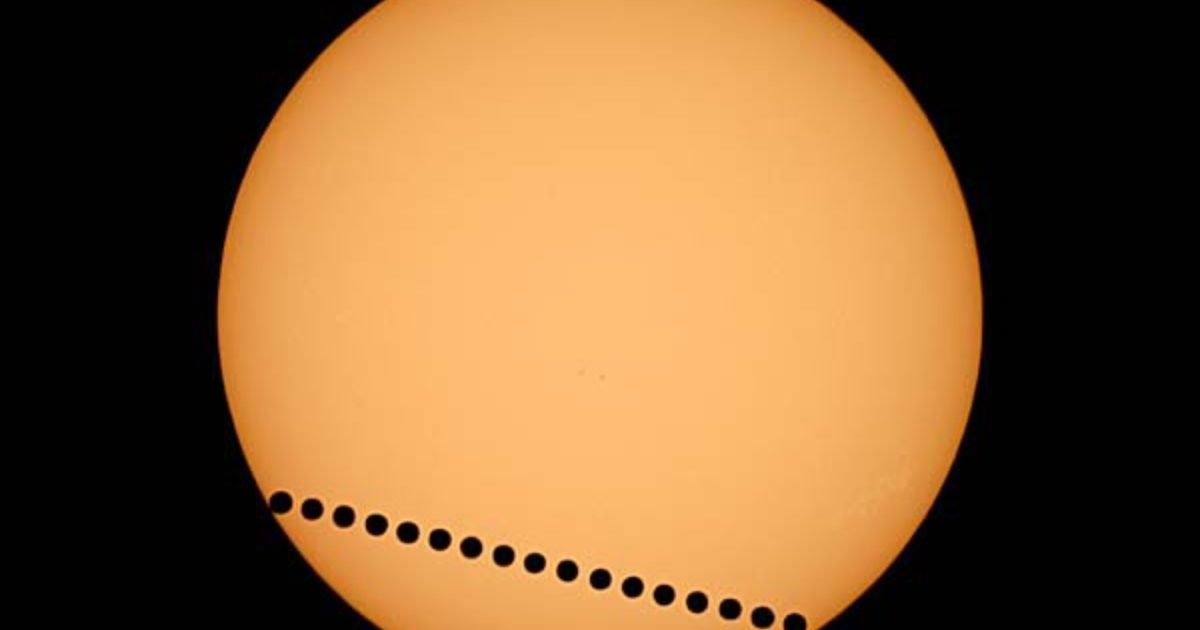
Venus transits are among the rarest predictable astronomical phenomena. They occur in a repeating 243-year pattern, arriving in pairs separated by exactly eight years, followed by vast gaps of over a century.
The next time the inner planetary shadow intersects the sun.
Used in 1761/1769 to map the scale of our solar system.
The Transit
A Rare Alignment. When Venus crosses the solar disk, it provides a unique window into orbital mechanics and planetary scale.
- ⏳ Cycle: 243-year recurrence pattern.
- 📏 Impact: Historically used to measure the AU.
- 📅 Next: December 11, 2117.
The 243 Cycle
Geometric Precision. Transits occur in a rhythmic 121.5 - 8 - 105.5 - 8 year sequence, governed by the 8:13 orbital resonance.
- 👯♂️ Pairing: Most transits occur in 8-year couples.
- ⏳ Century Gaps: Gaps exceed 100 years between pairs.
- 📐 Inclination: 3.4° orbital tilt creates the "miss" window.
Last Transit
June 2012. The final time in our century that the inner planet silhouetted against the Sun. A moment of cosmic precision.
- 🗓️ Last Seen: June 5–6, 2012.
- 🛰️ Legacy: Used to refine exoplanet detection.
- ⏳ Gap: No further transits until Dec 2117.
Parallax Shift
The Universal Yardstick. By measuring the tiny shift in Venus's path from different parts of Earth, we unlocked the true scale of the solar system.
- 📐 Triangulation: Using 18th-century math to measure 150M km.
- 🌌 Scale: Established the 'Astronomical Unit' as a standard.
- 🛰️ Exoplanets: Provides the 'gold standard' for transit light-curves.
MISSION: VENUS / CELESTIAL MECHANICS
THE RARE ALIGNMENT
A transit of Venus occurs only when the planet reaches its inferior conjunction at the exact moment it crosses the ecliptic plane—the path of the Sun. Because Venus's orbital plane is tilted relative to Earth's, this alignment is incredibly rare. Transits occur in a distinct pattern: two transits separated by eight years, followed by a gap of over a century. Historically, this event was the "holy grail" of astronomy; by measuring the parallax of Venus from different locations on Earth during a transit, 18th-century scientists were able to calculate the distance from the Earth to the Sun, effectively revealing the scale of our solar system.

MISSION: VENUS / CELESTIAL CALCULATIONS
THE PARALLAX METHOD
The Parallax Method relies on the fact that Venus appears to traverse the Sun at slightly different positions depending on the observer's location on Earth. By timing the transit duration from two widely separated points on the globe, astronomers could observe a shift in the path Venus took across the Sun's disk. This shift is the parallax. Because the distance between the two observation points (our baseline) was known, and the angular shift could be calculated via the timing difference, scientists used trigonometry to solve the triangle and determine the absolute distance from the Earth to the Sun, known as the Astronomical Unit.
Dive Deep Venus
Venus

Venus Pressure Depth

Structural Crush Depth
Atmospheric Density

Greenhouse Heating

Cooling Energy

Buoyancy Lift

Altitudinal Habitability

Floating Base Stability

Venus Day vs Year
Venus Transit

Sulfuric Acid Corrosion

CO2 to O2 Conversion

Lightning Frequency

Windturbine Power

Comms Through Clouds

Landed Probe Lifespan

Venus Gravity Assist
Titanium vs Steel

Sonic Velocity on Venus

Acid Rain

Cloud Cities

Venus Mysteries
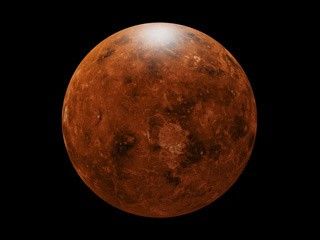
View 3D Model
Sources
HISTORICAL PAIRS
Transits occur in pairs 8 years apart, with over a century between the sets (e.g., 2004 and 2012).
NASA ARCHIVEBLACK DROP EFFECT
The optical phenomenon where a small "neck" appears to connect the planet to the Sun's edge.
OPTICAL PHYSICSMEASURING THE AU
How 18th-century astronomers used the transit and parallax to calculate the distance to the Sun.
HISTORICAL MATHSolar Transit

Venus appearing as a small black dot crossing the solar disk.
2004 vs 2012
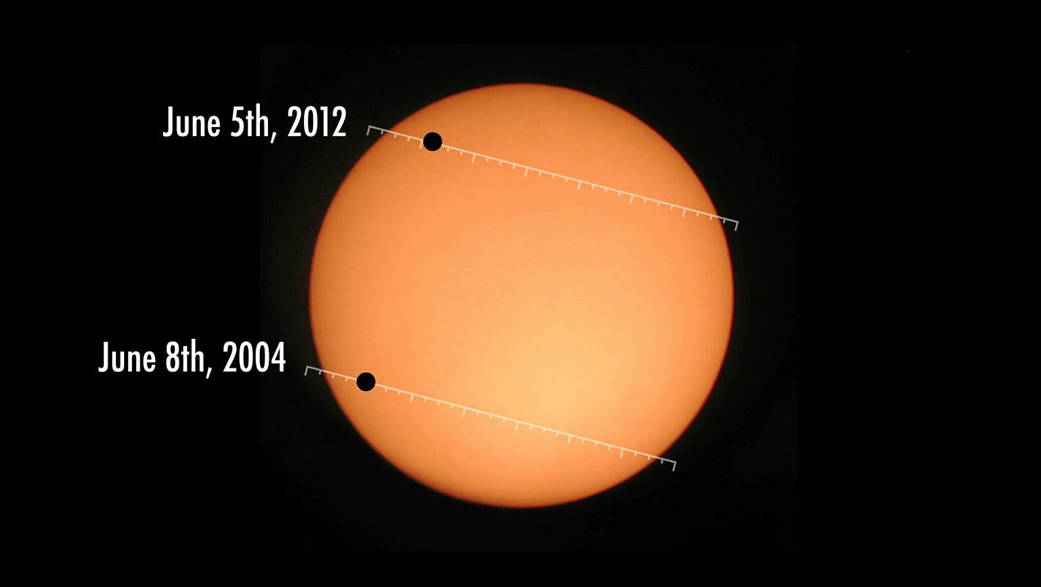
NASA composite showing the different paths taken during the 8-year interval.
Global View

Mapping the areas on Earth where the transit was fully visible.
Contact Phases
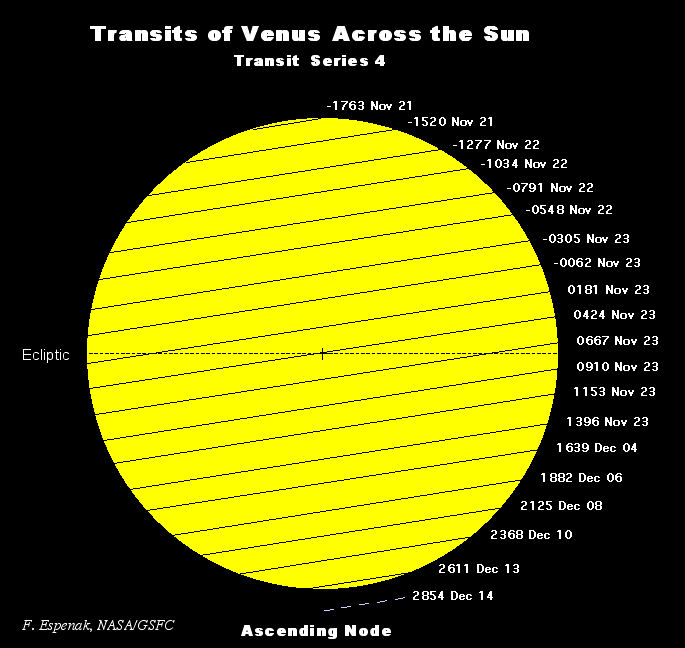
Pattern: 105.5, 8, 121.5, 8 years
Next Event: Dec 10, 2117
Utility: Measuring the AU (Distance to Sun)