
Floating Base Stability
AERO STABILITY
FLOATING BASE EQUILIBRIUM DYNAMICS
Keel Counter-Weights
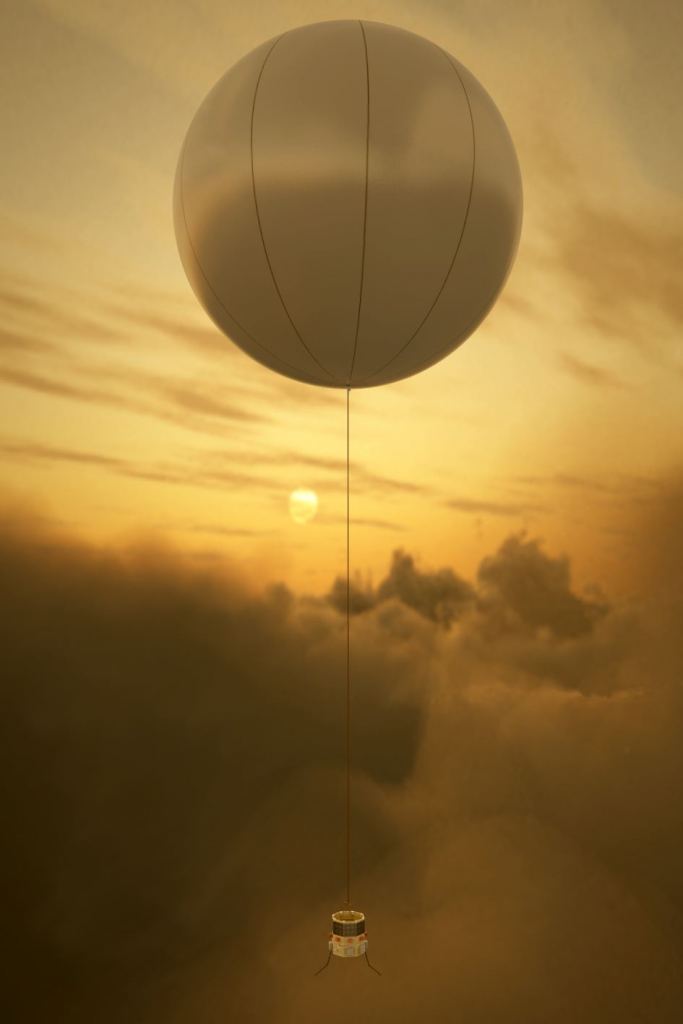
By suspending ultra-heavy processing units, machinery, and carbon collection arrays kilometers beneath the light lifting envelopes via high-tensile tethers, the base establishes a low center of gravity. This creates an un-flippable, self-righting pendulum structure.
Passive physics prevention against catastrophic cloud capsizing.
Structural tolerance during intense regional atmospheric shearing.
Base Stability
Atmospheric Surfing. Stability at 50km is maintained by balancing internal air pressure against the 360km/h super-rotating winds.
- 🎈 Passive Lift: Breathable air provides 100% of required buoyancy.
- 🌪️ Wind Load: Aerodynamic "fins" stabilize the habitat during super-rotation.
- 🛡️ Corrosion: PFA coatings protect against sulfuric acid clouds.
Super-Sync
Velocity Lock. At 50km, the base enters the 'Super-Rotation' stream, moving 60x faster than the surface below to maintain thermal equilibrium.
- 🔄 Rotation: Full planetary circuit every 100 hours.
- 📐 Alignment: Vertical trimming used to stay in 'Laminar Flow' layers.
- 🔋 Solar Gain: High-speed drift ensures 24/7 sunlight access.
Active Ballast
Precision Buoyancy. By compressing and shifting CO2 ballast, the base maintains a 'hover-lock' at 50km, neutralizing vertical wind shear and thermal lift.
- 💧 Liquid Shift: Rapid deck-leveling via fluid transfer.
- 🌪️ Altitude Trim: Gas compression for 100-meter vertical precision.
- ⚙️ Response: Sub-second latency in ballast-valve actuation.
Gyro-Sync
Instantaneous Leveling. Control Moment Gyros provide the millisecond-response needed to neutralize atmospheric shear before it affects habitat comfort.
- ⚙️ Rotor Speed: 15,000+ RPM for high-inertia torque.
- 📐 Precision: Holds level within 0.05° of the local horizon.
- ⚡ Active Response: Zero-propellant, electrically driven stability.
MISSION: VENUS / STATION-KEEPING
STABILITY IN SUPER-ROTATION
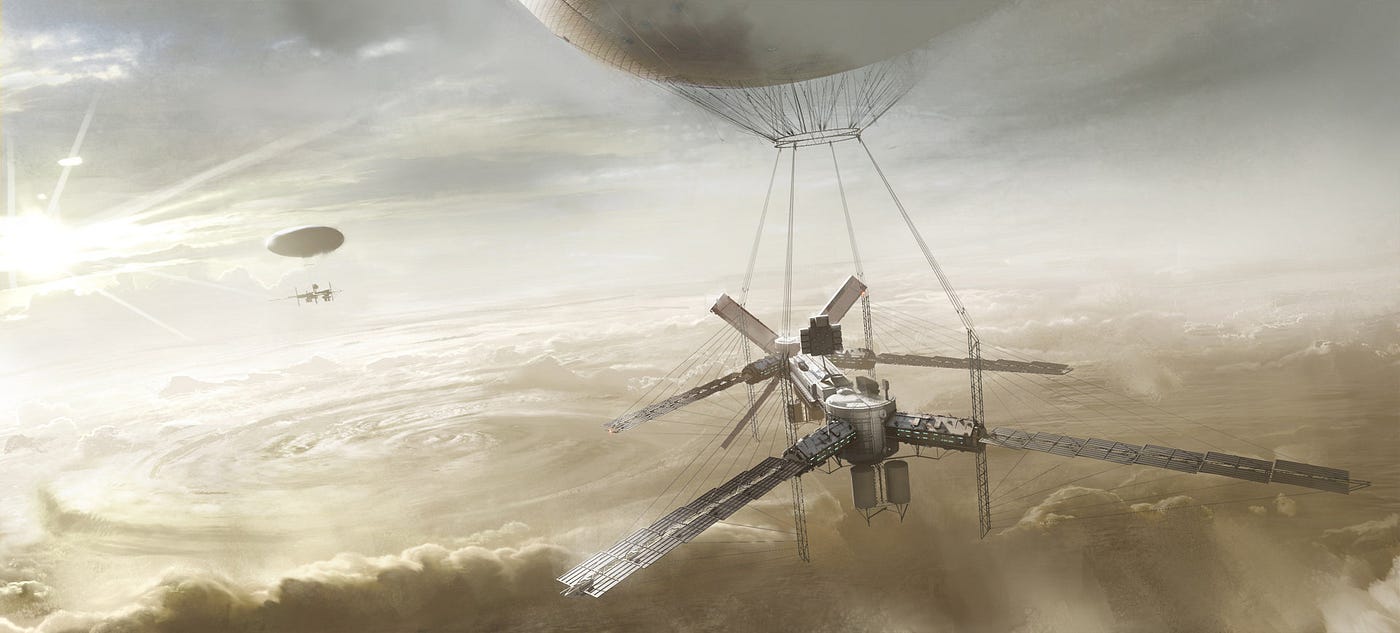
Venus is defined by a phenomenon called super-rotation. While the planet takes 243 Earth days to rotate once, its upper atmosphere circles the planet in just 4 days. For a floating base at 50 kilometers, this creates a massive challenge for stability. Any craft suspended in this layer will be swept along by winds exceeding 300 kilometers per hour. To maintain a stationary position over a specific site, a base cannot simply float; it requires active station-keeping, potentially utilizing variable-altitude buoyancy control to navigate into slower wind currents or anchoring to the surface via high-tensile cables—a feat requiring materials beyond our current reach.
MISSION: VENUS / VERTICAL NAVIGATION
VERTICAL MOBILITY: TACKING THE WINDS
Since fighting 300 km/h winds is impossible for a long-term station, we utilize the "tacking" method through vertical mobility. By adjusting internal buoyancy—either by heating the lifting gas or compressing it—a craft can rise or descend between different altitude layers. Because wind speeds vary significantly with altitude, changing height allows the base to find "shear zones" where wind velocity is lower or directed differently. This creates a highly efficient, low-energy navigation system that lets the platform drift, adjust, and re-position itself without relying on fuel-intensive thrusters.

Dive Deep Venus
Venus

Venus Pressure Depth

Structural Crush Depth
Atmospheric Density

Greenhouse Heating

Cooling Energy

Buoyancy Lift

Altitudinal Habitability

Floating Base Stability

Venus Day vs Year
Venus Transit

Sulfuric Acid Corrosion

CO2 to O2 Conversion

Lightning Frequency

Windturbine Power

Comms Through Clouds

Landed Probe Lifespan

Venus Gravity Assist
Titanium vs Steel

Sonic Velocity on Venus

Acid Rain

Cloud Cities

Venus Mysteries
View 3D Model
Sources
AERODYNAMIC LOADS
NASA technical papers on managing high wind speeds and super-rotation for stable flight.
WIND ANALYSISBUOYANCY CONTROL
Methods for variable altitude adjustment to find the most stable pressure layers.
ALTITUDE SYSTEMSSTATION-KEEPING
Research on solar-powered propulsion for keeping floating bases in a fixed geographic position.
PROPULSION DATACloud Habitat
Multi-tier floating colonies anchored in the upper atmosphere.
Base Dynamics

Structural cross-sections of the pressure vessels and lift bags.
V.I.S.R.U.
Lift Gas: Breathable Air (N₂/O₂)
Protection: Acid-Resistant Polymers
Atmosphere: 96% CO₂ (Resource rich)
Source: Venus Exploration Project