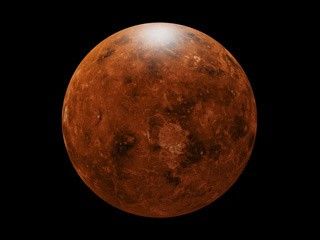
Venus Pressure Depth
PRESSURE DEPTH
CRUSHING BAROMETRIC PROFILE
92 Bar Surface Baseline
Standing on the surface of Venus is structurally identical to diving nearly 1 kilometer deep into Earth's oceans. The sheer structural weight of the massive air column would immediately crush an unprotected explorer.
Structural mechanical force exerted continuously on every square inch.
Atmospheric gas compressed so intensely it moves with heavy liquid properties.
Surface Survival
Extreme Engineering. Designing for 9.3 MPa loads and 737 K environments using phase-change cooling.
- 🛡️ Spherical Hull: Titanium-reinforced pressure vessel.
- ❄️ PCM Cooling: Absorbing 465°C heat via latent melting.
- 💎 Sapphire Optics: High-pressure visual ports for surface imaging.
Crush Tester
Structural Validation. Simulating 9.3 MPa loads and 737 K thermal stress to prevent hull implosion.
- 🛡️ Stress Analysis: Calculating Hoop and Longitudinal deformation.
- 🧪 Thermal Softening: Testing material yield at extreme heat.
- 🚢 Hydrostatic: Submersion testing in high-pressure oil baths.
Bathyscaphe Unit
Subsurface Aero-Vessel. Utilizing Titanium-Spheres and Phase-Change Cooling for surface-level reconnaissance.
- 🛡️ Hull Integrity: Rated for 150% Venusian surface pressure.
- ❄️ Thermal Sinks: Lithium Nitrate core for 4-hour survival.
- 🎈 Neutral Buoyancy: 1-Bar air supply acts as a lifting gas.
Depth Unit X-1
Steel-Titanium Matrix. Advanced MMC Architecture designed to survive the supercritical depths of the Venusian abyss.
- 🛡️ Matrix-Grade: High-tensile steel fibers in a Ti-6Al-4V base.
- 📉 Depth Rating: Certified for 92.4 Bar atmospheric submersion.
- 🌡️ Creep Resistance: Maintaining structural geometry at 737 K.
Why Depth?
Critical Analytics. Understanding the Pressure-Density curve is the only way to prevent structural implosion and motor failure.
- 🛡️ Hull Integrity: Determining the "Implosion Point" of the craft.
- ⚙️ Fluid Resistance: Calculating motor torque in supercritical air.
- 🌡️ Thermal Soak: Predicting how fast heat penetrates the hull.
Extreme Atmosphere
Crushing Barometric Load. The surface pressure on Venus reaches an astonishing 92 bars (about 92 times Earth's atmospheric pressure at sea level).
Atmospheric Composition: Driven by a dense carbon dioxide blanket, this crushing environment acts more like a supercritical fluid than a traditional gas layer.
- 🌡️ 92 Earth atmospheres of pressure.
- 🌋 Supercritical carbon dioxide environment.
Submerged Equivalent
Hydrostatic Comparison. To experience the exact same pressure experienced on the surface of Venus, a diver or submarine would need to descend approximately 900 meters (about 3,000 feet) underwater.
Fluid Pressure: Because water is much denser than air, it only takes nearly a kilometer of ocean depth to match the entire weight of Venus's thick atmosphere.
- 🌊 ~900 meters depth underwater.
- ⚓ Hydrostatic pressure equivalence.
Lander Survival
Titanium Hulls. Probes like the Soviet Venera landers required heavy, spherical pressure vessels built from specialized titanium alloys to withstand both the crushing pressure and 465°C heat.
Mission Lifespan: Even with extreme reinforcement, surface conditions reduce operational lifespans to mere hours before electronics succumb to the harsh environment.
- 🛡️ Specialized titanium pressure hulls.
- ⏱️ Short operational lander windows.

Venus Exploration FAQs
Long-tail questions about Venusian missions and atmospheric properties
Due to the extreme surface temperature of around 465°C and crushing atmospheric pressure, the Soviet Venera landers survived for a very short duration, ranging from 23 minutes up to a maximum of about 127 minutes before failing.
At the surface of Venus, the atmospheric density is about 65 kg per cubic meter, which is roughly 6.5% the density of liquid water on Earth.
Venus has a runaway greenhouse effect caused by a thick carbon dioxide atmosphere wrapped in dense clouds of sulfuric acid, which traps heat intensely.
A single rotation (solar day) on Venus takes about 117 Earth days, while its orbit around the Sun (year) takes only 225 Earth days, meaning its day is longer than its year.
Venus spins in the opposite direction of most planets (east to west). Scientists believe this backward spin was likely caused by a massive ancient impact or severe tidal friction with its thick atmosphere.
The surface pressure on Venus is about 92 times that of Earth, which is equivalent to the pressure experienced nearly 900 meters underwater on Earth.
The prominent cloud decks masking Venus are composed primarily of droplets of concentrated sulfuric acid along with water vapor and sulfur dioxide crystals.
Radar mapping and recent re-analysis of archival data from spacecraft like Magellan have provided strong evidence of recent and potentially ongoing volcanic activity on the surface.
Even though Venus has a molten metallic core similar to Earth, its very slow rotation speed fails to generate the powerful convective dynamo needed to drive a global magnetic field.
The Soviet Union's Venera 7 was the first spacecraft to successfully land on Venus and transmit data back to Earth on December 15, 1970.
MISSION: VENUS / DEPTH ANALYSIS
THE CRUSHING ABYSS
Descending toward the Venusian surface is unlike any atmospheric entry in our solar system. At 50 kilometers up, the pressure is remarkably Earth-like. However, as you plummet toward the surface, the atmosphere thickens into a dense, semi-liquid haze of carbon dioxide. By the time you reach the floor, the pressure is 92 times that of Earth—equivalent to being nearly one kilometer beneath our ocean surface. It is a world where the air behaves less like a gas and more like a high-pressure fluid, relentlessly pushing against any structure that dares to land.

PLANETARY SCIENCE / VENUS SURFACE PRESSURE EQUIVALENT OCEAN DEPTH
THE CRUSHING ATMOSPHERE
Standing on the surface of Venus is equivalent to diving nearly a kilometer beneath Earth's oceans. The planet's thick, carbon dioxide-dominated atmosphere generates a crushing surface pressure that transforms standard atmospheric physics.

MISSION: VENUS / VERTICAL DYNAMICS
STRATIFICATION: THE DUAL REALITY
Venusian atmospheric depth defines two distinct worlds. At the "sweet spot" altitude of 50–55 km, pressure and temperature are remarkably similar to Earth's surface—a region theorists suggest could host airborne microbial life. Conversely, as you descend through the troposphere, the depth gradient triggers a runaway thermal effect. By the time you reach the crust, the atmospheric profile is so dense it creates a heat-sink effect, trapping solar radiation and rendering the surface a static, molten-hot environment devoid of weather patterns or diurnal cooling.

Sources
ATMOSPHERIC PROFILE
A deep look at the supercritical CO2 fluid that covers the Venusian surface.
VIEW DATAVENERA LANDERS
The story of the Soviet probes that survived the crushing pressure for mere minutes.
SURFACE SURVIVALPRESSURE VS DEPTH
Comparing the crushing force of Venus to Earth's deepest ocean trenches.
READ COMPARISONDive Deep Venus

Venus

Venus Pressure Depth

Structural Crush Depth
Atmospheric Density

Greenhouse Heating

Cooling Energy

Buoyancy Lift

Altitudinal Habitability

Floating Base Stability

Venus Day vs Year
Venus Transit

Sulfuric Acid Corrosion

CO2 to O2 Conversion

Lightning Frequency

Windturbine Power

Comms Through Clouds

Landed Probe Lifespan

Venus Gravity Assist
Titanium vs Steel

Sonic Velocity on Venus

Acid Rain

Cloud Cities

Venus Mysteries