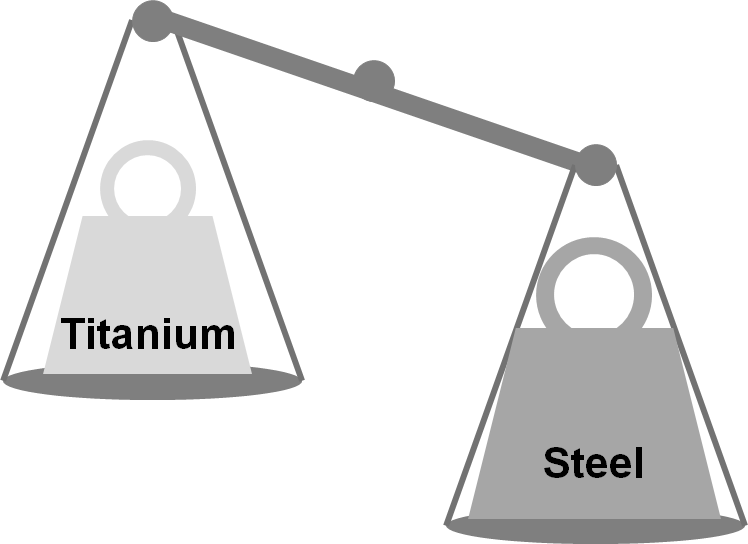
Titanium vs Steel
STRUCTURAL STEEL
- • Rapid Creep Deformation at 450°C
- • Acidic Corrosion Vulnerability
- • High Thermal Expansion
TITANIUM (Ti-6Al-4V)
- • Superior Strength-to-Weight Ratio
- • Natural Acid Resistance (Passivation)
- • Stable up to 600°C Operation
| Property | Steel (AISI 304) | Titanium (Grade 5) |
|---|---|---|
| Melting Point | 1400°C | 1668°C |
| Density | 8.0 g/cm³ | 4.4 g/cm³ (Lighter) |
| Venus Survival | Sub-Optimal | Highly Recommended |
Material Forge
Strength vs. Acid. Choosing the right alloy is the difference between a successful landing and a crushed tin can.
- 🛡️ Titanium: High yield strength at 465°C.
- ⚖️ Mass: 40% lighter than steel for launch efficiency.
- 🌫️ Corrosion: Inert against H₂SO₄ clouds.
Titanium Hull
The Titanium Shield. Grade 5 Titanium is the only material light enough for launch and strong enough to withstand the Venusian "crush depth."
- 🛡️ Tensile Strength: 880+ MPa (Grade 5).
- 🧪 Acid Proof: TiO2 passivation layer prevents corrosion.
- ⚖️ Mass: 4,430 kg/m³ (45% lighter than steel).
Steel Skeleton
The Iron Anchor. While heavy, high-grade steel provides the thermal mass and mechanical toughness needed for external drills and landing gear.
- ⛓️ Durability: High resistance to mechanical wear and abrasion.
- 🌡️ Thermal Mass: Absorbs significant energy before melting.
- 🧪 Alloys: 316L and Inconel used to resist sulfidation.
Efficiency King
Titanium Wins. When every gram counts, Titanium provides the highest strength-to-weight ratio for the Venusian descent.
- 🚀 Launch Efficiency: 45% lighter than steel.
- 🛡️ Strength Retention: Maintains 450+ MPa at surface heat.
- 💎 Reliability: Superior acid resistance via TiO2.
MATERIALS SCIENCE / EXTREME ENVIRONMENT
TITANIUM VS. STEEL: THE VENUSIAN VERDICT
The Soviet Venera probes—the only craft to successfully land and transmit from Venus—famously utilized Titanium alloys for their descent modules. Here is why you choose one over the other in this hostile environment:
The Verdict: Venus has clouds of concentrated sulfuric acid. Stainless steel (even high grades) can suffer from stress-corrosion cracking in such environments. Titanium alloys, however, form a stable oxide layer that resists this acid effectively. Furthermore, since your descent module needs to be light enough to be carried by a spacecraft but strong enough to not be crushed like a soda can by 93 bar of pressure, the high strength-to-weight ratio of Titanium makes it the gold standard. Steel is too heavy for the amount of structural integrity you would need to hold the same internal volume.

MATERIALS PHYSICS / STRUCTURAL INTEGRITY
THERMAL CREEP & SEAL INTEGRITY
The real killer of a Venusian lander isn't just the ambient temperature—it's the differential between the hot outside (460°C) and the cooler, pressurized interior. This creates Thermal Creep: metals under high stress (due to the 93 atm pressure) will slowly deform over time when exposed to high heat. Titanium alloys exhibit better "creep resistance" than most steels at these specific temperatures. However, the most critical failure point is the seal. When you bolt a viewport or a sensor into a Titanium shell, the two materials expand at different rates. If your Coefficient of Thermal Expansion (CTE) isn't perfectly matched, that seal will break, and the 93 atm pressure will crush the probe instantly.
Sources
CORROSION RESISTANCE
Titanium naturally forms a protective oxide layer that is highly resistant to sulfuric acid compared to standard carbon steel.
ACID TESTSSTRENGTH-TO-WEIGHT
Titanium is ~45% lighter than steel with comparable strength, crucial for buoyancy in floating base designs.
MASS EFFICIENCYTHERMAL CONDUCTIVITY
Titanium has lower thermal conductivity than steel, helping to slow down the "thermal soak" that kills electronics.
HEAT INSULATIONDive Deep Venus

Venus

Venus Pressure Depth

Structural Crush Depth
Atmospheric Density

Greenhouse Heating

Cooling Energy

Buoyancy Lift

Altitudinal Habitability

Floating Base Stability

Venus Day vs Year
Venus Transit

Sulfuric Acid Corrosion

CO2 to O2 Conversion

Lightning Frequency

Windturbine Power

Comms Through Clouds

Landed Probe Lifespan

Venus Gravity Assist
Titanium vs Steel

Sonic Velocity on Venus

Acid Rain

Cloud Cities

Venus Mysteries