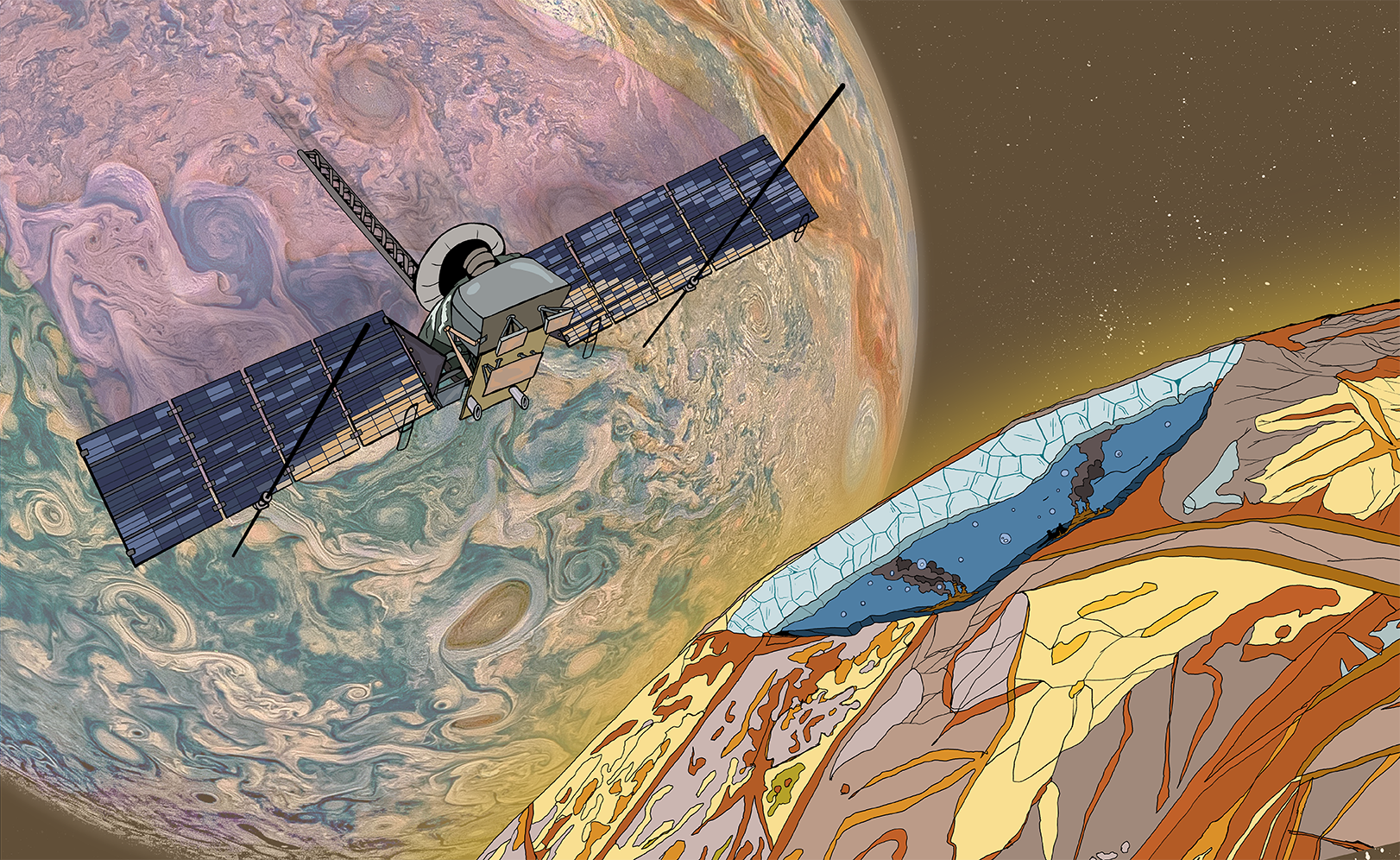
Europa orbits within Jupiter’s intense, rotating magnetosphere, which traps high-energy electrons and ions, creating a lethal radiation environment. For spacecraft, this necessitates robust shielding architectures to protect sensitive electronics and biological payloads. The environment is characterized by high-energy charged particles that can cause "total ionizing dose" (TID) degradation and "single-event upsets" in flight computers. Designing a mission here requires a layered approach: integrating high-Z (high atomic number) materials like tantalum or lead to block electrons, backed by secondary low-Z materials to mitigate the secondary X-ray (Bremsstrahlung) radiation produced by the primary shielding impact.
Radiation hardening goes beyond physical shielding; it is a fundamental approach to electronics design. Components must withstand Total Ionizing Dose (TID) effects, where gradual exposure causes leakage current and threshold shifts, and Single-Event Effects (SEE), where a high-energy particle causes an instantaneous state flip or latch-up. Strategies include utilizing silicon-on-insulator (SOI) fabrication processes, redundancy in logic gates, and "watchdog" circuits that can autonomously reset systems upon detecting an erroneous state. By combining these hardware-level safeguards with radiation-tolerant software routines, we create systems that can persist in the Jovian environment for years.
The most effective "shield" for a spacecraft in the Jovian system is not material, but orbital geometry. Because the radiation environment is highly localized near Jupiter and Europa, orbiting Europa directly is often prohibitively dangerous for long-duration missions. Instead, trajectory designers utilize a "flyby" architecture. By employing highly elliptical Jovian orbits and resonant gravity assists from other Galilean moons (like Ganymede or Callisto), the spacecraft can reach Europa for brief, high-intensity data collection windows and then rapidly escape to lower-radiation zones to transmit data back to Earth. This minimizes the "total ionizing dose" by ensuring the spacecraft spends the vast majority of its mission time outside the most intense radiation belts.
In the volatile Jovian environment, static shielding is not enough; the spacecraft must possess "situational awareness." This is achieved through active radiation monitoring. Onboard sensor suites—such as dosimeters, particle telescopes, and spectrometer arrays—provide real-time data on the current particle flux, electron energy spectra, and cumulative ionizing dose. This telemetry is fed directly into the onboard flight computer’s "fault protection" system. If a sudden solar particle event or magnetic flux surge is detected, the computer can autonomously place the spacecraft into a "safe mode," orienting the shielded side toward the radiation source and suspending non-essential operations to preserve the integrity of the hardware.
In the extreme radiation of Jupiter, longevity is not merely about shielding; it is about graceful degradation. We design mission architectures with high-level system redundancy, where secondary and tertiary hardware modules remain dormant, protected within "radiation vaults," to be activated only if primary systems experience significant degradation. Furthermore, "End-of-Life" (EOL) testing is performed on all flight-grade hardware to calibrate exactly how much performance loss (in power generation, sensor sensitivity, and communication bandwidth) the mission can tolerate while still returning high-value science. This philosophy ensures that even as the spacecraft "ages" due to radiation-induced damage, it remains a functional scientific laboratory.
Before building hardware, we rely heavily on Monte Carlo radiation transport codes (like GEANT4 or MCNP). These simulations model the interaction of individual high-energy particles with the spacecraft’s complex geometry. By firing millions of simulated electrons and protons at a virtual model of the craft, we can statistically track how energy is deposited into sensitive components and predict the likelihood of "bremsstrahlung" generation behind shield walls. This allows engineers to iterate on the shield design—optimizing for mass by thinning out non-critical areas and thickening shielding around high-risk electronics—ensuring mission success while keeping the spacecraft within strict weight limits.
In the Jovian system, the spacecraft does not simply exist in a vacuum; it interacts with an intense plasma environment dominated by ionized sulfur and oxygen from Io. Because electrons are significantly lighter than ions, they strike the spacecraft's surface at higher flux rates, leading to "spacecraft charging"—the accumulation of a net negative electric potential. This buildup creates two critical issues: Differential Charging (where different materials charge at different rates, leading to catastrophic electrostatic discharges) and Plasma-Enhanced Radiation Sensitivity (where a charged spacecraft can actually attract or focus incident high-energy particles). Understanding this interaction is vital, as a negatively charged hull can unintentionally accelerate or focus ambient radiation into sensitive electronic bays or sensor apertures.
Integrating radiation shielding is a complex, multi-variable optimization problem. Every gram of shielding added to protect electronics increases the spacecraft's launch mass, which in turn demands more propellant—limiting the science payload. Furthermore, heavy shielding can impede thermal radiation, causing the spacecraft to overheat while in the intense shadow-to-sunlight transitions of the Jovian system. True system integration requires a "holistic" approach: placing the most sensitive electronics inside a central, heavily shielded "vault" while utilizing clever geometry—such as orienting fuel tanks or structural bulkheads to act as secondary shielding—to protect the rest of the craft.