Cassini-Huygens
CASSINI-HUYGENS
EXPLORING THE LORD OF THE RINGS
Lord of the Rings
A collaborative mission that spent 13 years orbiting Saturn, revealing its complex rings, diverse moons, and the secrets of Titan.
Studying the Saturnian system.
Unprecedented scientific detail.
Saturn Sync
Ring Mapping. Monitoring the Proximal-Orbit Buffer to track the 22 dives between Saturn and its rings.
- 🪐 Dives: Grand Finale Sync.
- 🛰️ Impact: 2017 Atmospheric Protocol.
- 🌌 Gravity: Ring-Structure Buffer.
Titan Sync
Surface Mapping. Monitoring the Huygens descent buffer to track the first landing in the outer solar system.
- 🪂 Descent: Parachute-Aero Sync.
- 🧪 Atmo: Methane-Nitrogen Protocol.
- 🌑 Landing: Adiri Region Buffer.
Plume Sync
Oceanic Mapping. Monitoring the Tiger-Stripe Buffer to track the cryovolcanic geysers of the south pole.
- ❄️ Output: Water-Ice Particle Sync.
- 🌊 Source: Global Subsurface Protocol.
- 🧪 Organic: Salt-Rich Vapor Buffer.
Plunge Sync
Atmospheric Mapping. Monitoring the Terminal-Entry Buffer to track Cassini’s final 2017 plunge into Saturn.
- ☄️ Descent: 22 Proximal Ring Dives.
- 🛡️ Protocol: Planetary Protection Sync.
- 📡 Signal: Final-Telemetry Buffer.
SATURNIAN EXPLORATION / CASSINI-HUYGENS
THE GRAND SATURNIAN TOUR
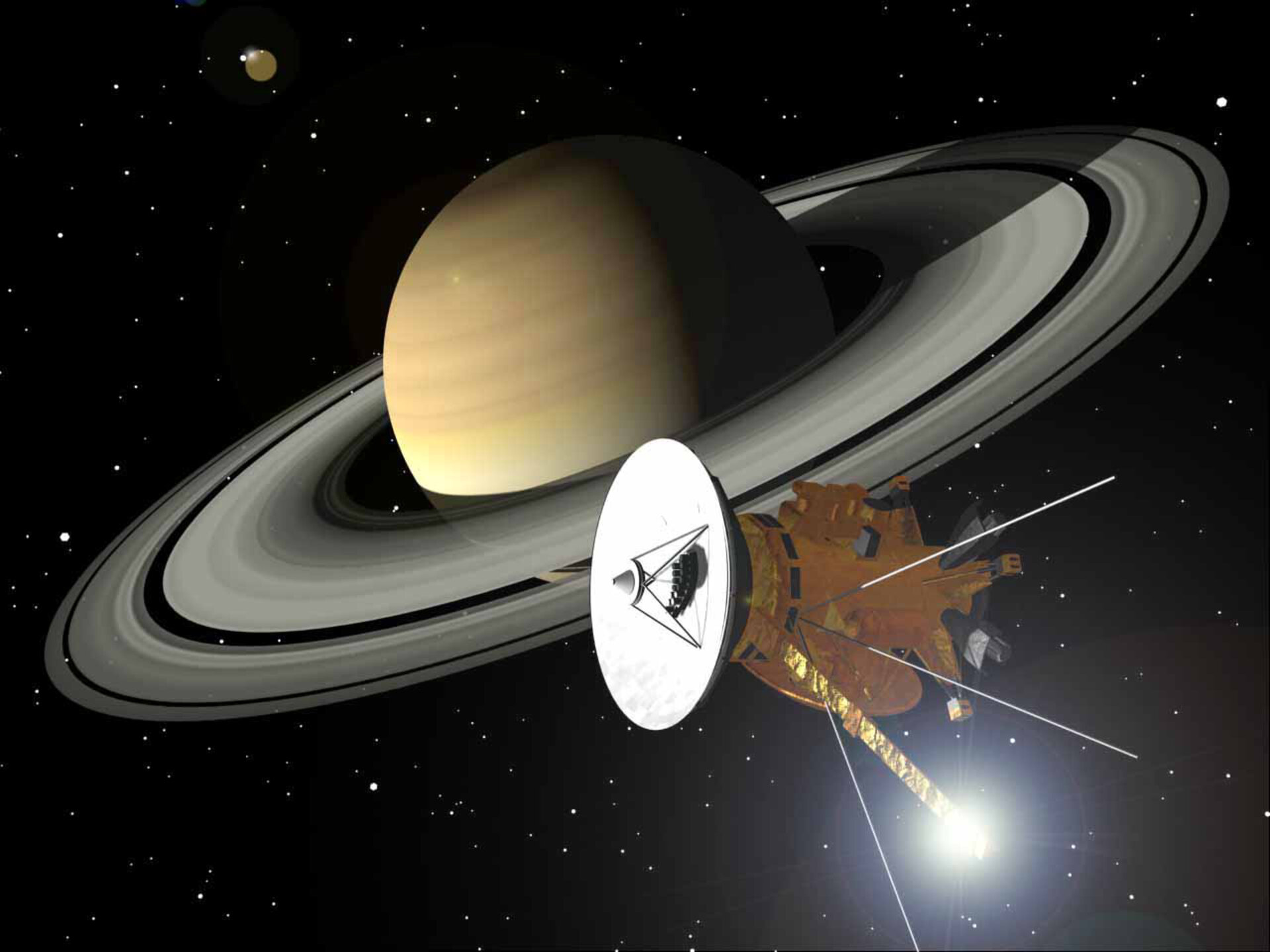
As one of the most ambitious interplanetary collaborations in history, the Cassini-Huygens mission spent over a decade unraveling the mysteries of Saturn, its complex ring architecture, and its geologically active moons.
SATURNIAN EXPLORATION / MOON DISCOVERIES
TITAN SEAS & ENCELADUS PLUMES
Cassini and Huygens unlocked two worlds of profound astrobiological interest: Titan, featuring vast surface lakes of liquid methane, and Enceladus, venting global water-ice geysers from a subsurface global ocean.

SATURNIAN EXPLORATION / THE GRAND FINALE
THE GRAND FINALE PLUNGE
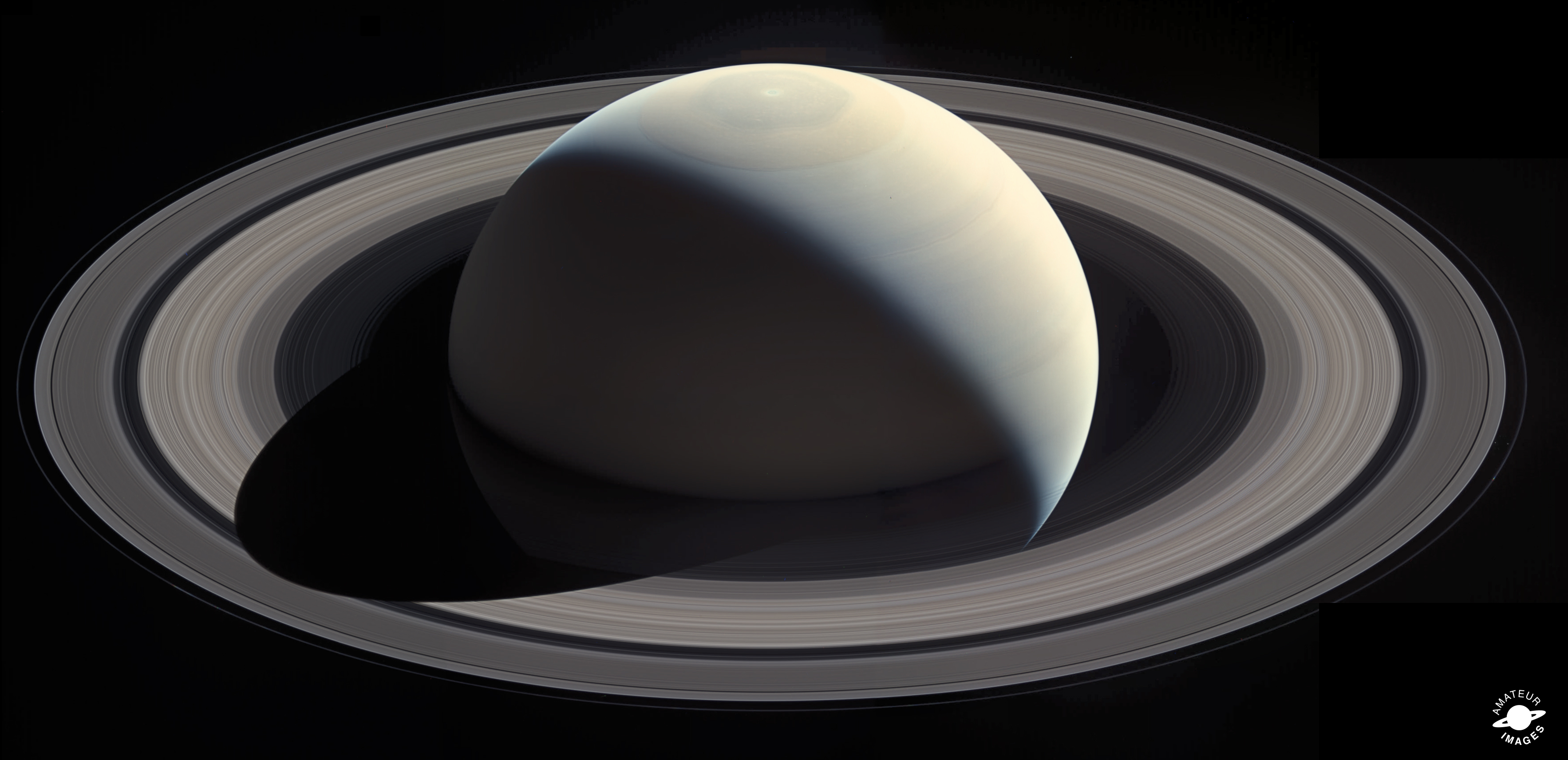
Running low on fuel after two decades in space, Cassini executed its daring "Grand Finale" phase—diving 22 times through the narrow gap between Saturn and its rings before making a final, planned plunge into the gas giant's atmosphere.
Outer Solar System Flagships
Cassini-Huygens Data Logs • Comparative Mass & Mission SpecsA clear look at landmark interplanetary exploration platforms. Metrics cover total launch mass, operational payload, and destination parameters for comparative analysis.
| Mission & Agency | Launch Mass | Payload / Landed |
|---|---|---|
|
Cassini-Huygens NASA / ESA
Orbiter (Cassini) + Lander (Huygens)
|
0 kg | 0 kg |
|
Voyager 1 NASA
Outer Planet Flyby
|
0 kg | 0 kg |
|
Galileo NASA
Orbiter & Atmospheric Probe
|
0 kg | 0 kg |
|
New Horizons NASA
Pluto & Kuiper Belt Explorer
|
0 kg | 0 kg |
Sources
HUYGENS PROBE
In 2005, the Huygens probe landed on **Titan**, the first landing in the outer solar system. It revealed a world of methane lakes and a thick, nitrogen-rich atmosphere.
LANDING DATAENCELADUS GEYSERS
Cassini discovered plumes of water ice and organic molecules spraying from the south pole of **Enceladus**, suggesting a habitable subsurface ocean.
PLUME SPECSTHE GRAND FINALE
In 2017, Cassini completed 22 daring dives between Saturn and its rings before plunging into the planet's atmosphere to protect the moons from contamination.
FINAL MISSION
Cassini-Huygens Mission FAQs
Exploring Saturn, its magnificent rings, and the historic landing on Titan
The joint mission aimed to conduct in-depth studies of Saturn, its complex ring system, its magnetic environment, and deploy a lander onto its largest moon, Titan.
It was a historic international collaboration primarily between NASA, the European Space Agency (ESA), and the Italian Space Agency (ASI).
The ESA-built Huygens probe successfully touched down on Titan's surface on January 14, 2005, marking the first landing in the outer solar system.
It remains the most distant landing ever accomplished on another world and the only soft landing on a moon other than Earth's moon.
After arriving in orbit in July 2004, Cassini spent 13 years examining the Saturnian system before concluding its mission in September 2017.
Cassini discovered active geysers shooting salty water vapor and organic molecules from a subsurface global ocean through cracks in the icy crust of Enceladus.
On September 15, 2017, Cassini executed its "Grand Finale" plunge into Saturn's upper atmosphere, intentionally burning up to prevent biological contamination of Titan or Enceladus.
Data and images showed a nitrogen-rich, hazy atmosphere with surface features carved by liquid methane channels, resembling a cryogenic version of early Earth.
Launched in October 1997, the spacecraft used four gravity-assist flybys—twice at Venus, once at Earth, and once at Jupiter—to gain the velocity needed to reach Saturn.
The orbiter was named after Italian-French astronomer Giovanni Cassini (discoverer of Saturn's ring gaps) and the probe after Dutch physicist Christiaan Huygens (discoverer of Titan).
Recommended Tools
View AllLoading recommended tools...