James Webb
JWST OBSERVATORY
INFRARED COSMIC DEEP-FIELD INFRASTRUCTURE
Lagrange Point L2 Anchor
The James Webb Space Telescope operates from the Second Lagrange Point (L2), roughly 1.5 million kilometers from Earth. This unique gravitational balance point keeps JWST aligned with Earth, allowing its massive sunshield to block heat from the Sun, Earth, and Moon simultaneously.
Composed of 18 individual beryllium-gold hexagons acting together as a single colossal light-gathering eye.
Advanced cryocoolers drive instruments down to near absolute zero to detect the faintest infrared photon tracks.
Webb Sync
Temporal Mapping. Monitoring the Infrared Redshift Buffer to track the deep-space interface of the JWST mission.
- 🔭 Mirror: 6.5m Gold-Coated Sync.
- ❄️ Cryo: -233°C Thermal Buffer.
- ⏳ History: 13.5 Billion Year Protocol.
Time Sync
Temporal Mapping. Monitoring the Photon-Lookback Buffer to track the early universe interface of JWST.
- ⏳ Lookback: 13.5 Billion Year Buffer.
- ✨ Target: First Light Interface Sync.
- 🔆 Reflector: 6.5m Gold Mirror Protocol.
L2 Sync
Station Mapping. Monitoring the Gravitational Buffer to track the L2 equilibrium interface of JWST.
- 📍 Range: 1.5M km Orbital Sync.
- ❄️ Thermal: Earth/Moon Heat Rejection.
- 🔄 Orbit: Halo Trajectory Protocol.
Vision Sync
Wavelength Mapping. Monitoring the Infrared Buffer to track the stellar birth interface of JWST.
- 🌫️ Dust: Scattering Rejection Protocol.
- 🌟 Birth: Protostellar Thermal Sync.
- 🔴 Shift: Deep-Space Redshift Buffer.
Shield Sync
Thermal Mapping. Monitoring the Heat-Rejection Buffer to track the 5-layer Kapton interface of JWST.
- 📐 Size: Tennis-Court Surface Sync.
- ❄️ Delta: 300°C Thermal Buffer.
- 🛡️ Layers: 5-Level Radiative Protocol.
ASTROPHYSICS / INFRARED ASTRONOMY
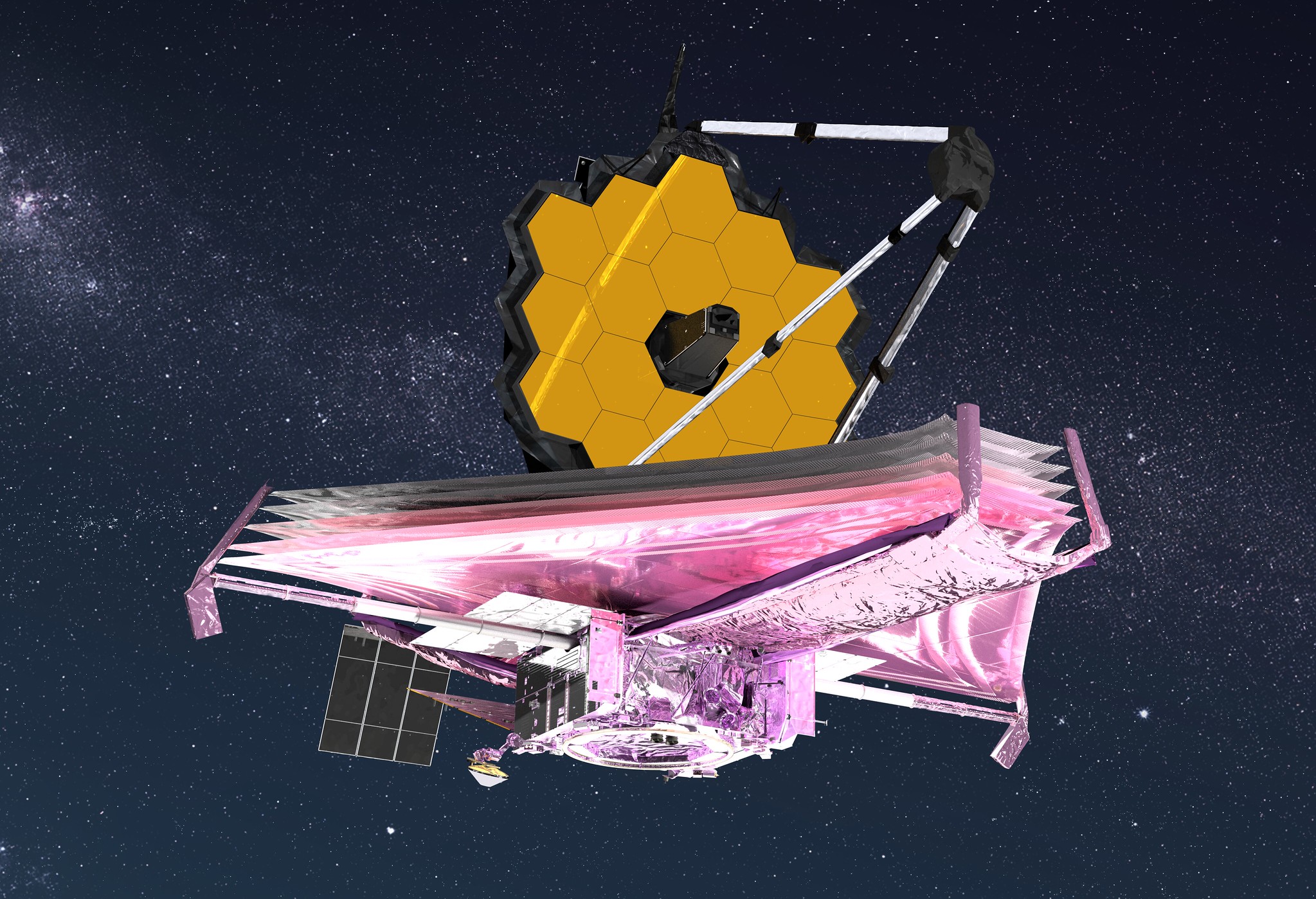
THE INFRARED EYE
Webb operates in the infrared spectrum because the expansion of the universe has "stretched" the light from the earliest stars and galaxies, shifting it from visible light into the infrared. By cooling its massive 6.5-meter golden mirror to extremely low temperatures, Webb can detect the faint heat signatures of these ancient objects that are otherwise invisible to other telescopes.
ENGINEERING / THERMAL ARCHITECTURE
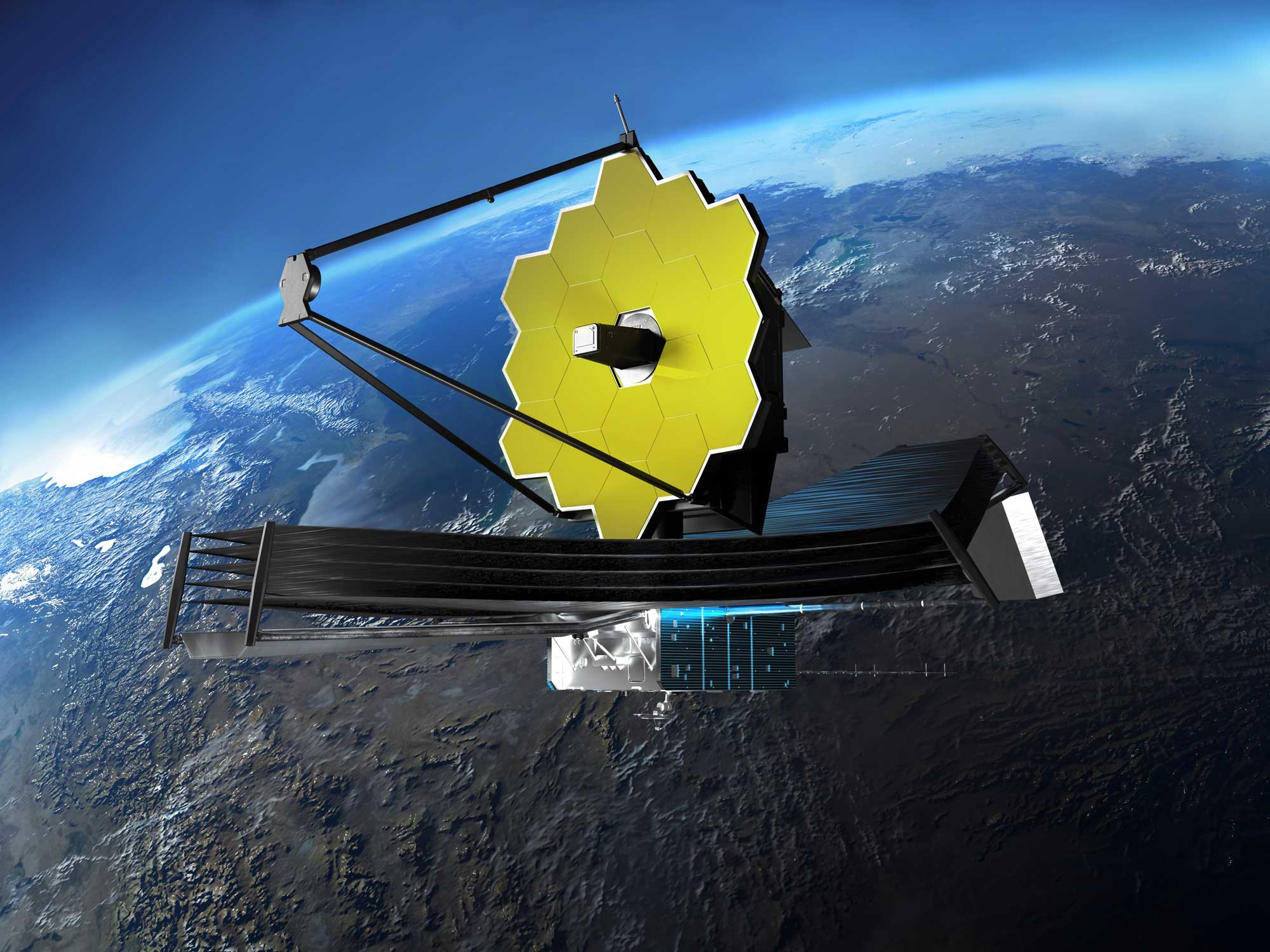
THE FIVE-LAYER SHIELD
The sunshield, roughly the size of a tennis court, is composed of five layers of Kapton E, each thinner than a human hair and coated with reflective aluminum and doped silicon. This passive cooling system creates a massive temperature differential: the "hot" side facing the Sun can reach over 110°C, while the "cold" side, where the instruments reside, sits below -233°C.
ORBITAL MECHANICS / L2 VANTAGE
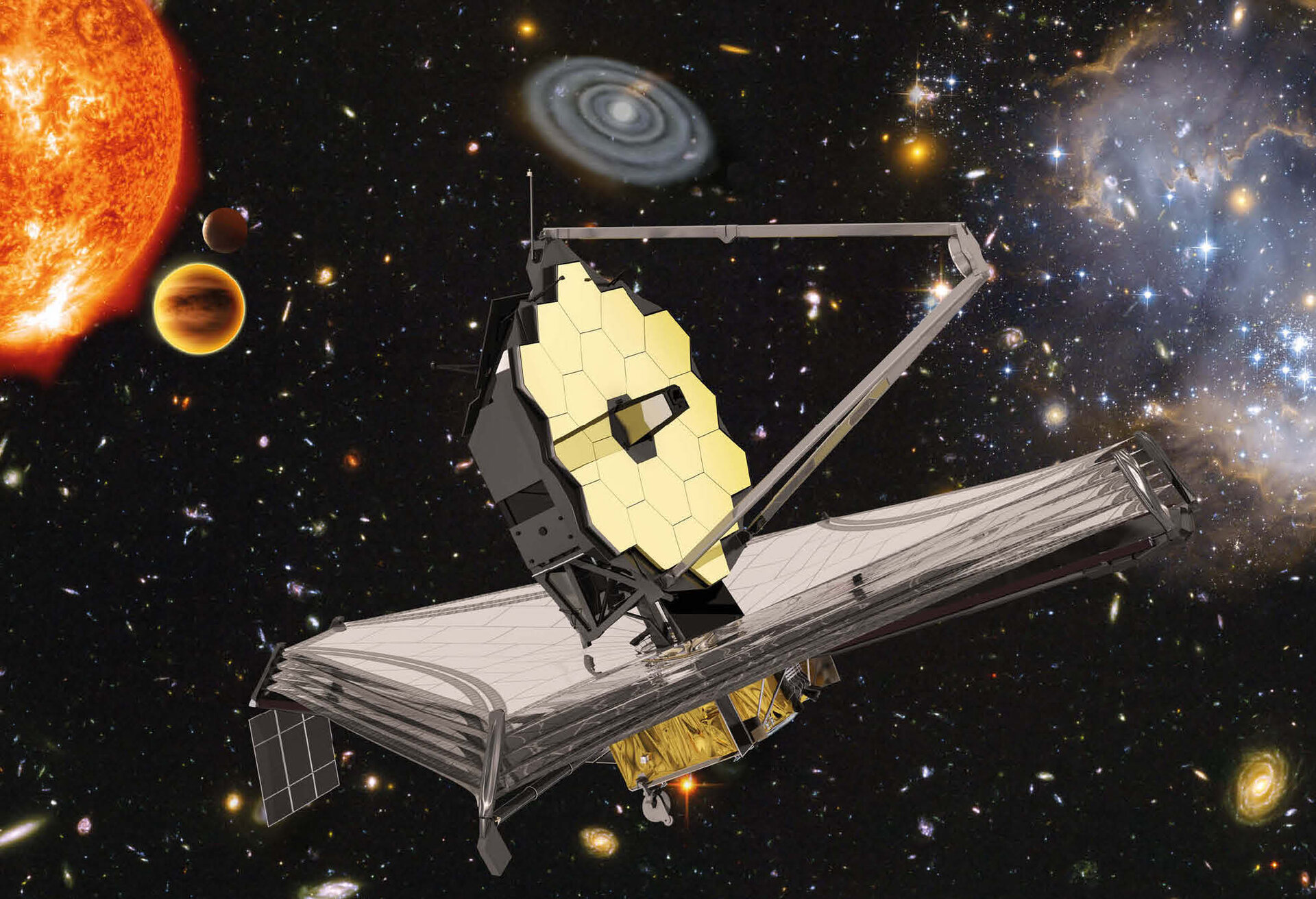
WHY L2?
L2 is a position in space where the gravitational pull of the Sun and the Earth balances the centripetal force required for a small object to orbit with them. By placing the JWST at L2, the telescope remains in a constant alignment where the Sun, Earth, and Moon are always located behind its sunshield. This provides a clear, thermally stable, and unobstructed view of the deep universe 24/7.
STATUS UPDATE / MISSION EVOLUTION
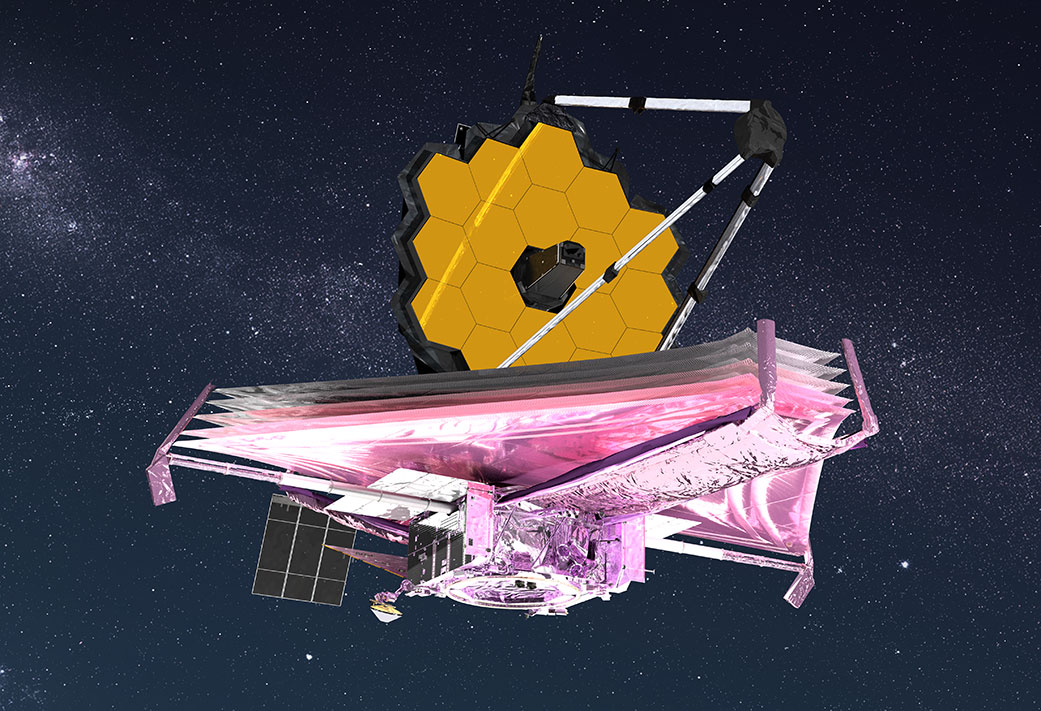
JWST: OPERATIONAL VANTAGE
In mid-2026, Webb remains the premier infrared facility for astrophysics. Its current operations focus on both legacy surveys of the early universe and targeted observations of Solar System phenomena and exoplanetary atmospheres. It is now part of a multi-mission ecosystem, often performing follow-up observations on targets identified by wide-field surveys.

Recommended Tools
View AllLoading recommended tools...
- Missions -

Artemis II
James Webb Telescope
Mars Perseverance
Voyager Missions

Parker Solar Probe

Cassini-Huygens

Europa Clipper
New Horizons

Hubble Telescope

Chandrayaan-3
Vector Architecture

A clean schematic highlighting the primary deployment sequence and main mirror structure.
Infrared Array
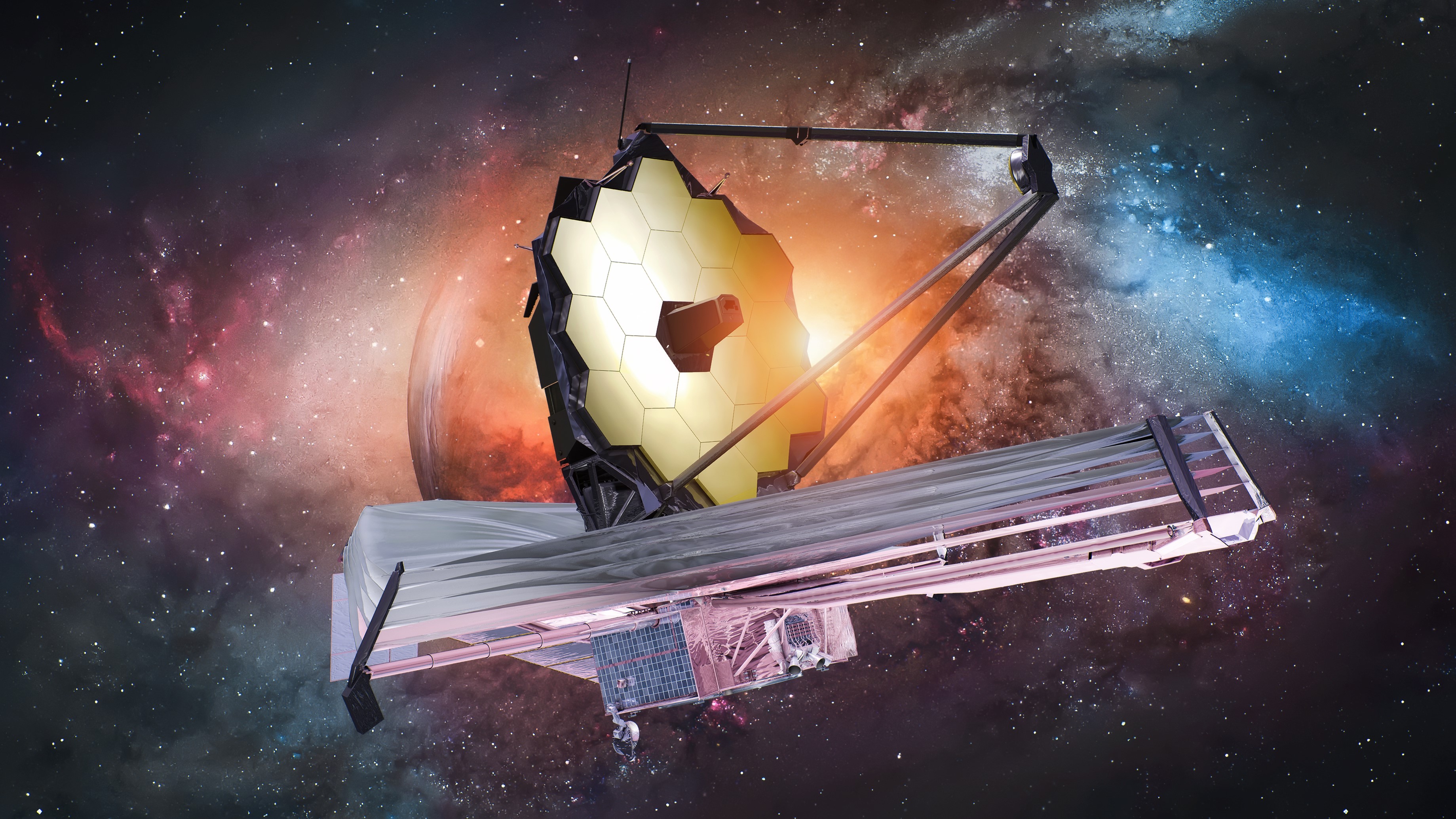
Visualization of JWST in full deployment, optimized for the cosmic mid-infrared (MIRI) spectrum.
System Core
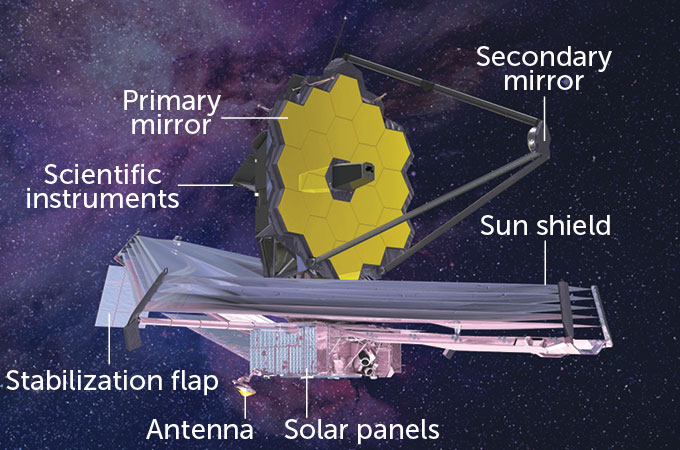
Operational logic diagram showing the flow from the 6.5m mirror to the core science instruments.
Sources
PRIMARY MIRROR
JWST features a **6.5-meter** primary mirror composed of 18 hexagonal segments coated in a thin layer of gold to maximize infrared reflection.
MIRROR TECHINFRARED VISION
By detecting infrared light, Webb can see through cosmic dust and observe "redshifted" light from galaxies over **13.5 billion light-years** away.
INFRARED PHYSICSTHERMAL PROTECTION
The 5-layer sunshield is as big as a tennis court. It keeps the telescope at a cryogenic **-233°C** to prevent its own heat from interfering with observations.
COOLING SPECS