Ceres holds more water than any other object in the inner solar system besides Earth. Beneath its rocky, cratered surface lies evidence of vast subsurface brines and possibly ancient oceans. The famous bright spots are just the visible hint of this hidden water world. This series explores the distribution, history, and implications of water on Ceres — from deep reservoirs to surface expressions.
Liquid water reservoirs and cryovolcanic links.
Surface evidence of rising salts and water.
Up to 25-50% by volume
Brines & ice reservoirs
Bright salt deposits
Ceres may have once hosted a global ocean. Today, pockets of brine still exist and occasionally reach the surface, creating one of the most intriguing water stories in our solar system.
Beneath Ceres' crust lies evidence of a once-global ocean and current pockets of salty liquid water (brines). Data from the Dawn mission suggests these reservoirs could still exist tens of kilometers deep. In the distant past, a muddy ocean may have covered much of the dwarf planet, driven by radioactive heating and accretion energy. Over time, this water froze and concentrated into brines that occasionally migrate upward, feeding cryovolcanoes and creating the bright surface deposits we see today.
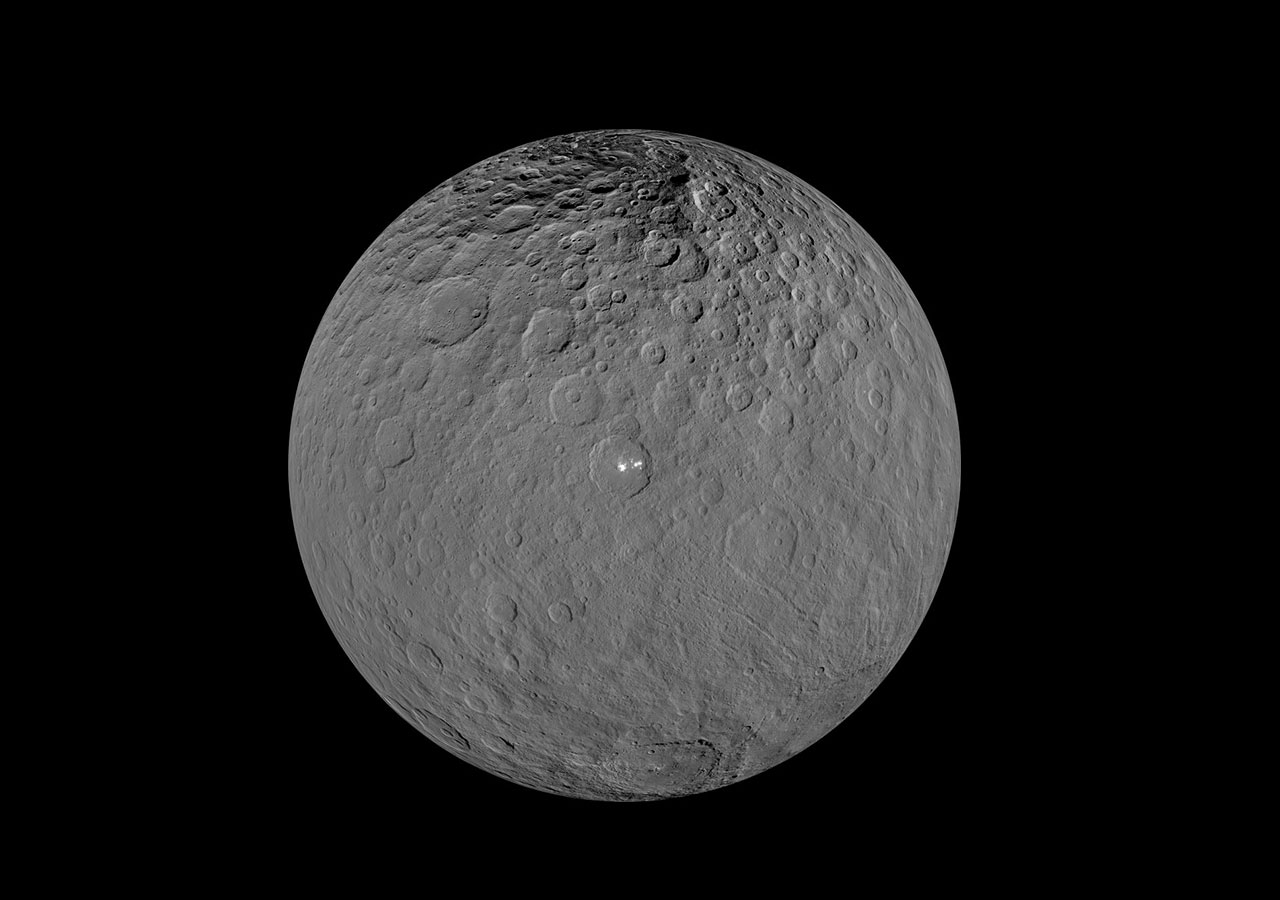
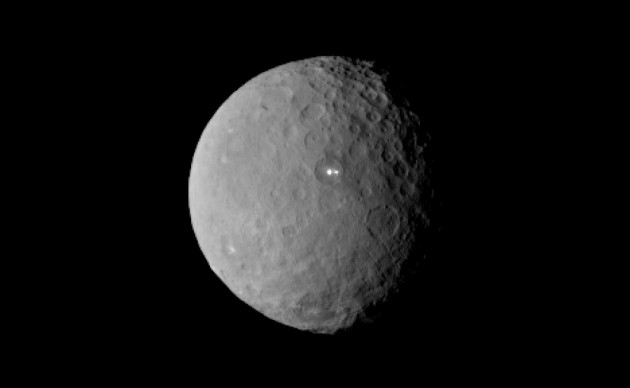
The brilliant white patches on Ceres, most famous in Occator Crater, are among the most reflective features in the solar system. These are primarily sodium carbonate salts deposited when briny water rose from below, reached the surface, and evaporated in the vacuum of space. Some deposits appear geologically young, suggesting that water-related activity continues even today. These bright spots act as direct messengers from Ceres’ hidden water reservoirs.
The abundance of water on Ceres, combined with organic molecules, minerals, and past heat sources, raises intriguing questions about habitability. While the surface is cold and airless, ancient subsurface oceans or long-lived brine pockets could have provided stable environments where prebiotic chemistry took place. Even today, localized brines might offer protected niches. Ceres stands as one of the most water-rich bodies in the inner solar system and a key target for understanding the distribution of water — and possibly life — in our cosmic neighborhood.
Ceres has its own version of a water cycle, though very different from Earth’s. Subsurface brines migrate upward through fractures, reach the surface in craters, and evaporate in the near-vacuum, leaving behind bright salt deposits. Some water vapor escapes into a very thin, transient atmosphere before freezing or being lost to space. This slow but active cycle links the deep interior with the visible surface, powered by residual heat and occasional geological triggers.
Ceres is a prime target for upcoming missions seeking to understand water in the solar system. Future landers could directly sample bright spots, drill into the crust to study brines, or analyze organic material preserved in ice. Such missions would reveal how water has shaped this dwarf planet over billions of years and help us assess its past habitability. As the most water-rich world in the inner solar system after Earth, Ceres may hold keys to the origin and distribution of water — and life — across the cosmos.
Deep dive into the hydrologic secrets of the dwarf planet
Estimates suggest that water ice makes up approximately 25% to 30% of Ceres' mass.
It is predominantly found as water ice, though briny, liquid-like reservoirs may exist deep beneath the crust.
Sublimation is the process where surface ice turns directly into water vapor due to low pressure.
Scientists believe a briny, slushy ocean may have persisted deep in the interior even into recent times.
Salts act as an antifreeze, lowering the freezing point of water and allowing it to remain liquid at lower temperatures.
Ice is primarily hidden beneath a thick layer of rocky, dusty regolith to protect it from solar radiation.
It has a limited cycle where ice sublimates to vapor, but it lacks the atmosphere to support clouds or rain.
The Gamma Ray and Neutron Detector (GRaND) instrument detected hydrogen, indicating the presence of water ice.
By volume, Ceres contains a significantly higher percentage of water than the planet Earth does.
Low surface temperatures and the protective insulating layer of surface debris keep the interior water stable.