
The Rocks Field
THE ASTEROID BELT
CIRCUMSTELLAR DEBRIS PROFILE
Mass Concentration
Occupying the vast expanse between Mars and Jupiter, the main asteroid belt contains millions of rocky and metallic remnants left behind from the solar system's early formation. Despite its huge volume, its total combined mass is only about 4% of Earth's moon.
The sprawling orbital expanse separating the inner terrestrial worlds from the outer gas giants.
Over half of the entire belt's mass is locked inside just four objects: Ceres, Vesta, Pallas, and Hygiea.
Belt Sync
Protoplanetary Fragment Mapping. Measuring the orbital stability of the transition zone between Mars and Jupiter. New Horizons monitors the Asteroid Belt to track the kinetic remnants of the early solar system.
- 🪐 Region: 2.2 to 3.2 AU Range.
- 🪨 Largest: Ceres (Dwarf Planet).
- 🛡️ Factor: Jupiter Gravity Sync.
Gap Sync
Mars Jupiter Transition Mapping. Analyzing the orbital void maintained by gas giant resonance. New Horizons monitors the "Stagnation Zone" to track why a fifth terrestrial planet failed to manifest.
- 🚀 Boundary: Mars (1.5 AU) to Jupiter (5.2 AU).
- 🛰️ Occupant: The Main Asteroid Belt.
- 🌀 Force: Resonant Gravitational Shearing.
Failed Sync
Protoplanetary Disruption Mapping. Analyzing the kinetic failure of the 2.8 AU accretion zone. New Horizons monitors the Failed Planet Theory to track why Jupiter resonance prevented a fifth terrestrial world.
- 🌪️ Cause: Jupiter Tidal Shearing.
- 💥 Effect: Destructive Impact Velocity.
- 📉 Status: Scattered Kinetic Remnants.
Ceres Sync
Dwarf Planet Mapping. Analyzing the dominant mass of the main belt. New Horizons monitors the Queen of the Belt to track cryovolcanic activity and ice mantle stability.
- 📏 Diameter: 940 km (The Largest).
- ⚖️ Mass: 33% of Entire Belt.
- 🧊 Feature: Subsurface Brine Reservoir.
Lonely Sync
Spatial Density Mapping. Analyzing the isolation constants of the Mars Jupiter gap. New Horizons monitors the Lonely Rocks to track why the belt is 99 percent empty space despite containing millions of objects.
- 🌌 Average Gap: 1,000,000+ Kilometers.
- 📡 Density: High Vacuum Saturation.
- 🛰️ Navigation: Zero Impact Probability.
Belt Creator
Orbital Population Mapping. Defining the procedural parameters for the Mars Jupiter gap. New Horizons utilizes "Keplerian Sync" to distribute fragments across a 1 AU wide torus.
- 📐 Input: Inner Outer Radius Sync.
- 🌀 Physics: Orbital Velocity Delta.
- 🪨 Density: Fragments per Cubic AU.
ASTROPHYSICS / PLANETARY FORMATION
THE MYTH OF DENSITY
The asteroid belt is not a debris field that prevents passage; it is an incredibly sparse region. The total mass of all asteroids in the belt is estimated to be only about 4% of the mass of our Moon, spread across hundreds of millions of kilometers. If you were to place all the asteroids together, they wouldn't even form a planetoid the size of Mercury. The reason they never coalesced into a planet is the gravitational influence of Jupiter, which "stirred" the region, preventing the accretion of material and maintaining the belt as a relic of the early solar system.

ASTROGEOLOGY / SPECTROSCOPY
THE THREE PRIMARY CLASSES
We classify asteroids based on their composition, which tells us how far they formed from the Sun and whether they belonged to a larger, differentiated body. The three main classes are:
C-types are the most abundant and are found primarily in the outer reaches of the belt, containing organic compounds and water. S-types dominate the inner belt, representing the rocky "mantle" materials of early protoplanets. M-types are the most intriguing—they are essentially the exposed iron-nickel cores of shattered protoplanets that underwent thermal differentiation, stripping away their rocky outer shells.
ORBITAL MECHANICS / RESONANCE
THE KIRKWOOD GAPS
Kirkwood Gaps occur at specific orbital distances where an asteroid's orbital period forms a simple integer ratio with Jupiter's (e.g., 3:1, 5:2, 7:3). Because Jupiter is so massive, objects in these resonances receive repeated gravitational "tugs" at the same point in their orbit. Over millions of years, these cumulative perturbations significantly increase the eccentricity of the asteroid's orbit until it is ejected from the belt entirely or crosses the path of Mars. These "gaps" are dynamic clearing zones, showing that the belt is not a static graveyard, but a gravitationally sculpted system.
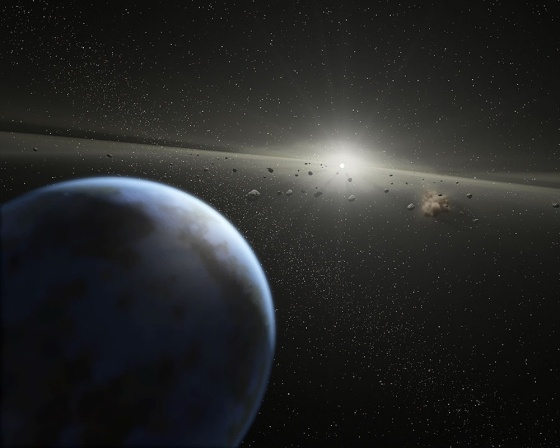
- Asteriods -
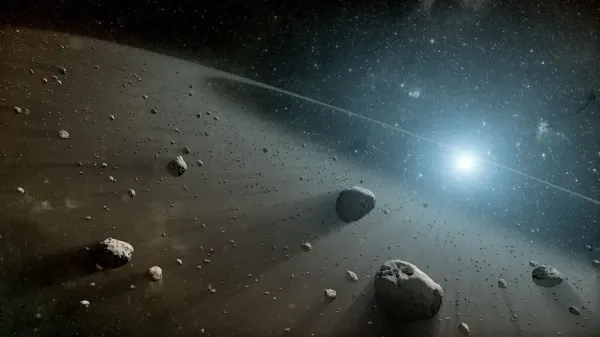
Asteroid
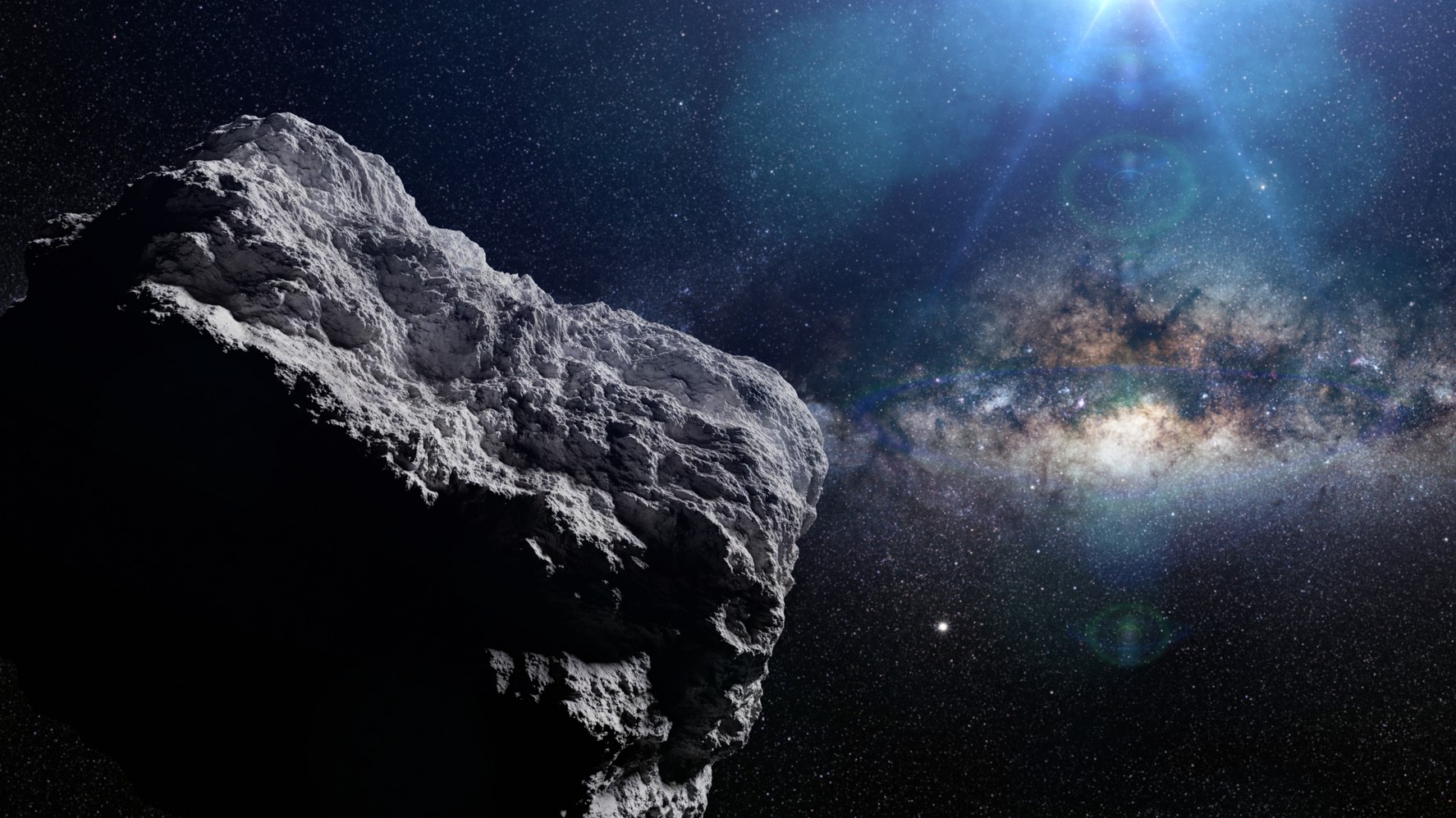
Asteroid Spacing

Space View Point

Ceres Gravity/Size

Mining Profit

Impact Energy

Trojan Logic

Ceres 3D Model

More About Asteroids
Sources
COMPOSITION
The belt contains millions of asteroids, but their total mass is only 4% of Earth's Moon. Ceres accounts for 1/3 of this mass.
NASA ASTEROIDSFORMATION
Jupiter's massive gravity prevented these planetesimals from accreting into a single planet during the solar system's birth.
GRAVITATIONAL MATHKIRKWOOD GAPS
These are regions in the belt where orbital resonances with Jupiter have cleared out asteroids, leaving distinct empty gaps.
ORBITAL GAPSInner Worlds

Comparative visualization of the four terrestrial planets: Mercury, Venus, Earth, and Mars.
The Inner Map
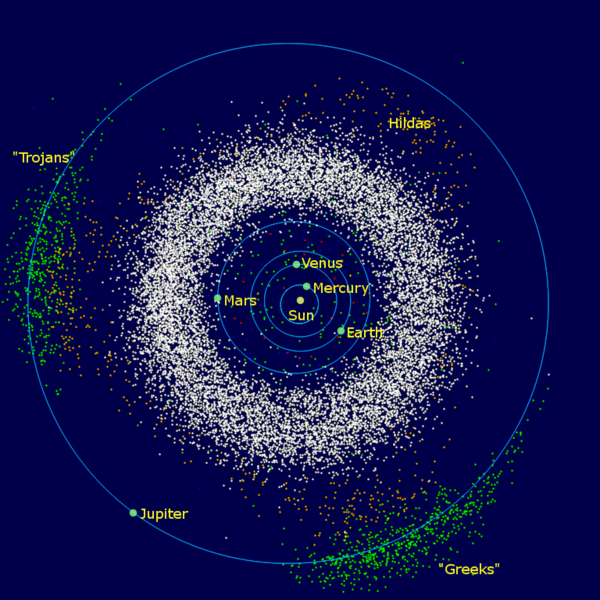
Top-down schematic showing the elliptical orbits and the main Asteroid Belt boundary.
Massive Scale

Context: Size comparison of planets vs. the Sun.
Utility: Visualizing the 1.3 million Earths that fit inside the Sun.
Theme: Universal Perspective