
Ceres Gravity/Size
1 CERES CHARACTERISTICS
GEOMETRIC & GRAVITATIONAL TELEMETRY
Planetary Scale
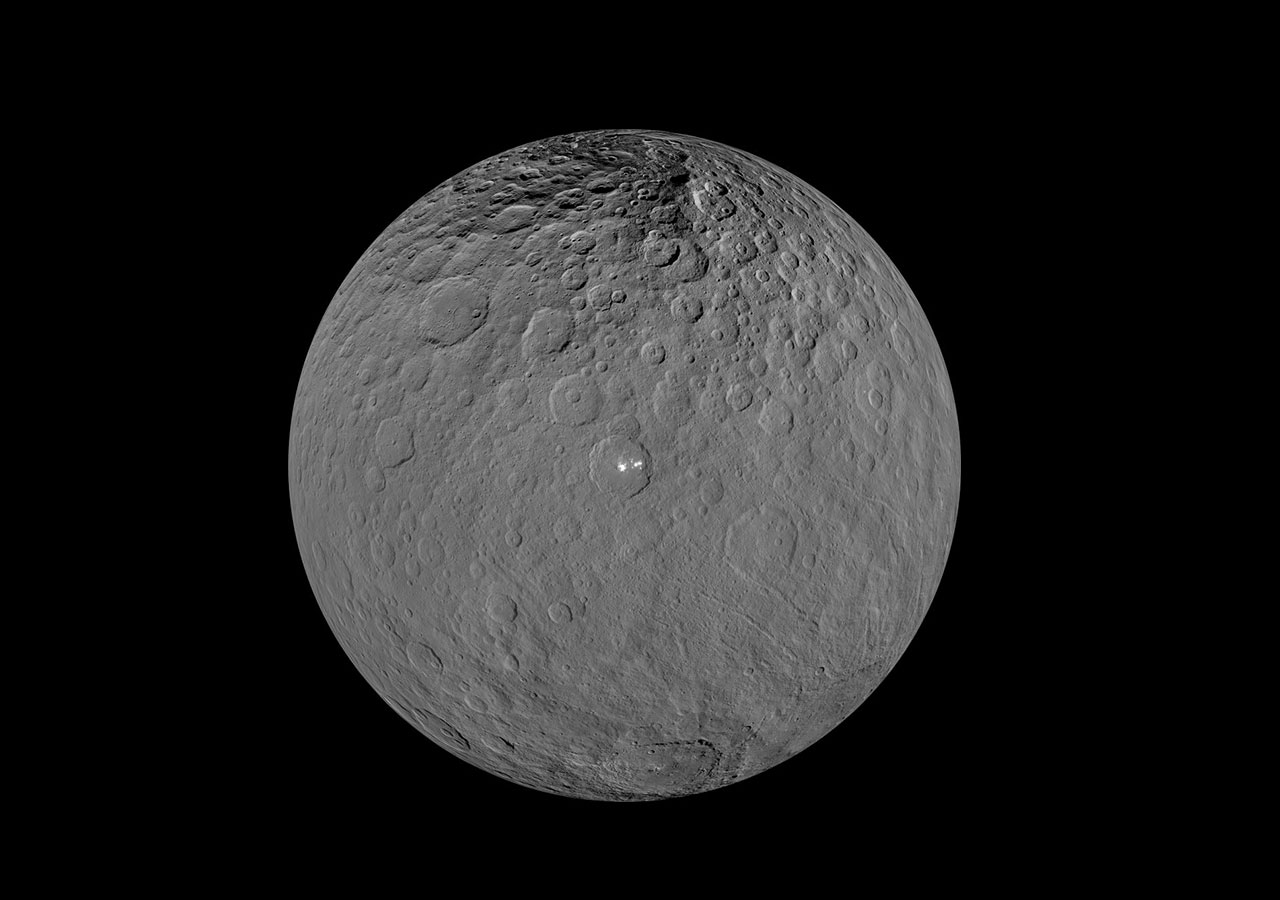
Spanning roughly 940 kilometers across, Ceres is the largest object in the asteroid belt. Its immense mass provides enough self-gravity to form a stable hydrostatic equilibrium, carving its distinct spherical, planet-like profile.
Equivalent to about 1/13th the width of Earth, making up a massive quarter of the entire belt's mass.
Sufficient to anchor an internal water-ice mantle and active subsurface salt-brine reserves.
Ceres Stats
Dwarf Planet Mass Mapping. Analyzing the gravitational pull of the largest object in the belt. New Horizons monitors the Gravity Constant to track how 940 km of diameter creates a 0.28 m/s² acceleration environment.
- 📏 Diameter: 940 km.
- ⚖️ Gravity: 0.03g (3% of Earth).
- 🏃 Escape Velocity: 0.51 km/s.
Mass Sync
Gravitational Anchor Mapping. Analyzing the 33 percent mass concentration within the Mars Jupiter gap. New Horizons monitors the Equilibrium Constant to track how Ceres maintains hydrostatic stability.
- ⚖️ Share: 1/3 of Total Belt Mass.
- ⚪ Shape: Hydrostatic Equilibrium Sphere.
- 🛰️ Status: Primary Inner System Dwarf.
Micro G Sync
Micro Gravity Mapping. Analyzing the slow motion kinetics of the Ceres surface. New Horizons monitors the Gravity Constant to track why a standard fall takes 10 seconds to complete.
- 🕰️ Fall Time: 6x Slower than Earth.
- 🎾 Kinetics: High Bounce Potential.
- ⚖️ Gravity: 0.28 m/s² Acceleration.
Weight Sync
Gravitational Leverage Mapping. Analyzing the 97 percent reduction in weight-force on the Ceres surface. New Horizons monitors the Weight Constant to track how 1,500 kg becomes functionally equivalent to 43 kg.
- 🏋️ Leverage: 35x Muscle Multiplier.
- ⚖️ Human Weight: ~2 kg Perception.
- 🏎️ Vehicle Lift: One Hand Feasible.
Mantle Sync
Internal Volatile Mapping. Analyzing the 100 km deep water ice layer beneath the Ceres crust. New Horizons monitors the Density Constant to track how 2.16 g/cm³ indicates a massive sub surface reservoir.
- ❄️ Layer: 100 KM Water Ice Mantle.
- 📊 Density: 2.16 g/cm³ Composite.
- 🌋 Activity: Brine Cryovolcanism Detected.
PLANETARY SCIENCE / DWARF PLANETS
THE DWARF PLANET CERES
Ceres is massive enough that its gravity has pulled it into a near-spherical shape, distinguishing it from the irregular, potato-shaped asteroids that surround it. Its small size, however, means that your experience on the surface would be defined by extreme weightlessness. A standard 70kg human would weigh only about 2kg on the surface of Ceres.
Sources
PHYSICAL DIMENSIONS
Ceres has a diameter of about **940 km**. It is so large that its own gravity has molded it into a spherical shape.
DAWN MISSION DATASURFACE GRAVITY
Gravity on Ceres is just **0.27 m/s²**, which is roughly **3%** of Earth's gravity. You could jump incredibly high here.
GRAVITY STATSMASS FRACTION
Ceres is so massive compared to other asteroids that it contains **one-third** of the entire mass of the Asteroid Belt.
ORBITAL DYNAMICSDwarf Planet Surface Gravity Comparison
Ceres vs Other Dwarf Planets • g-values in m/s²Surface gravity (g) is the acceleration due to gravity at the equator. Ceres has the lowest gravity among the officially recognized dwarf planets. Values are approximate equatorial surface gravity.
| Dwarf Planet | Surface Gravity | vs Earth |
|---|---|---|
|
Ceres 1
Asteroid Belt
|
0 m/s² | 0 g |
|
Pluto 134340
Kuiper Belt
|
0 m/s² | 0 g |
|
Haumea 136108
Kuiper Belt
|
0 m/s² | 0 g |
|
Makemake 136472
Kuiper Belt
|
0 m/s² | 0 g |
|
Eris 136199
Scattered Disc
|
0 m/s² | 0 g |
|
Gonggong 225088
Scattered Disc
|
0 m/s² | 0 g |
|
Quaoar 50000
Kuiper Belt
|
0 m/s² | 0 g |
|
Orcus 90482
Kuiper Belt
|
0 m/s² | 0 g |
- Asteriods -
Asteroid
Asteroid Spacing

Space View Point

Ceres Gravity/Size

Mining Profit

Impact Energy

Trojan Logic

Ceres 3D Model

More About Asteroids

Explore Dwarf Planet Ceres
Journey into the heart of the asteroid belt. Discover the mysteries of Ceres, from its icy surface composition and mysterious bright spots to its potential as a gateway for future deep-space exploration.
READ CERES RESEARCH