Saturn Season Tilt
PLANETARY LAB: SATURN SEASON TILT
AXIAL OBLIQUITY (~26.73°), 29.4-YEAR ORBIT & SOLSTICE EXTREMES
Axial Tilt & Seasonal Dynamics
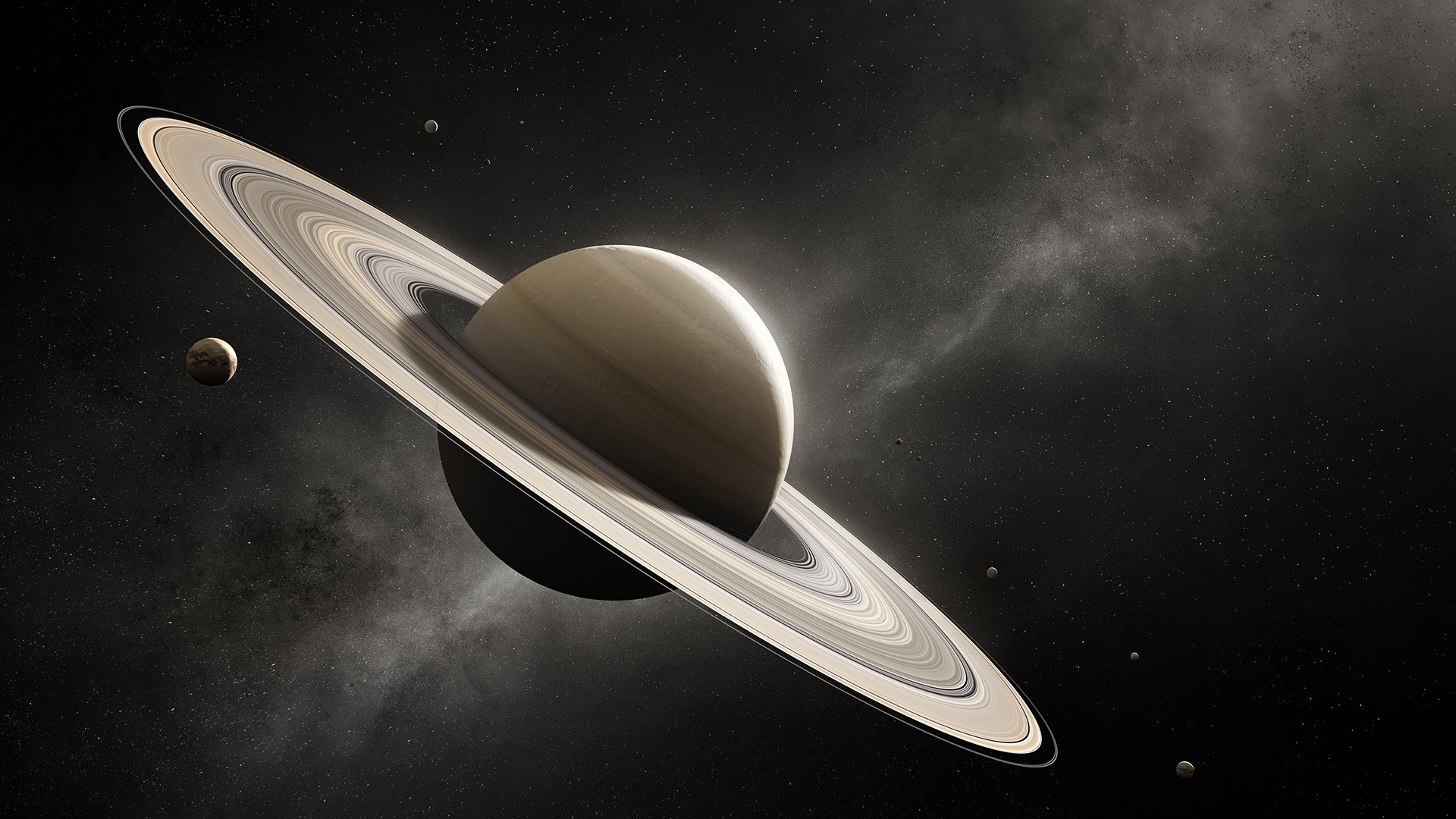
Saturn exhibits a pronounced axial tilt of approximately 26.73 degrees, closely mirroring Earth's 23.5-degree obliquity. Because of this tilt, Saturn experiences distinct seasonal variations, though each individual season lasts over seven Earth years due to its long orbital period.
Pronounced inclination driving hemispheric solar heating variations.
Length of each individual season across Saturn's great year.
Season Sync
Axial Mapping. Analyzing the 26.7° / Orbit constant. New Horizons monitors the Inclination Buffer to track seasonal atmospheric shifts and ring orientation.
- ☀️ Obliquity: 26.7° Axial Inclination Sync.
- 📅 Duration: 7-Year Seasonal Cycle Buffer.
- 🪐 Rings: Periodic Edge-on Equinox Protocol.
Tilt Sync
Energy Mapping. Analyzing the 26.7° / Insolation constant. New Horizons monitors the Axial Buffer to track the distribution of solar energy across Saturn's hemispheres.
- 📐 Obliquity: 26.7° Axial Inclination Sync.
- 🌡️ Thermal: Hemispheric Heat Horizons Buffer.
- 🗓️ Cycles: Seven-Year Seasonal Progression.
Duration Sync
Temporal Mapping. Analyzing the 29.5-Year / 4-Quadrant constant. New Horizons monitors the 7.4-Year Buffer to track the long-term evolution of Saturn's climate.
- 📅 Segment: 7.4-Year Seasonal Intensity Sync.
- ❄️ Extreme: Decadal Winter Cooling Buffer.
- 🔄 Orbit: 10,759-Day Revolution Protocol.
Equinox Sync
Planar Mapping. Analyzing the 0° Tilt / Thickness constant. New Horizons monitors the Vanishing Buffer to track the 15-year cycle of ring visibility.
- 📏 Edge-On: 10-Meter Thickness Calibration.
- 👻 Spokes: Low-Angle Dust Feature Sync.
- 🌑 Shadows: Vertical Relief Observation Buffer.
PLANETARY DYNAMICS / ORBITAL OBLIQUITY
The Extreme Axial Obliquity of Saturn
Saturn’s rotation axis is tilted at an angle of roughly 26.73° relative to its orbital plane around the Sun. This axial obliquity is remarkably similar to Earth's 23.44° tilt, meaning the ringed gas giant experiences well-defined, albeit drastically extended, seasonal variations. As Saturn slowly traces its immense 29.4-year orbit, different hemispheres tilt toward or away from the Sun, shifting sunlight distribution across its broad disc and altering atmospheric circulation patterns over multi-year cycles.
PLANETARY DYNAMICS / RING PLANE GEOMETRY
Ring Plane Geometry and Equinox Transitions
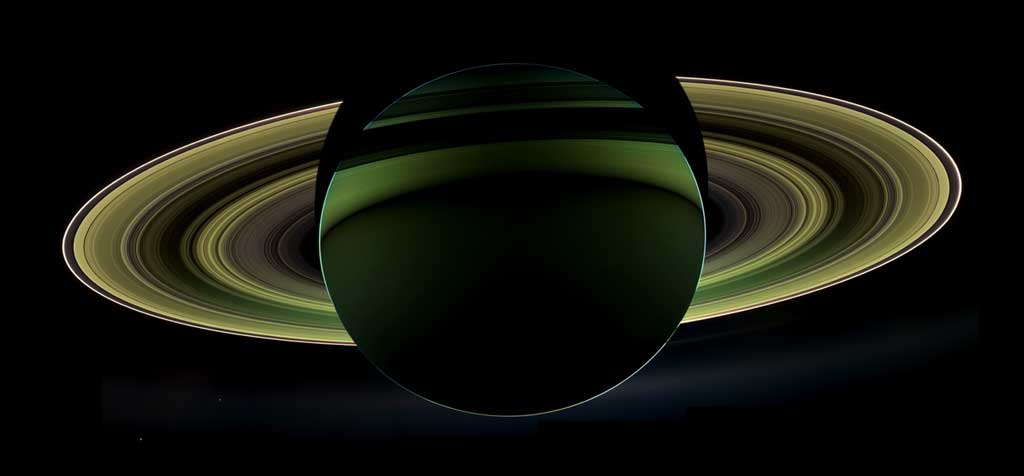
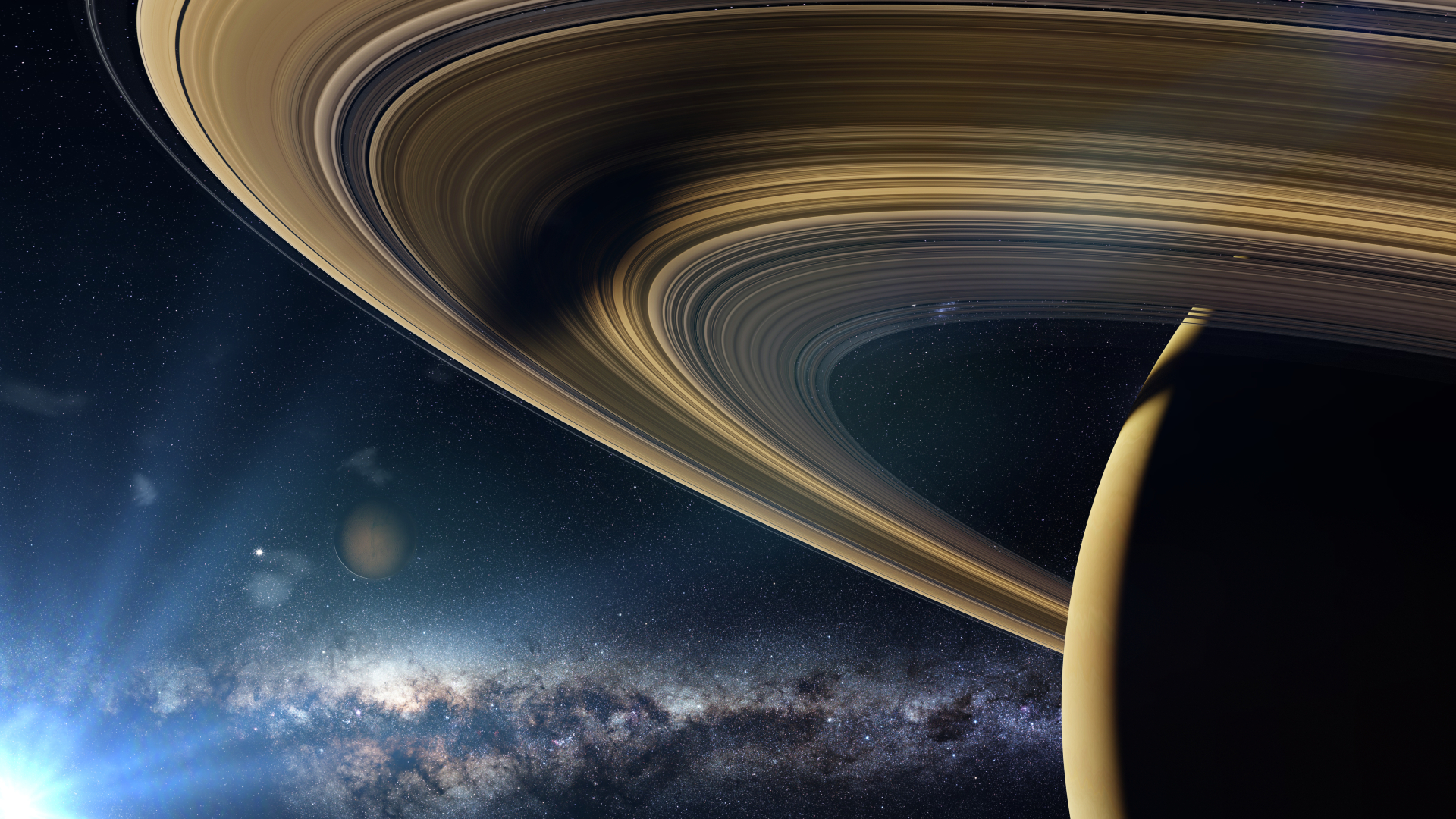
Saturn's extensive ring system is bound to its equatorial plane, meaning the rings tilt in tandem with the planet's $26.73^\circ$ obliquity. As Saturn orbits the Sun, the apparent opening angle of the rings shifts dramatically from a maximum tilt of nearly $27^\circ$ down to a razor-thin, edge-on profile every 14.7 years. During these equinox transitions, the rings cast narrow, linear shadows directly across the planetary equator, profoundly altering the solar insolation balance and cooling the upper atmosphere.
PLANETARY DYNAMICS / SEASONAL STORMS
Hemispheric Asymmetries and Great Storm Dynamics
Saturn's extended axial tilt and nearly 30-year orbital period drive dramatic seasonal asymmetries between the northern and southern hemispheres. As one hemisphere experiences long, sunlit summers while the other plunges into cryogenic winter darkness, deep convective instabilities build up within the atmosphere. These seasonal temperature gradients occasionally rupture in spectacular fashion, erupting into colossal periodic disturbances known as Great White Spots—massive convective thunderstorms that encircle the entire planet and alter global stratospheric circulation for years.
Sources
AXIAL INCLINATION
Saturn is tilted at **26.73°** relative to its orbit. This is very close to Earth's 23.5°, resulting in familiar seasonal patterns, just on a much longer timescale.
OBLIQUITY DATARING EQUINOX
During the equinox, the Sun shines edge-on to the rings. They virtually "disappear" from Earth's view and cast long, dramatic shadows across the planet.
RING PHENOMENASOLAR RADIANCE
Each pole experiences 15 years of continuous sunlight followed by 15 years of darkness. This drives massive seasonal storms and color changes in the atmosphere.
SEASONAL CYCLES
Saturn Seasonal Tilt & Axial Dynamics FAQs
Examining the axial tilt, multi-year seasonal shifts, ring shadow effects, and atmospheric changes across the ringed planet Saturn
Saturn has an axial tilt of approximately 26.7 degrees, which is very similar to Earth's 23.5-degree tilt, creating pronounced seasonal cycles as the planet orbits the Sun.
Because Saturn takes roughly 29.4 Earth years to complete a single orbit around the Sun, each of its four distinct seasons lasts for more than seven Earth years.
The massive ring system casts expansive shadows across Saturn's hemispheres depending on the axial angle, blocking sunlight and altering regional temperatures throughout the long Saturnian year.
During an equinox, the Sun sits directly edge-on with Saturn's rings, causing the massive ring system to cast only a razor-thin shadow across the planet's equator.
Observations from spacecraft show that Saturn's hemispheres shift in hue—such as changing from bluish tones to golden hazes—as ultraviolet sunlight interacts with atmospheric gases during seasonal transitions.
At solstice, one hemisphere is tilted maximally toward the Sun while the other is tilted away, resulting in multi-year periods of continuous sunlight or prolonged shadowed darkness at the poles.
Solar heating variations driven by the tilt trigger massive convective disturbances, leading to planetary-scale storms like the periodic Great White Spot outbursts that wrap entirely around the planet.
Recent gravitational models indicate that Saturn's tilt is maintained and slowly increasing due to gravitational interactions and orbital resonances with its migrating moons, particularly Titan.
Through telescopes over a 15-year span, viewers see Saturn's ring system transition from maximum open tilt—showing the top or bottom face clearly—to completely disappearing edge-on views during equinoxes.
Yes, moons like Titan orbit within the same plane and share Saturn's 26.7-degree tilt, driving massive seasonal weather shifts such as the migration of methane storm clouds between northern and southern hemispheres.
- Horizon -

Saturn

Ring Particle Collision

Thickness / Scale Ratio

Shepherd Moon Gravity
Roche Limit Calc

Dust to Ice Ratio
Ring Orbital Speed

Hexagon Wind Speed

Saturn's Density

Helium Rain Energy

Diamond Rain Energy

Supersonic Jet Streams

Methane Rain Ratio

Human Flight on Titan

Hydrocarbon Lake Depth

Titan Buoyancy

Gravity Well

Atmospheric Opacity

Enceladus Geyser Height

Light Travel Delay
Saturn Season Tilt
/https://tf-cmsv2-smithsonianmag-media.s3.amazonaws.com/filer_public/ca/b0/cab0042a-70c0-4d60-a94a-20474eb1885b/gettyimages-560665807.jpg)
3D Model of Saturn