Helium Rain
PLANETARY LAB: HELIUM RAIN ON SATURN
PHASE SEPARATION, INTERIOR HEAT & METALLIC HYDROGEN DYNAMICS
The Helium Rain Phenomenon
Deep within Saturn's interior, extreme pressures and temperatures cause liquid hydrogen and helium to phase-separate. Helium droplets condense out of the liquid hydrogen mixture and rain downward toward the planet's core, releasing gravitational potential energy.
Heavy helium droplets precipitating through metallic hydrogen layers.
Explains why Saturn radiates significantly more heat than it absorbs.
Helium Sync
Thermodynamic Mapping. Analyzing the 2.5x thermal excess constant. New Horizons monitors the Gravitational Buffer to track helium droplet descent energy.
- 🌧️ Process: Helium Phase Separation.
- ⚡ Energy: Gravitational Potential to Heat.
- 🌡️ Result: 2.5x Solar Radiance Sync.
Thermal Sync
Gravitational Mapping. Analyzing the 2.5x thermal radiance constant. New Horizons monitors the Potential Energy Buffer to track the helium precipitation heat.
- 🌧️ Mechanism: Helium Droplet Descent.
- ⚡ Energy: Potential to Thermal Sync.
- 🌡️ Anomaly: Internal Heat Source Lock.
Radiance Sync
Thermal Output Mapping. Analyzing the 2.5x energy surplus constant. New Horizons monitors the Infrared Buffer to track internal heat generation.
- 🌡️ Output: 2.5x Solar Intake.
- ⚙️ Engine: Helium Rain Precipitation.
- 🛰️ Detection: Infrared Signature Lock.
K-H Sync
Gravitational Compression Mapping. Analyzing the potential-to-kinetic energy constant. New Horizons monitors the Virial Buffer to track the heat generated by planetary contraction.
- 📉 Process: Slow Gravitational Contraction.
- 🔥 Conversion: Potential to Internal Heat.
- ⚖️ Law: The Virial Theorem Sync.
Neon Sync
Chemical Scavenging Mapping. Analyzing the 0.1x neon abundance constant. New Horizons monitors the Solubility Buffer to track noble gas transport to the core.
- 🧪 Element: Neon (Noble Gas Sync).
- 📉 Deficit: 90% Missing in Upper Atmosphere.
- 🚁 Carrier: Sinking Helium Droplets.
PLANETARY PHYSICS / HELIUM RAIN ON SATURN
THE METALLIC PHASE SEPARATION
Deep within Saturn's crushing interior, temperatures and pressures reach thresholds where helium is no longer soluble in liquid metallic hydrogen. This phase separation triggers a planetary-scale phenomenon: droplets of helium condensing and precipitating inward.

PLANETARY PHYSICS / INTERNAL HEAT DYNAMICS
THE PLANETARY POWER ENGINE
The continuous precipitation of helium droplets is not just a chemical oddity; it acts as a massive thermal engine. As heavy helium sinks toward the center, it releases gravitational potential energy, powering Saturn's internal heat source.

PLANETARY PHYSICS / ATMOSPHERIC IMPACTS
WEATHER PATTERNS & ASTROPHYSICAL LEGACY
The continuous drainage of helium from Saturn's upper atmosphere directly influences its meteorological systems, driving complex zonal jet streams and providing astrophysicists with a masterclass in planetary differentiation.


Helium Rain On Saturn FAQs
Uncovering the fascinating physics behind phase separation and helium droplets falling deep inside the gas giant
Helium rain is a unique atmospheric phenomenon where liquid helium droplets separate from hydrogen under extreme pressure and temperature, precipitating downward through Saturn's deep interior.
Deep within the planet, immense gravitational pressure compresses liquid hydrogen into a metallic state that cannot easily mix with helium, causing helium to form insoluble droplets that condense and fall.
As heavy helium droplets fall downward through lighter liquid hydrogen layers, gravitational potential energy is converted into kinetic energy and frictional heat, explaining why Saturn radiates more heat than it receives from the Sun.
Models suggest this phase separation occurs thousands of kilometers below the cloud tops, where pressures reach millions of atmospheres and temperatures soar to thousands of degrees.
Yes, but because Jupiter is warmer and more massive, helium rain occurs deeper and started later in its evolutionary timeline, whereas Saturn's cooler interior allowed this process to begin earlier.
For decades, scientists puzzled over why Saturn's upper atmosphere is depleted of helium compared to the Sun and Jupiter; helium rain explains that the helium is simply washing down into the core.
Data gathered by NASA's Cassini spacecraft during its dramatic Grand Finale orbits provided precise gravity measurements that confirmed models of Saturn's interior density and helium depletion.
It falls as liquid droplets rather than a gaseous storm, descending through a metallic liquid hydrogen ocean toward the planet's central core.
Yes, models indicate that helium rain is an ongoing planetary-scale process that has been steadily occurring inside Saturn for billions of years.
Key search phrases include: helium rain on Saturn, metallic hydrogen phase separation, Saturn internal heat source, and Cassini interior gravity measurements.
Sources
GRAVITATIONAL POTENTIAL
As helium droplets fall toward the core, they release gravitational potential energy which is converted into thermal energy via friction.
INTERNAL HEATIMMISCIBILITY
At temperatures below ~10,000 K and high pressure, H and He separate like oil and water. This is the "Immiscibility Gap."
METALLIC HYDROGENLUMINOSITY EXCESS
This process explains why Saturn is 2x brighter in the infrared than it should be. It generates more internal heat than Jupiter per unit mass.
PLANETARY Horizons- Horizon -

Saturn

Ring Particle Collision

Thickness / Scale Ratio

Shepherd Moon Gravity
Roche Limit Calc

Dust to Ice Ratio
Ring Orbital Speed

Hexagon Wind Speed

Saturn's Density

Helium Rain Energy

Diamond Rain Energy

Supersonic Jet Streams

Methane Rain Ratio

Human Flight on Titan

Hydrocarbon Lake Depth

Titan Buoyancy

Gravity Well

Atmospheric Opacity

Enceladus Geyser Height

Light Travel Delay
Saturn Season Tilt
/https://tf-cmsv2-smithsonianmag-media.s3.amazonaws.com/filer_public/ca/b0/cab0042a-70c0-4d60-a94a-20474eb1885b/gettyimages-560665807.jpg)
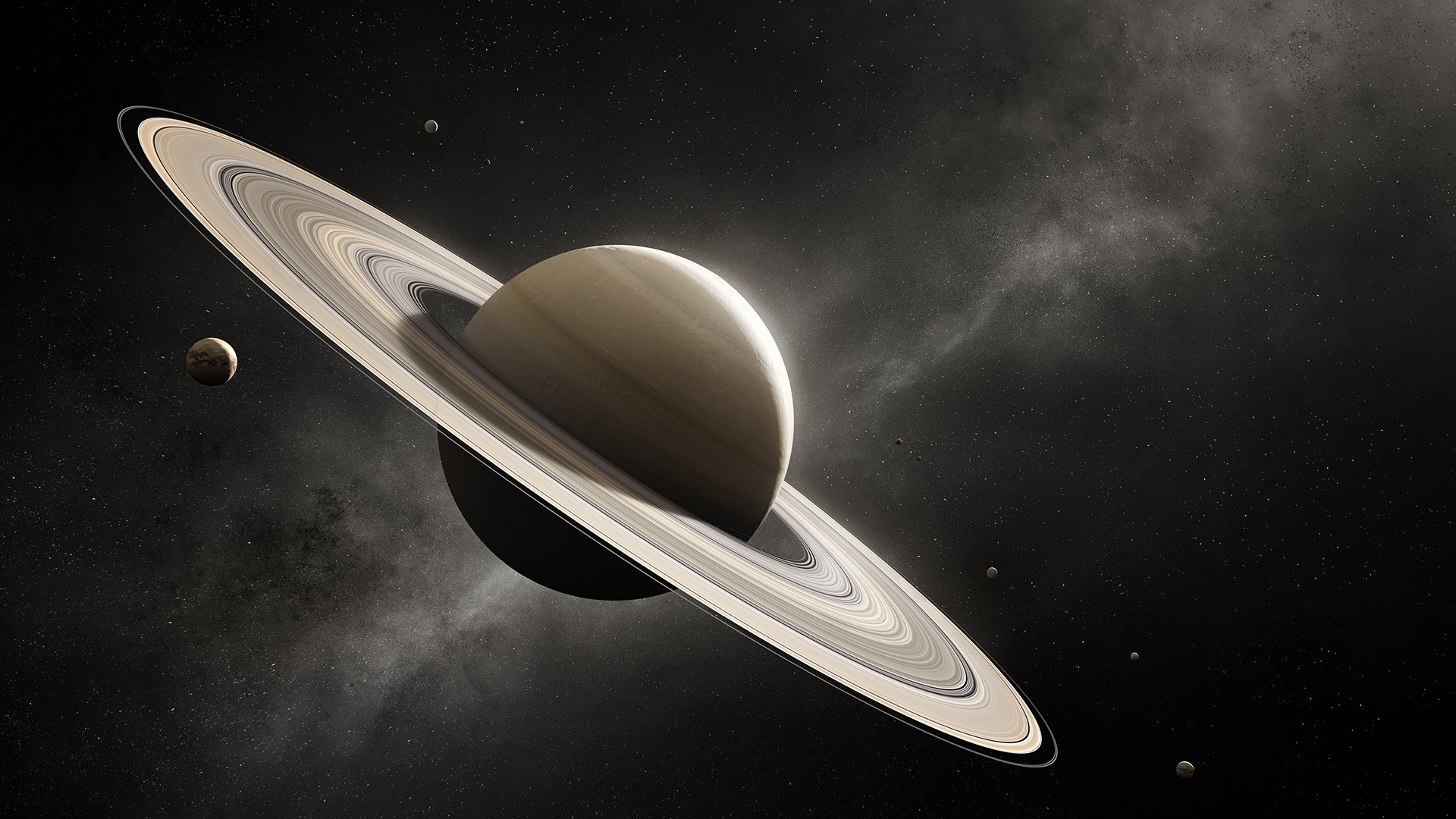
3D Model of Saturn