Light Travel Delay
PLANETARY LAB: SATURN LIGHT TRAVEL DELAY
ELECTROMAGNETIC PROPAGATION, TELEMETRY LATENCY & ORBITAL SEPARATION
Electromagnetic Propagation & Latency
Because light and radio waves travel at a finite speed ($c \approx 299,792\text{ km/s}$), communicating with spacecraft or observing optical events at Saturn involves a significant time delay. Depending on the relative positions of Earth and Saturn in their respective orbits, this delay spans anywhere from 67 to over 93 minutes.
Time required for solar radiation to reach Saturn's cloud tops.
Dynamic radio signal telemetry lag across synodic cycles.
Cosmic Delay
The Speed of Information. Light is the fastest thing in the universe, traveling at approximately 300,000 kilometers per second. Yet, across the vast expanses of the solar system, even light takes time to bridge the gaps.
Looking Into the Past: Because of this finite speed, when we observe Saturn or receive signals from probes like Cassini, we are not seeing them as they are right now, but as they were minutes ago.
- ⚡ Governed by the cosmic speed limit.
- 🔭 Every observation is a look back in time.
Average Distance
Over an Hour Away. Saturn orbits the Sun at an average distance of about 1.43 billion kilometers (roughly 9.5 astronomical units) from Earth.
The 80-Minute Mark: When you calculate the time it takes for electromagnetic waves to cross this average gulf, it comes out to approximately 79 to 84 minutes one-way.
- ⏱️ Average one-way delay of ~80 minutes.
- 🪐 ~1.43 billion km from Earth on average.
Closest Approach
Opposition Alignment. Because both Earth and Saturn orbit the Sun at different speeds, the distance between them constantly changes. When Earth passes directly between the Sun and Saturn (opposition), they are at their closest.
Shrinking the Gap: At this point, the distance drops to about 1.2 billion kilometers, reducing the light travel delay down to roughly 67 minutes.
- 📍 Minimum delay of ~67 minutes.
- 🌐 Occurs during yearly opposition cycles.
Maximum Separation
Solar Conjunction. Conversely, when Saturn is on the opposite side of the Sun from Earth, the two worlds reach their maximum possible separation.
The Longest Wait: At this stage, the distance stretches up to roughly 1.67 billion kilometers, pushing the light travel delay past the 90-minute mark—nearly an hour and a half each way.
- ☀️ Maximum delay exceeding 90 minutes.
- 🔭 Obscured partially by solar interference.
Deep Space Comms
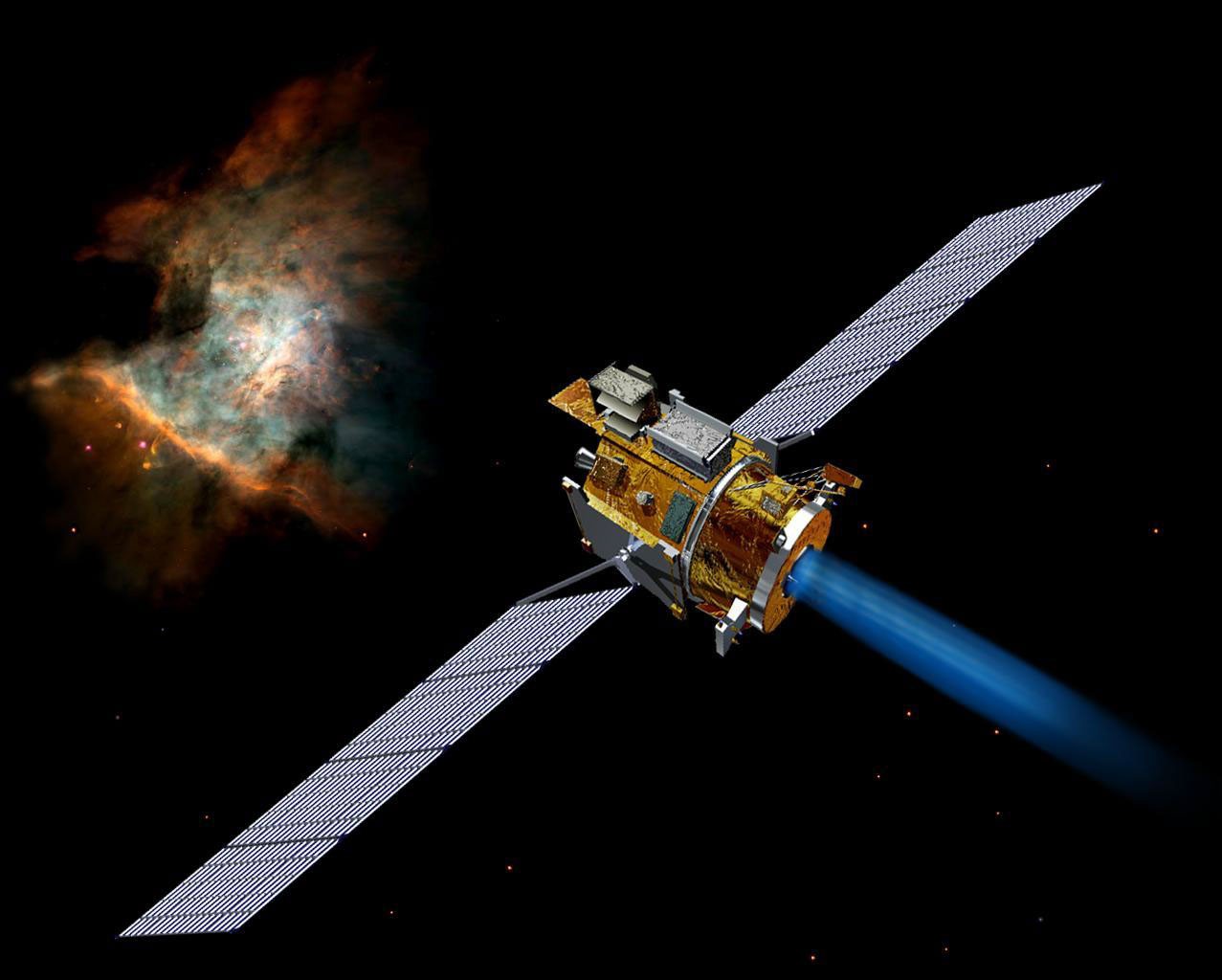
No Real-Time Control. The light travel delay means that robotic missions exploring Saturn—such as the historic Cassini orbiter or future probe concepts—cannot be driven via real-time remote control like a drone on Earth.
Autonomous Operations: Every command sent from mission control takes over an hour to arrive, and the confirmation response takes another hour. Spacecraft must execute complex maneuvers autonomously.
- 🛰️ Round-trip delay of nearly 3 hours.
- 🤖 Requires advanced spacecraft autonomy.
Cosmic Perspective
A Window to Outer Worlds. The light travel delay between Earth and Saturn serves as a constant reminder of the immense scale of our solar system and the absolute barrier imposed by the speed of light.
Patient Exploration: Whether studying planetary rings, cloud bands, or active cryovolcanic geysers, exploring the Saturnian system demands both technological precision and cosmic patience.
- 🌌 Highlights vast interplanetary distances.
- 📜 Bridges human curiosity with deep space.
INTERPLANETARY COMMUNICATIONS / SIGNAL LATENCY
The Finite Speed of Light Across the Saturnian Expanse
Communication and observation between Earth and the Saturnian system are fundamentally constrained by the finite speed of light. Because electromagnetic radiation travels through the vacuum of space at a constant velocity of approximately 299792 kilometers per second, telemetry signals, imaging data, and command sequences cannot transmit instantaneously. This creates a mandatory real-time delay that profoundly impacts deep space probe navigation, automated trajectory corrections, and human operational planning for missions venturing into the outer solar system.
INTERPLANETARY COMMUNICATIONS / ORBITAL DISTANCE LATENCY
Quantifying the Hourly Transmission Delay
Depending on the relative orbital positions of Earth and Saturn on opposite sides of the solar system, the distance between the two worlds varies from roughly 1.2 billion to over 1.6 billion kilometers. At this vast astronomical scale, light and radio transmissions require between 70 and 85 minutes to travel a one-way path. A complete round-trip command and response cycle takes nearly three hours, requiring deep space probes like Cassini to operate via highly autonomous onboard flight software rather than real-time ground control.
INTERPLANETARY COMMUNICATIONS / AUTONOMOUS NAVIGATION
Autonomous Probe Operation and Deep Space Telemetry
Because a nearly three-hour round-trip transmission latency prevents real-time teleoperation from Earth, robotic spacecraft visiting Saturn must rely entirely on sophisticated onboard autonomy. Flight systems execute scheduled routines, monitor thermal thresholds, and manage high-gain antenna pointing independently. Ground teams upload compressed instruction packets hours in advance, trusting fault-protection algorithms and redundant sensor arrays to safely navigate the complex ring planes and gravitational fields of the outer solar system without human intervention.
Sources
AVERAGE DURATION
On average, it takes light **79 minutes** to travel from Saturn to Earth. When astronomers "see" a storm on Saturn, it actually happened over an hour ago.
ORBITAL STATSVARIATION RANGE
The delay fluctuates based on the planets' positions. It can range from **66 minutes** (Opposition) to **93 minutes** (Conjunction).
DISTANCE DATAMISSION LATENCY
For the Cassini mission, commands took over an hour to arrive. Spacecraft must be autonomous because "real-time" remote control is impossible.
CASSINI OPERATIONS- Horizon -

Saturn

Ring Particle Collision

Thickness / Scale Ratio

Shepherd Moon Gravity
Roche Limit Calc

Dust to Ice Ratio
Ring Orbital Speed

Hexagon Wind Speed

Saturn's Density

Helium Rain Energy

Diamond Rain Energy

Supersonic Jet Streams

Methane Rain Ratio

Human Flight on Titan

Hydrocarbon Lake Depth

Titan Buoyancy

Gravity Well

Atmospheric Opacity

Enceladus Geyser Height

Light Travel Delay
Saturn Season Tilt

3D Model of Saturn