
Thickness / Scale Ratio
RING THICKNESS RATIO
VERTICAL PROFILE VS. HORIZONTAL SPAN
Pencil-Thin Proportions
While Saturn's main ring system spans an immense width of roughly 300,000 kilometers across, its vertical thickness is astonishingly small—averaging only about 10 meters in most primary sections (like the A and B rings).
To exact mathematical scale, the rings are vastly thinner and more uniform than a single sheet of paper.
Equivalent to the height of a multi-story building stretched across the distance from Earth to the Moon.
Scale Sync
Extreme Geometry Mapping. Analyzing the 28,000,000:1 aspect ratio of the icy ring plane. New Horizons monitors the Scale Constant to track the razor-thin vertical limit.
- 📏 Width: 282,000 km Radial Span.
- 📐 Thickness: 10m Average Vertical.
- 💎 Flatness: Flatter than any man-made object.
Ultra-Flat Sync
Dimensional Ratio Mapping. Analyzing the 280,000x paper-flatness constant of the ring disk. New Horizons monitors the Scaled Thickness to track the 10m vertical limit.
- 📄 Paper: 280,000x thicker than Rings.
- 📏 Ratio: 28,000,000 : 1 Aspect.
- 🛰️ Result: Near 2D Orbital Plane.
Ratio Sync
Aspect Ratio Mapping. Analyzing the 28.2 Million to 1 geometric constant. New Horizons monitors the Engineering Gap to track why no man-made object can achieve this flatness.
- 📐 Ratio: 28,200,000 : 1 Scale.
- 🏗️ Engineering: 6000x flatter than a Razor.
- 🚫 Limit: Beyond Human Manufacturing.
Myth Sync
Proportional Scalability Mapping. Analyzing why a vinyl record is 141,000x too thick to represent the rings. New Horizons monitors the Scaled Depth to track the 2D-limit.
- 💿 Vinyl: 200:1 Aspect Ratio.
- 🪐 Rings: 28,200,000:1 Aspect Ratio.
- 📏 Result: Most Extreme 2D Object in Space.
ASTROPHYSICS / GEOMETRIC SCALE
THE ULTIMATE THINNESS
Saturn's main rings stretch across roughly 282,000 kilometers of space, yet in most places they measure barely 10 meters thick. This staggering aspect ratio makes them proportionately thinner than a sheet of microscopic paper stretched across an entire continent.
ASTROPHYSICS / PARTICLE MECHANICS
MAINTAINING THE PLANE
Maintaining a thickness of only 10 meters across a structure spanning hundreds of thousands of kilometers requires a continuous physical balancing act. Inelastic collisions among icy boulders constantly bleed away vertical momentum, forcing the entire system into a flat, highly compressed disk.
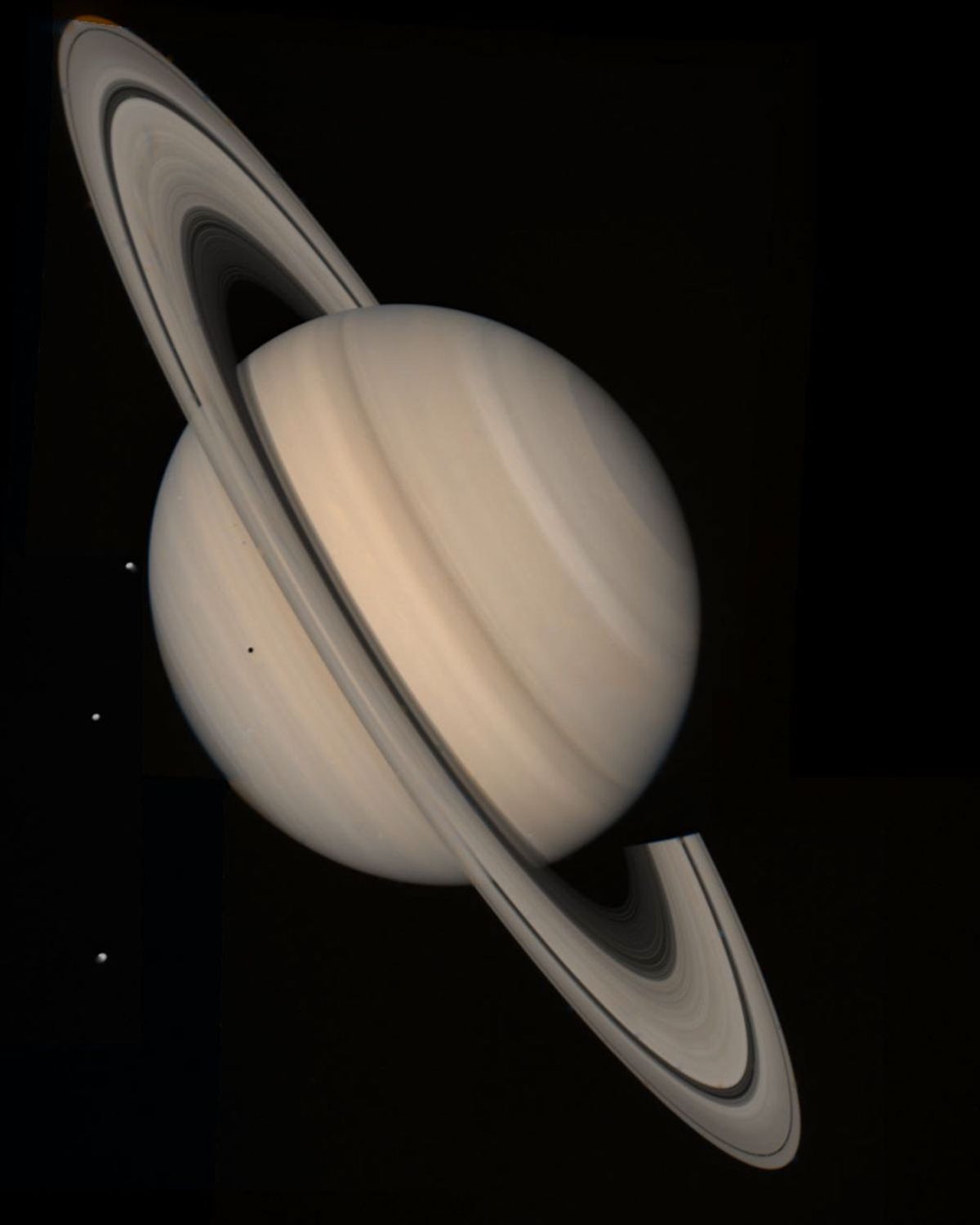
ASTROPHYSICS / VISUAL SCALING
SCALING THE IMPOSSIBLE
To truly comprehend Saturn's ring structure, scale it down: if the rings were compressed to the thickness of a standard piece of paper, their width would stretch across an entire continent. This extreme dimensional ratio highlights how delicate planetary ring systems truly are.
- Horizon -

Saturn

Ring Particle Collision

Thickness / Scale Ratio

Shepherd Moon Gravity
Roche Limit Calc

Dust to Ice Ratio

Ring Orbital Speed

Hexagon Wind Speed

Saturn's Density

Helium Rain Energy

Diamond Rain Energy

Supersonic Jet Streams

Methane Rain Ratio

Human Flight on Titan

Hydrocarbon Lake Depth

Titan Buoyancy

Gravity Well

Atmospheric Opacity

Enceladus Geyser Height

Light Travel Delay
Saturn Season Tilt
/https://tf-cmsv2-smithsonianmag-media.s3.amazonaws.com/filer_public/ca/b0/cab0042a-70c0-4d60-a94a-20474eb1885b/gettyimages-560665807.jpg)
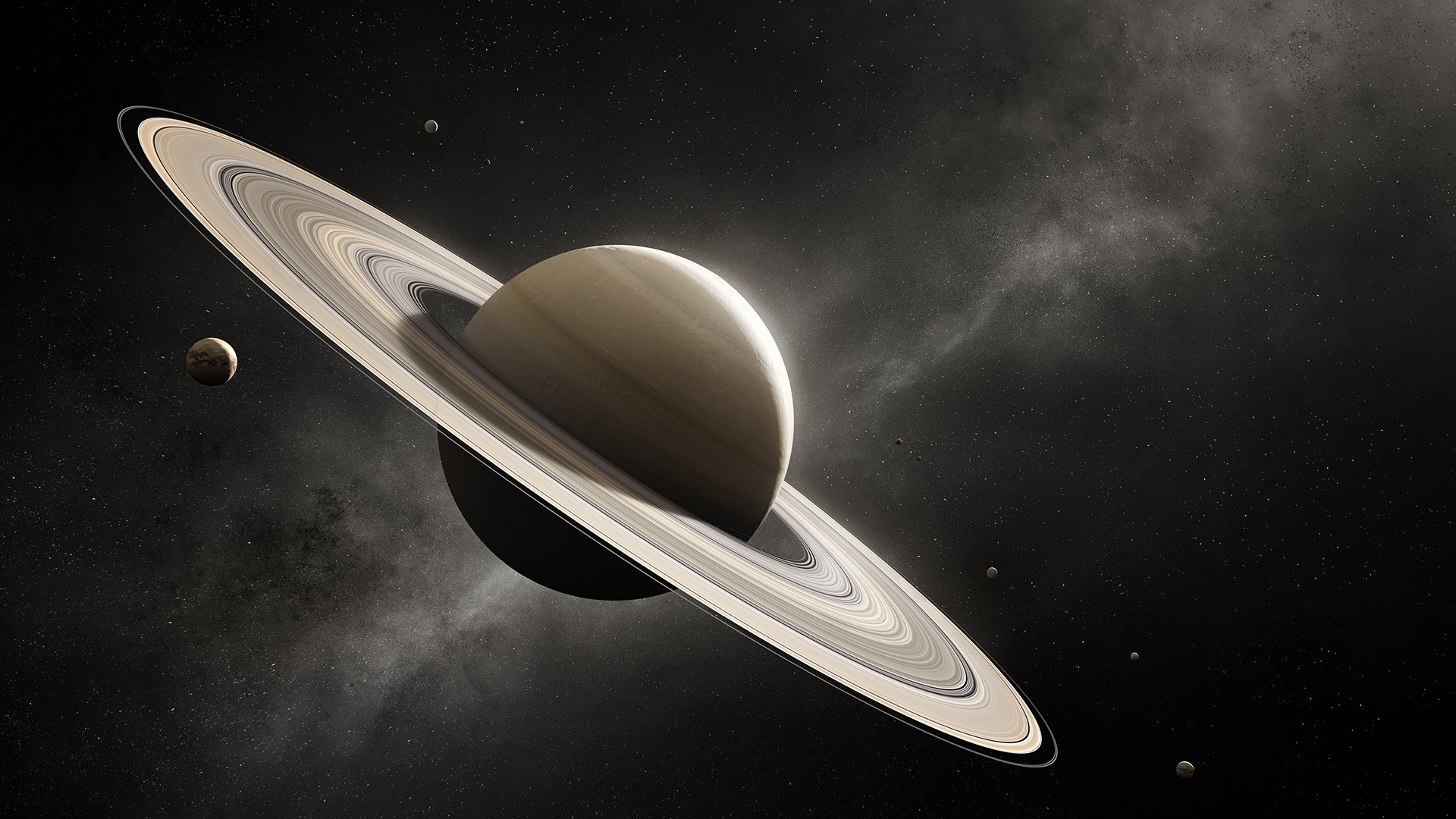
3D Model of Saturn
Saturn Mysteries

Saturn Ring Thickness & Scale FAQs
Understanding the astonishingly thin geometry of Saturn's ring system
Despite spanning hundreds of thousands of kilometers across, Saturn's main rings are remarkably thin, averaging only about 10 meters in thickness.
The scale ratio is extreme: if the main ring system were scaled down to the thickness of a single sheet of paper, it would stretch out wider than several football fields.
Gravitational interactions, particle collisions, and Saturn's massive equatorial pull force the ring particles to continuously flatten into a narrow disk.
No. When Saturn's ring plane aligns edge-on with Earth, the rings practically disappear from view because they are so remarkably thin.
No, while the main rings are paper-thin, some vertical structures and wave disturbances created by embedded moonlets can cause particles to rise up to several hundred meters high.
Sources
DIMENSIONAL GAP
The main rings span **282,000 km** in diameter, yet they are only about **10 to 100 meters** thick. This makes them "flatter" than a sheet of paper.
RING DIMENSIONSMACRO ANALOGY
If you built a scale model of the rings the size of a city (30 km wide), the rings would be thinner than a single strand of human hair.
SCALE COMPARISONDYNAMICS OF FLATNESS
This ratio is maintained by inelastic collisions that cancel out vertical motion, forcing particles into a hyper-thin mid-plane.
FLUID DYNAMICS