Density Of Saturn
PLANETARY LAB: SATURN DENSITY
HYDROGEN ENVELOPES & THE FAMOUS LESS-THAN-WATER METRIC
Saturn's Low Mean Density
Saturn has a mean density of approximately 0.69 g/cm³, making it the least dense planet in our solar system. Because its density is lower than 1.0 g/cm³ (the density of liquid water), a hypothetical ocean large enough would allow Saturn to float.
The lowest mass-to-volume ratio of any body in the solar system.
The classic theoretical benchmark for floating gas giants.
Density Sync
Buoyancy Mapping. Analyzing the 0.687 g/cm³ constant. New Horizons monitors the Volumetric Buffer to track Saturn's unique ability to float in water.
- 🧊 Value: 0.687 g/cm³ (Lower than water).
- 🎈 Composition: 96% Hydrogen / 3% Helium.
- ⚖️ Result: Positive Buoyancy Sync.
Buoyancy Sync
Hydrological Mapping. Analyzing the 0.687 g/cm³ constant. New Horizons monitors the Density Buffer to track Saturn's unique "floating" status relative to water.
- 🌊 Reference: Water (1.0 g/cm³).
- 🎈 Property: 0.69 Density Ratio.
- ⚖️ Status: Geometrically Buoyant.
Density Sync
Atmospheric Mass Mapping. Analyzing the 0.687 g/cm³ constant. New Horizons monitors the Volumetric Buffer to track the hydrogen-helium dilution ratio.
- ☁️ Primary: 96% Hydrogen Sync.
- ⚖️ Density: 0.687 g/cm³ (Ultra-Low).
- 💎 Core: Dense Metallic Hydrogen.
Density Contrast
Comparative Mapping. Analyzing the 8:1 density ratio constant. New Horizons monitors the Composition Buffer to track the Rocky vs. Gaseous planetary sync.
- 💎 Earth: 5.51 g/cm³ (High Density).
- ☁️ Saturn: 0.69 g/cm³ (Low Density).
- ⚖️ Ratio: Earth is ~8x Denser.
760 Rule Sync
Volumetric Mapping. Analyzing the 760:1 fit constant. New Horizons monitors the Density Deficit to track the mass-to-volume ratio gap.
- 📦 Volume: 760 Earths (Capacity).
- ⚖️ Mass: 95 Earths (Weight).
- ☁️ Nature: Low-Density Gas Sync.
PLANETARY PHYSICS / DENSITY OF SATURN
THE GAS GIANT PARADOX
Saturn holds a famous and counterintuitive distinction in astrophysics: despite being a massive gas giant containing immense gravitational power, its overall density is less than that of liquid water.

PLANETARY PHYSICS / INTERIOR STRUCTURE
METALLIC HYDROGEN CORE
While Saturn's upper cloud decks are extraordinarily fluffy, plunging toward the planet's center reveals extreme thermodynamic pressures that compress hydrogen into an exotic liquid metallic state surrounding a rocky core.

PLANETARY PHYSICS / GRAVITATIONAL FIELDS
PROBING THE DEEP INTERIOR
By tracking subtle Doppler shifts in spacecraft radio signals during close orbital passes, planetary scientists mapped Saturn's gravitational field with exquisite precision, unlocking new insights into core dilution and planetary evolution.


Density Of Saturn FAQs
Exploring the unique mass, volume, and low-density characteristics of the ringed gas giant
Saturn has an average density of approximately 0.687 g/cm³ (or 687 kg/m³), making it the least dense planet in our solar system.
Yes! Liquid water has a density of 1.0 g/cm³. Because Saturn's mean density is only 0.687 g/cm³, Saturn would theoretically float if placed in a vast enough ocean of water.
Saturn is composed primarily of light volatile gases—roughly 96% hydrogen and 3% helium—with a huge extended atmosphere that inflates its total volume relative to its mass.
Earth is the densest planet in the solar system at about 5.51 g/cm³, meaning Saturn's average density is only about 12.5% (one-eighth) of Earth's density.
Yes, 0.687 g/cm³ is only an overall average. Its upper cloud layers are extremely light and diffuse, while its deep interior core compressed under immense pressure is estimated to be much denser.
Jupiter has an average density of 1.33 g/cm³, which is nearly double that of Saturn. Jupiter's superior gravity compresses its interior gases into much denser states.
Density is determined by dividing total mass by total volume ($\rho = \frac{M}{V}$). Saturn's mass ($5.68 \times 10^{26}\text{ kg}$) was calculated from lunar and spacecraft gravity measurements, divided by its volume ($8.27 \times 10^{14}\text{ km}^3$).
Because of its low fluid density and rapid rotational period (~10.7 hours), outward centrifugal force causes Saturn to bulge noticeably at its equator and flatten at its poles, making it the most oblate planet in the solar system.
Internal heat generated by slow gravitational compression and helium precipitation keeps gases expanded, preventing the upper gas layers from collapsing into a smaller, denser volume.
Descending into Saturn's atmosphere causes density and pressure to rise rapidly, smoothly transitioning gas into liquid hydrogen and eventually dense metallic hydrogen surrounding a rocky/icy core.
Sources
SPECIFIC GRAVITY
Saturn's mean density is **0.687 g/cm³**. Since pure water is **1.0 g/cm³**, Saturn would float in a sufficiently large ocean.
PLANETARY STATSCOMPOSITION RATIO
Over 96% of the planet's volume is Hydrogen. The low density is a result of these light elements being held in a gaseous/liquid state.
ELEMENTAL DATARADIAL GRADIENT
While the atmosphere is very thin, the core is likely very dense (solid rock/metal). The *average* is pulled down by the massive gas envelope.
INTERNAL STRUCTURE- Horizon -

Saturn

Ring Particle Collision

Thickness / Scale Ratio

Shepherd Moon Gravity
Roche Limit Calc

Dust to Ice Ratio
Ring Orbital Speed

Hexagon Wind Speed

Saturn's Density

Helium Rain Energy

Diamond Rain Energy

Supersonic Jet Streams

Methane Rain Ratio

Human Flight on Titan

Hydrocarbon Lake Depth

Titan Buoyancy

Gravity Well

Atmospheric Opacity

Enceladus Geyser Height

Light Travel Delay
Saturn Season Tilt
/https://tf-cmsv2-smithsonianmag-media.s3.amazonaws.com/filer_public/ca/b0/cab0042a-70c0-4d60-a94a-20474eb1885b/gettyimages-560665807.jpg)
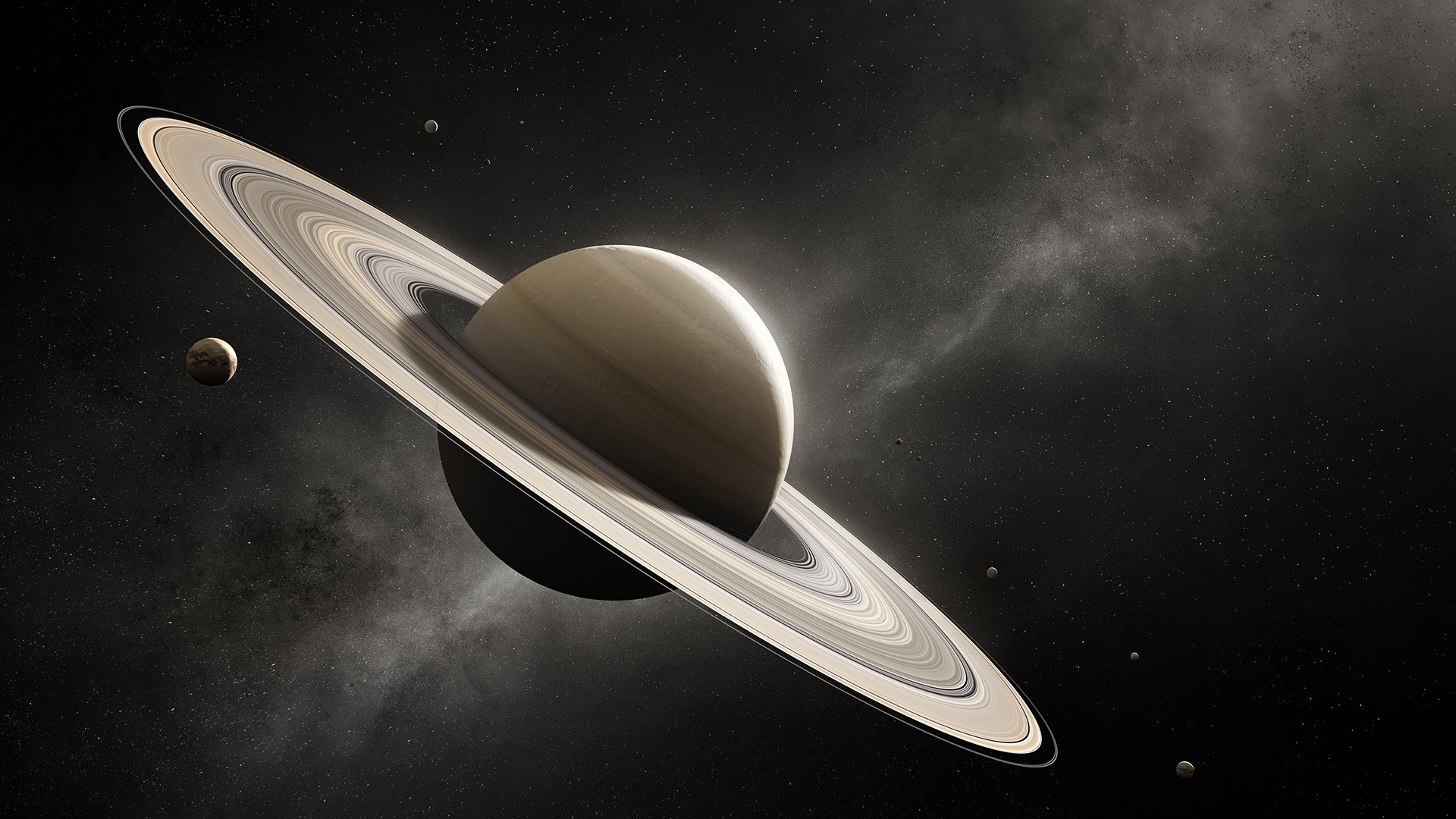
3D Model of Saturn