
Saturn Collision
SATURN COLLISIONS
ORBITAL IMPACT DYNAMICS & HISTORY
The Titan-Moon Merger
Recent astronomical models propose that Saturn's system was shaped by major impacts. A prime hypothesis suggests an ancient moon ("Chrysalis" or a proto-satellite) collided and merged with Titan roughly 400 million years ago, wiping clean Titan's ancient craters and triggering secondary chain reactions.
Past lunar disruptions cascaded inward, shattering ice-rich bodies to construct the modern ring structure.
No major catastrophic body collisions with Saturn itself are predicted in the foreseeable cosmic timeline.
Collision Sync
Ring Flattening Mapping. Analyzing the low-velocity energy loss between icy ring fragments. New Horizons monitors the Damping Constant to track the 10-meter thickness limit.
- 📉 Damping: Energy Loss via Inelastic Impact.
- 📏 Scale: Thickness Reduced to < 10m.
- ❄️ Material: 99.9% Pure Water Ice.
Gentle Sync
Velocity Match Mapping. Analyzing the cm/s interaction constant that prevents orbital puffing. New Horizons monitors the Damping Ratio to track the 10-meter vertical limit.
- 🐌 Velocity: 1-10 cm/s Relative Speed.
- 📉 Impact: Low-Energy Kinetic Damping.
- 📏 Result: Razor-Thin Orbital Disk.
Strike Sync
Hypervelocity Impact Mapping. Analyzing the 50 km/s kinetic constant that vaporizes ring ice into plasma. New Horizons monitors the Strike Ratio to track electrostatic spoke formation.
- 🌠 Velocity: 20-50 km/s External Entry.
- ⚡ Plasma: Instant Ice Vaporization.
- 🌌 Spokes: Electromagnetic Dust Lift.
Stir Sync
Gravitational Wave Mapping. Analyzing the 2 km vertical displacement stirred by shepherd satellites. New Horizons monitors the Tidal Force to track ring edge perturbations.
- 🌊 Verticals: 2km High Ice Waves.
- 🌙 Shepherd: Daphnis / Keeler Gap.
- 📐 Result: 3D Ring Topology.
ASTROPHYSICS / PLANETARY DYNAMICS
THE COSMIC WRECKING BALL
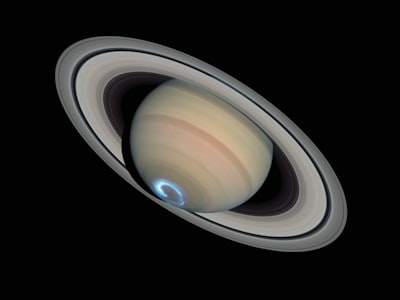
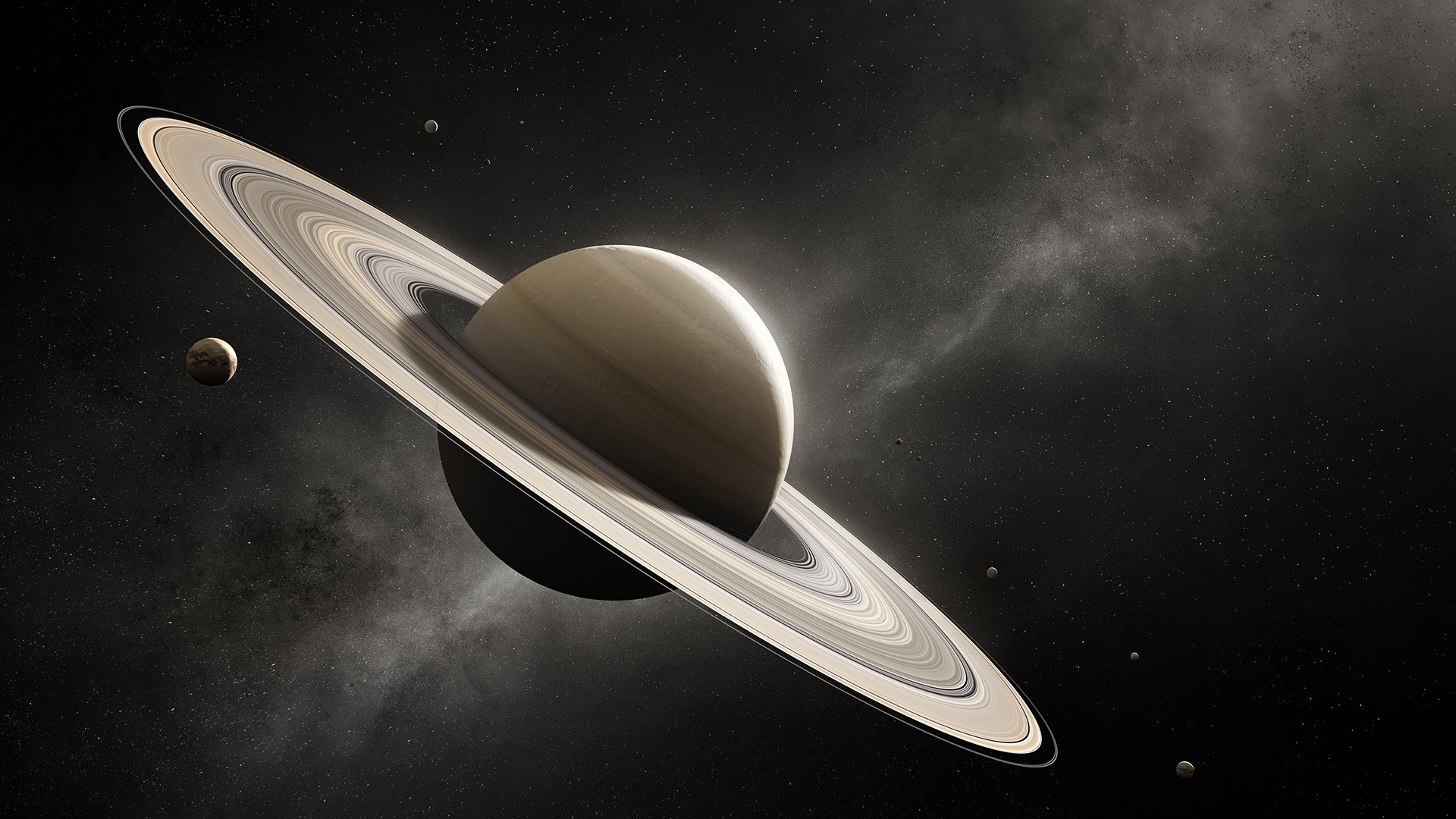
Long before Saturn sported its iconic, pristine rings, its orbital neighborhood was a chaotic shooting gallery. Planetary collision models suggest that giant impacts and the tidal destruction of ancient icy moons are the primary mechanisms behind the birth of ring systems.

ASTROPHYSICS / ORBITAL DEBRIS
THE DEBRIS DISK DYNAMICS
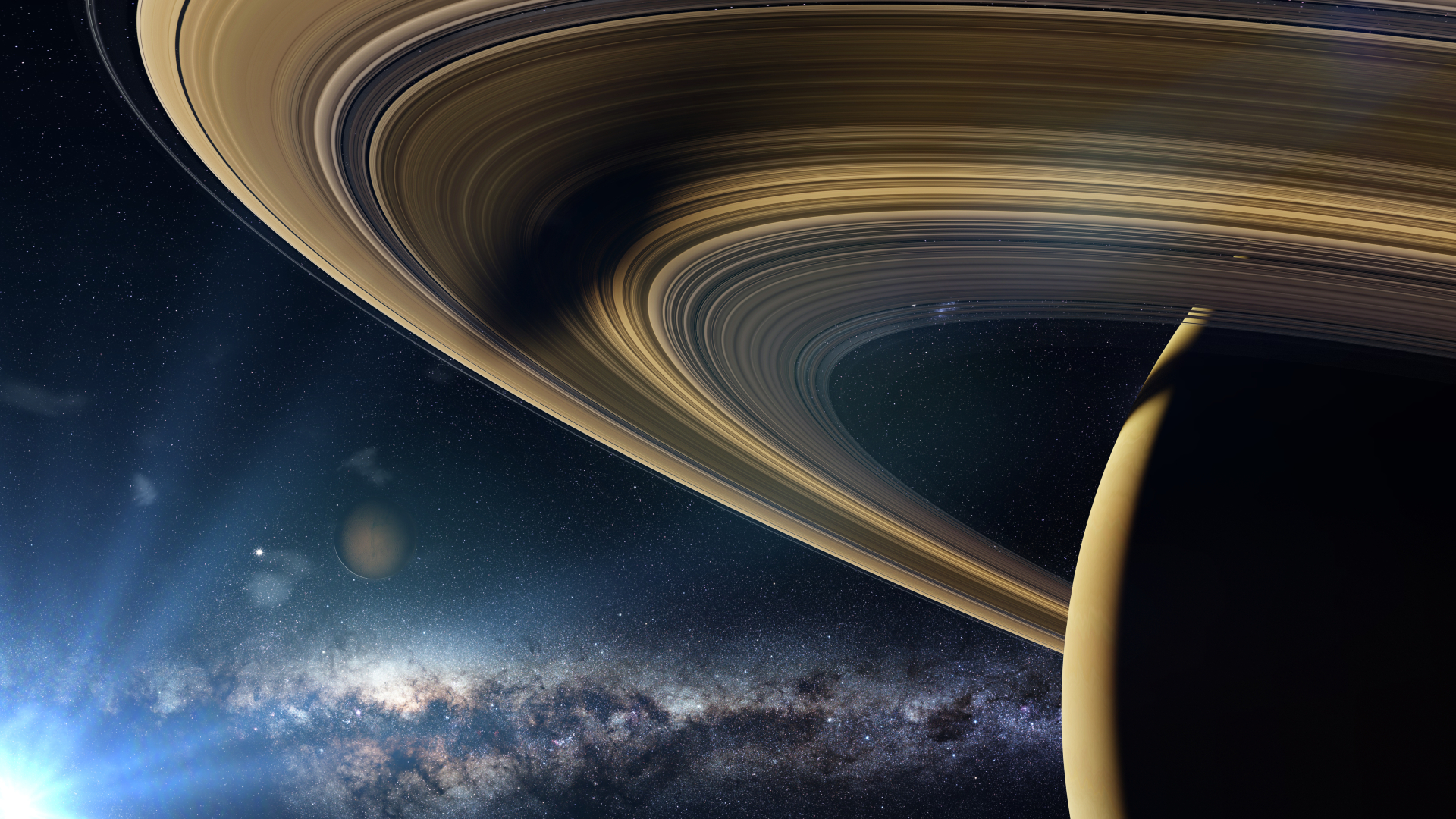
Following a major collisional disruption within Saturn's gravitational sphere, the shattered remnants of ice and rock entered a violent sorting process. Over millions of years, endless particle collisions ground the boulders down, flattening them into the razor-thin plane we call the rings.
ASTROPHYSICS / PLANETARY EVOLUTION
THE VANISHING RINGS
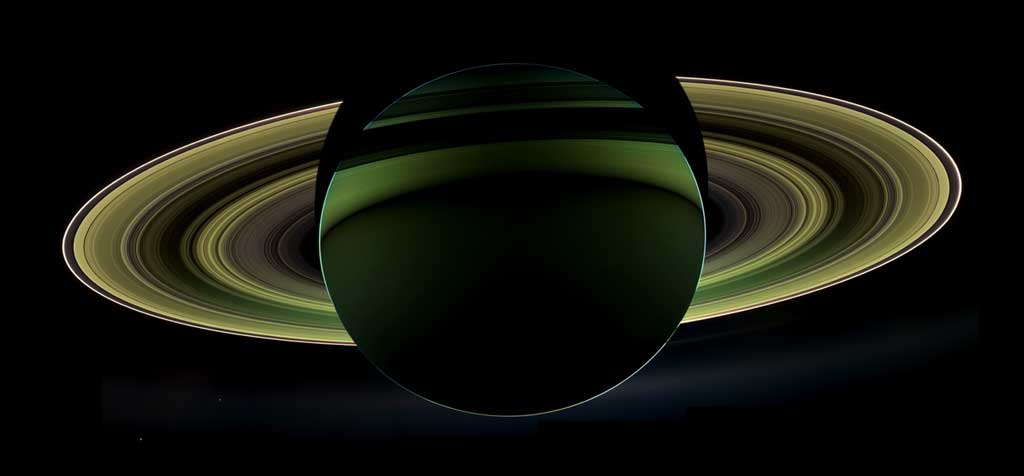
The collision and disruption events that created Saturn's rings also set their expiration date. Pulled inward by gravity and ionized by solar radiation, the icy particles are constantly draining away, meaning future astronomers millions of years from now will see a completely ringless Saturn.

- Horizon -

Saturn

Ring Particle Collision

Thickness / Scale Ratio

Shepherd Moon Gravity
Roche Limit Calc

Dust to Ice Ratio
Ring Orbital Speed

Hexagon Wind Speed

Saturn's Density

Helium Rain Energy

Diamond Rain Energy

Supersonic Jet Streams

Methane Rain Ratio

Human Flight on Titan

Hydrocarbon Lake Depth
Titan Buoyancy

Gravity Well

Atmospheric Opacity

Enceladus Geyser Height

Light Travel Delay
Saturn Season Tilt
/https://tf-cmsv2-smithsonianmag-media.s3.amazonaws.com/filer_public/ca/b0/cab0042a-70c0-4d60-a94a-20474eb1885b/gettyimages-560665807.jpg)
3D Model of Saturn
Saturn Mysteries
Sources
VELOCITY REGIME
Collisions are "gentle," occurring at speeds of only **mm/s to cm/s**. This is because all particles orbit in the same direction.
RING DYNAMICSRESTITUTION
Collisions are inelastic. The Coefficient of Restitution (e) for icy particles determines how much energy is lost as heat.
IMPACT PHYSICSFLATTENING EFFECT
Every time particles collide, they lose vertical momentum. Over time, this "damps" the ring into a perfectly flat plane.
GEOMETRIC MATH
Saturn Collisions & Impacts FAQs
Exploring cosmic collisions, ring impacts, and future threats to the ringed giant
Yes, like all gas giants, Saturn's massive gravity frequently attracts passing comets and asteroids, resulting in hidden impacts deep within its atmosphere.
Micrometeoroids constantly collide with Saturn's icy rings, vaporizing ice, kicking up dust plumes, and creating ripples observed by probes like Cassini.
No, the orbits of the planets in our solar system are stable. There is zero risk of Saturn colliding with Jupiter or any other planet in the foreseeable future.
Yes! On September 15, 2017, NASA intentionally plunged Cassini into Saturn's atmosphere to burn up, preventing any accidental contamination of its moons.
Many scientists believe Saturn's rings formed when an ancient icy moon or a passing comet got too close and was torn apart by tidal forces.