
Saturn
SATURN SYSTEM
RINGED GAS GIANT DYNAMICS
The Jewel of the Solar System
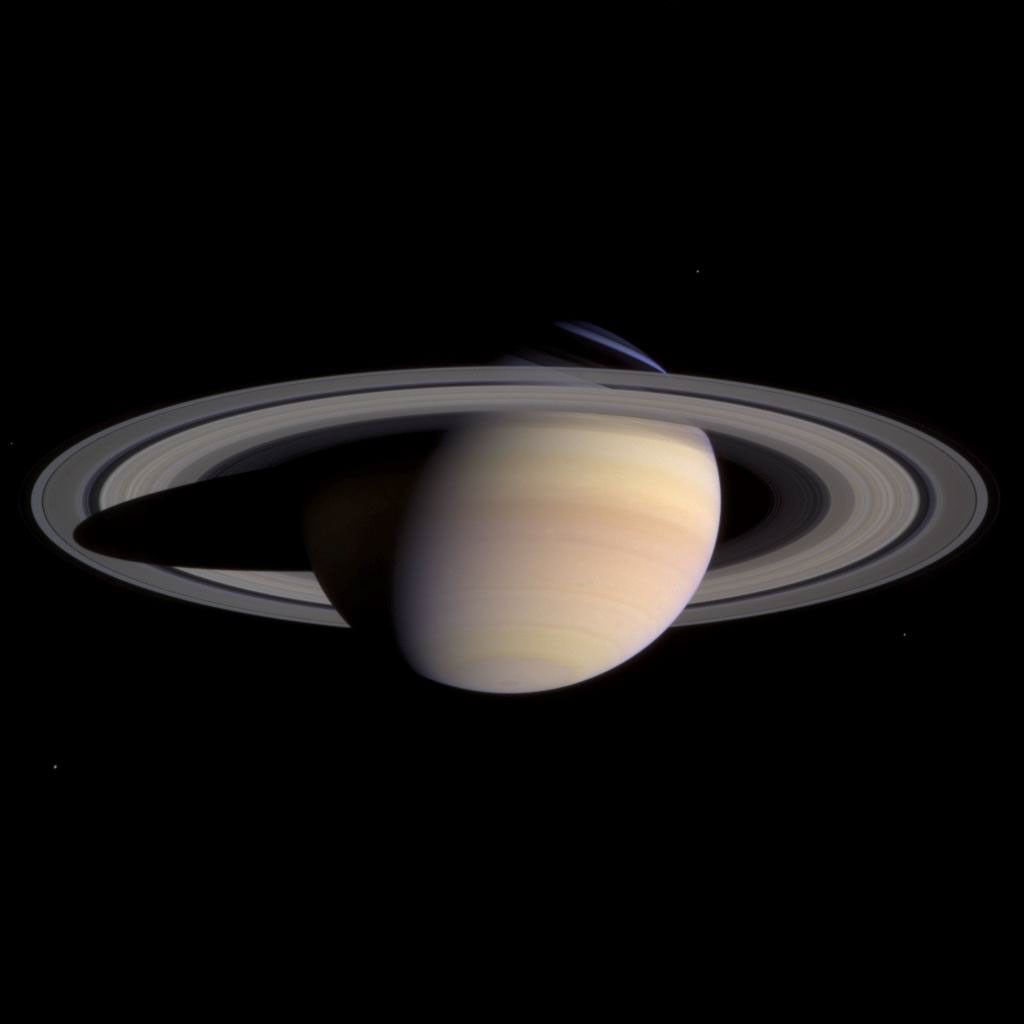
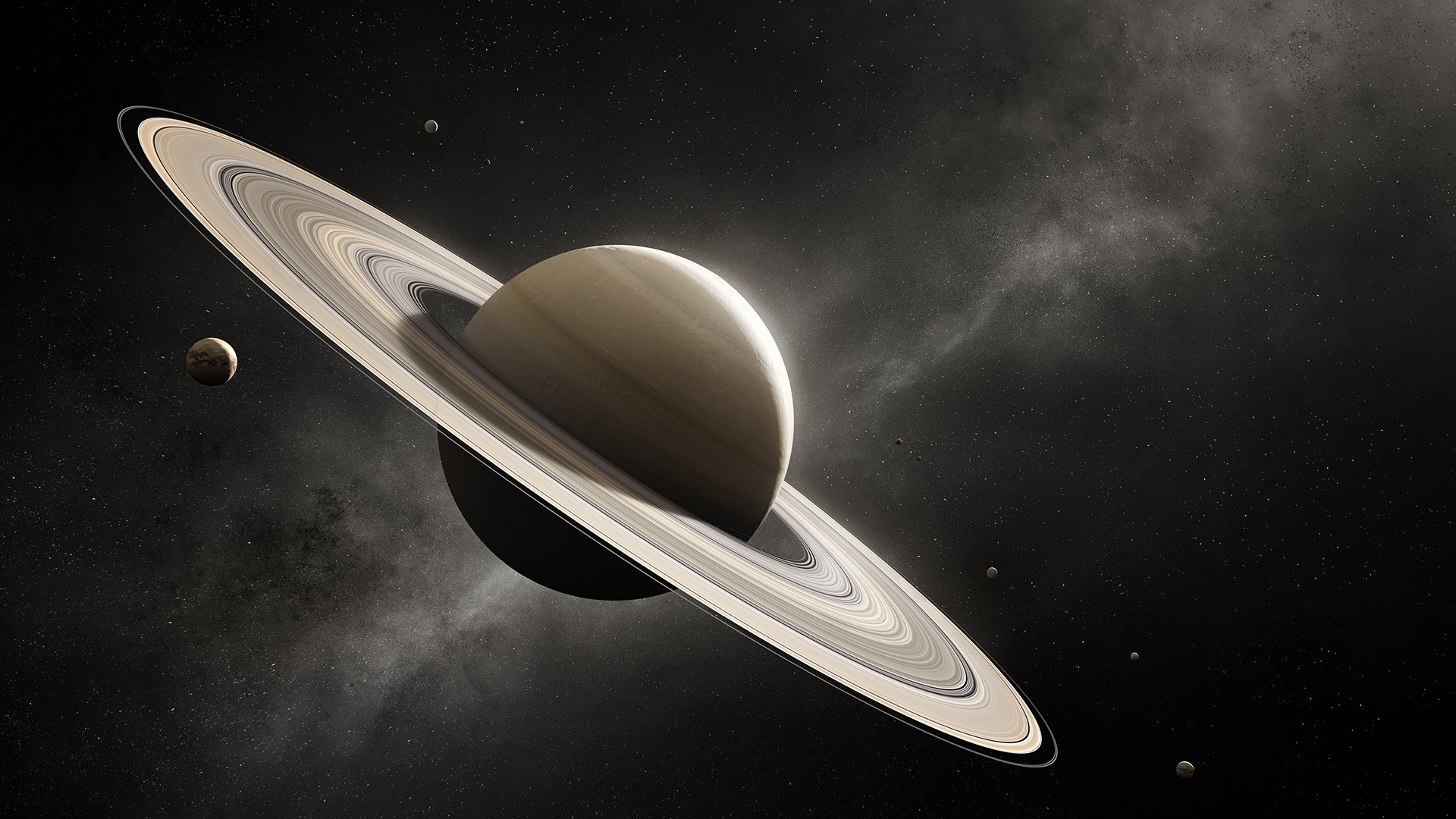
Saturn is the sixth planet from the Sun and the second-largest in the solar system. Adorned with a dazzling, complex system of icy rings, it is a gas giant primarily composed of hydrogen and helium with a density lower than water.
Billions of particles ranging from tiny dust specks to mountain-sized chunks orbit the giant.
Saturn has a lower specific gravity than water, meaning it would float if you could find a bathtub big enough.
Saturn Sync
Ring System Mapping. Analyzing the 10.7 hour rotation and icy debris of the 6th planet. New Horizons monitors the Ring Constant to track gravitational oblateness.
- 💍 Rings: Water Ice Debris Structure.
- ☁️ Density: Lower than Liquid Water.
- 🌙 Moons: 140+ Satellite Resonance.
Hexagon Sync
Polar Jet Stream Mapping. Analyzing the 450 km/h standing wave at Saturn's north pole. New Horizons monitors the Aero Constant to track the 14,500 km geometry.
- 💠 Geometry: Permanent 6 Sided Polygon.
- 💨 Velocity: 450 km/h High Speed Winds.
- 🌍 Scale: Sides Longer than Earth.
Diamond Sync
Atmospheric Carbon Mapping. Analyzing the transformation of methane soot into solid gemstones under crushing pressure. New Horizons monitors the Carbon Constant to track the Diamond Rain cycle.
- ⚡ Energy: 10k Joule Lightning Strikes.
- 💎 Product: Crystalline Carbon Rain.
- 🏗️ Force: Planetary Pressure Compression.
Buoyancy Sync
Relative Density Mapping. Analyzing the 0.687 g/cm³ volume constant of the 6th planet. New Horizons monitors the Density Constant to track positive buoyancy in water.
- 💧 Water: 1.0 g/cm³ Baseline.
- 🪐 Saturn: 0.687 g/cm³ Density.
- 🛶 Result: Celestial Floatation.
Moon Sync
Satellite Population Mapping. Analyzing the 140+ orbital neighbors of the 6th planet. New Horizons monitors the Tidal Constant to track Titan's atmosphere and Enceladus' geysers.
- 🛰️ Titan: 5,150 km Diameter Giant.
- 🌊 Enceladus: Subsurface Ocean Plumes.
- 💍 Shepherds: Ring Maintenance Units.
Mission Sync
Deep Space Trajectory Mapping. Analyzing the 7-year voyage and orbital insertion of the Cassini and Dragonfly explorers. New Horizons monitors the Mission Constant to track robotic sync.
- 🛰️ Cassini: 13 Year Orbital Legacy.
- 🚁 Dragonfly: Future Titan Rotorcraft.
- 🌠 Voyager: The Grand Tour Pioneers.
ASTROPHYSICS / GAS GIANTS
SATURN: LORD OF THE RINGS
Saturn is the second-largest planet in our solar system, composed primarily of hydrogen and helium. While its iconic rings make it visually stunning, its vast family of over 140 moons—particularly ocean worlds like Enceladus and Titan—makes it one of the most compelling targets in astrobiology.

ASTROPHYSICS / RING MECHANICS
THE PHYSICS OF THE RINGS
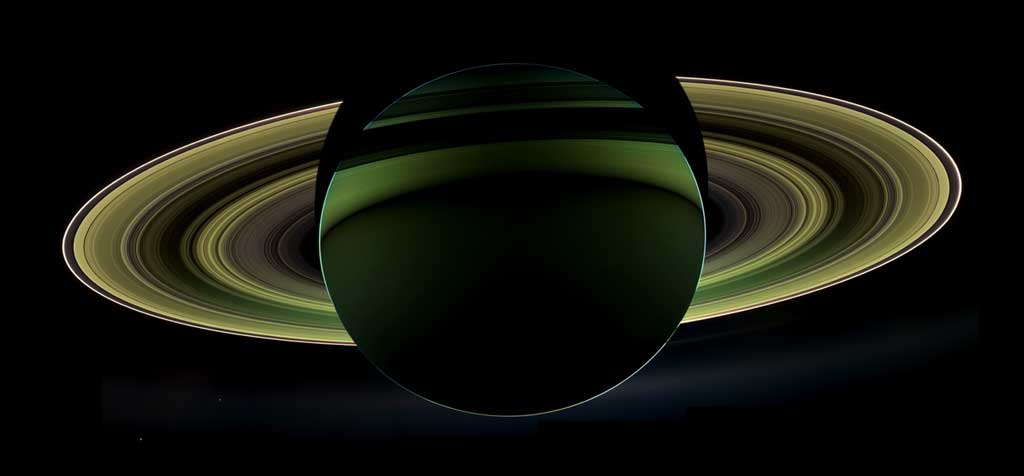
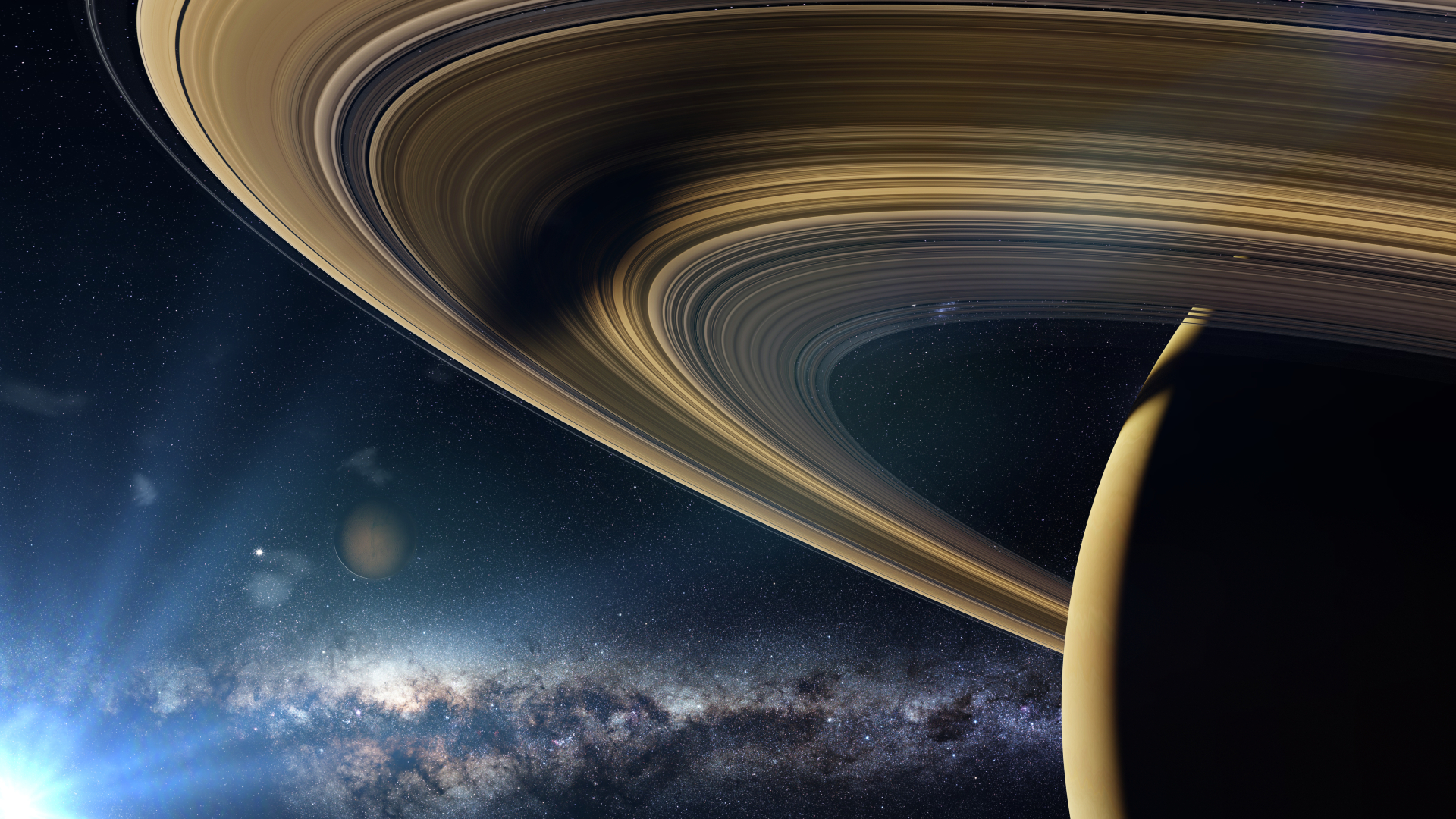
Saturn's main rings are incredibly wide (over 280,000 kilometers) yet astonishingly thin—averaging only about 10 meters thick. Composed of trillions of icy chunks ranging from dust grains to mountain-sized blocks, they are governed by subtle gravitational resonances and shepherd moons.

ASTROBIOLOGY / OCEAN WORLDS
ENCELADUS: THE ACTIVE MOON
Discovered by the Cassini spacecraft, Enceladus shoots massive geysers of water vapor, salts, and organic molecules from fractures known as "tiger stripes" at its south pole. These plumes originate from a global subsurface saltwater ocean in direct contact with a rocky core.
ASTROBIOLOGY / ATMOSPHERIC WORLDS
TITAN: THE METHANE WORLD
Titan features a thick, nitrogen-rich atmosphere that mimics Earth's early chemical environment. Instead of water, its active weather cycle relies on liquid methane and ethane, which rain from the sky to fill vast northern lakes and carve winding river networks.

ASTROPHYSICS / MISSION ARCHITECTURE
THE CASSINI LEGACY
After launching in 1997 and spending seven years cruising to the outer solar system, Cassini orbited Saturn for 13 years. It revolutionized our understanding of ring dynamics, mapped ocean worlds, and concluded with a daring "Grand Finale" plunge directly into the planet's atmosphere.

ASTROPHYSICS / FUTURE EXPLORATION
THE NEXT FRONTIER
Proposed missions like the Enceladus Orbilander and dedicated Titan lake probes represent the next evolutionary step in planetary science. These concepts combine orbital reconnaissance with surface sampling to directly answer whether life exists beyond Earth.

ASTROBIOLOGY / ROTORCRAFT EXPLORATION
DRAGONFLY: FLYING ON TITAN
Scheduled to launch toward Saturn's hazy moon, Dragonfly is a dual-quadcopter rotorcraft designed to hop across Titan's organic sand dunes and impact craters, sampling diverse chemical environments and searching for prebiotic building blocks.

ASTROPHYSICS / PLANETARY INTERIORS
THE HIDDEN DYNAMO
Deep within Saturn, crushing atmospheric pressures transform hydrogen into a liquid metallic state. This vast subterranean ocean of conducting fluid acts as a planetary dynamo, generating a powerful magnetic field and driving spectacular polar auroras.

- Horizon -

Saturn

Ring Particle Collision

Thickness / Scale Ratio

Shepherd Moon Gravity
Roche Limit Calc

Dust to Ice Ratio
Ring Orbital Speed

Hexagon Wind Speed

Saturn's Density

Helium Rain Energy

Diamond Rain Energy

Supersonic Jet Streams

Methane Rain Ratio

Human Flight on Titan

Hydrocarbon Lake Depth

Titan Buoyancy

Gravity Well

Atmospheric Opacity

Enceladus Geyser Height

Light Travel Delay
Saturn Season Tilt
/https://tf-cmsv2-smithsonianmag-media.s3.amazonaws.com/filer_public/ca/b0/cab0042a-70c0-4d60-a94a-20474eb1885b/gettyimages-560665807.jpg)
3D Model of Saturn
Saturn Mysteries
Sources
COMPOSITION
Saturn is a gas giant with no true surface. It is mostly Hydrogen and Helium, surrounding a dense core of rock and metal.
NASA QUICK FACTSRING SYSTEM
Made of billions of chunks of ice and rock, the rings span 282,000 km but are only about 10 meters thick on average.
RING STRUCTUREATMOSPHERE
Yellow and gold bands are caused by super-fast winds in the upper atmosphere, reaching speeds of 1,800 km/h.
WIND DYNAMICS
Saturn Exploration FAQs
Discover the mysteries of the ringed gas giant
Saturn's rings are made up of billions of pieces of ice, rock, and dust, ranging from tiny grains to mountain-sized chunks.
Yes! Saturn is mostly made of hydrogen and helium, giving it a density lower than water, meaning it would float if you had a bathtub big enough.
Saturn has over 140 officially recognized moons, with Titan and Enceladus being the most famous and scientifically fascinating.
It takes Saturn about 29.4 Earth years to complete one full orbit around the Sun.
NASA's Cassini spacecraft spent 13 years orbiting Saturn, providing unprecedented data and images of the planet and its rings.