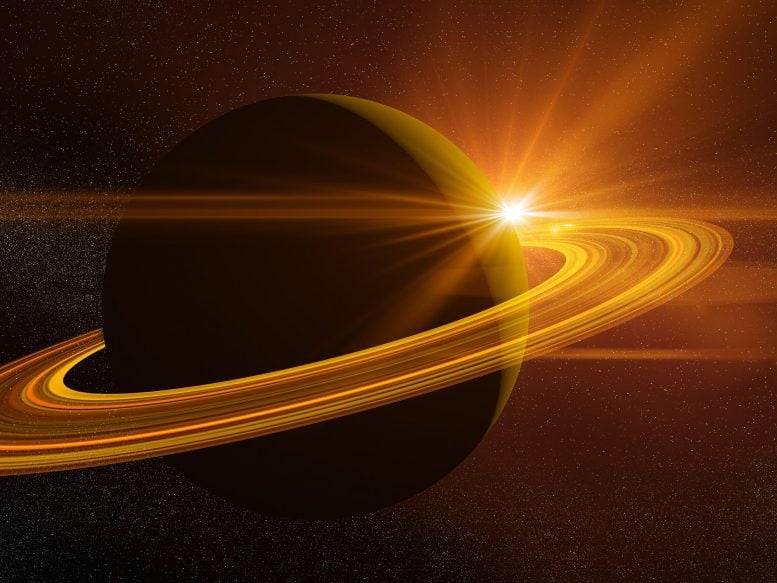
Rings Velocity
RINGS VELOCITY MATRIX
KEPLERIAN ORBITAL SPEED & SHEAR DYNAMICS
Differential Keplerian Rotation
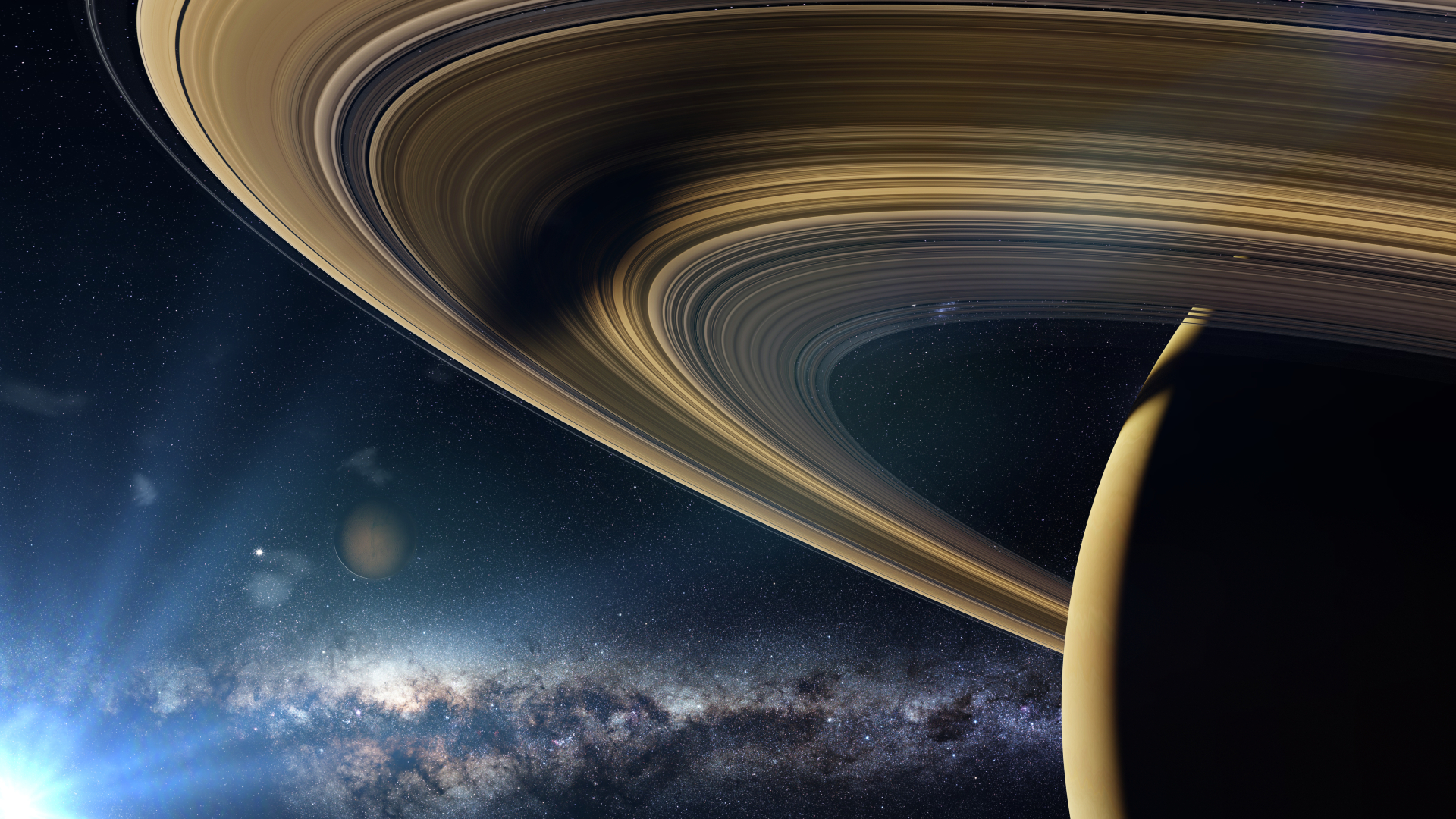
Saturn's rings do not rotate as a single solid disk. Instead, every particle follows Kepler's Laws of Planetary Motion: inner particles race around the planet at high speeds, while outer particles move significantly slower, creating continuous orbital shear across the ring plane.
Inner ring particles travel at over 85,000 km/h to maintain their low-altitude orbits.
The substantial speed difference between the inner edge and outer edge continually stretches structures into thin bands.
Velocity Sync
Keplerian Motion Mapping. Analyzing the v ∝ 1/√r velocity constant across the ring plane. New Horizons monitors the Differential Rotation to track particle "lap" rates.
- 🚀 Inner Speed: ~23.6 km/s (Fast).
- 🐌 Outer Speed: ~16.4 km/s (Slow).
- 📐 Physics: Independent Keplerian Orbits.
Motion Sync
Velocity Vector Mapping. Analyzing the r3 period constant across the A-D ring planes. New Horizons monitors the Shear Ratio to track independent particle orbits.
- 🚀 Inner Edge: 23.6 km/s (Orbit: ~6h).
- 🐌 Outer Edge: 16.4 km/s (Orbit: ~14h).
- ⚖️ Physics: Independent Keplerian Rotation.
D-Ring Sync
Inner-Limit Velocity Mapping. Analyzing the 23.2 km/s constant that defines the D-Ring's 6.4-hour orbit. New Horizons monitors the Ionospheric Buffer to track "Ring Rain" decay.
- 🚀 Speed: 23.2 km/s (Fastest in System).
- ⏱️ Orbit: 6.4 Hours (Rapid Sync).
- 🌧️ Interaction: Atmospheric Ring Rain.
A-Ring Sync
Outer-Limit Velocity Mapping. Analyzing the 16.4 km/s constant that defines the A-Ring's 14-hour orbit. New Horizons monitors the Radial Decay to track shepherd moon resonance.
- 🐌 Speed: 16.4 km/s (Stable Outer Orbit).
- ⏱️ Orbit: ~14.5 Hours (Extended Sync).
- 🛰️ Interaction: Encke Gap Shepherd Moons.
Kepler Sync
Orbital Proof Mapping. Verifying the v ∝ 1/√r constant. New Horizons monitors the Velocity Decay to distinguish between solid-body rotation and particle swarms.
- ⚖️ Law: Inverse Square Root Velocity.
- 🧩 Proof: Independent Particle Composition.
- 🏎️ Inner/Outer: 23.2 km/s vs 16.4 km/s.
ASTROPHYSICS / KEPLERIAN DYNAMICS
THE DIFFERENTIAL SPEED
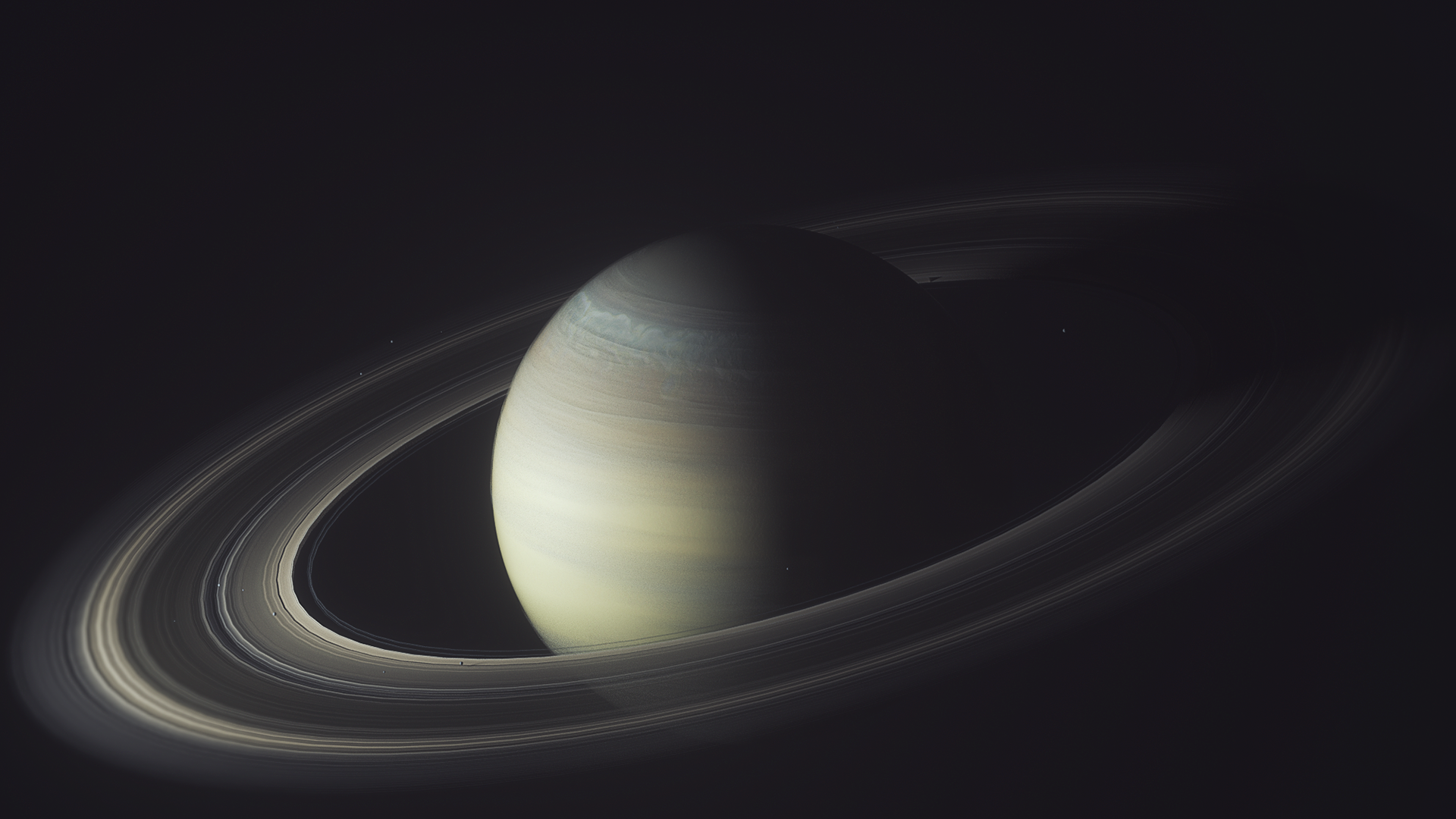
Although Saturn's rings appear from a distance like solid rotating vinyl records, they are actually composed of trillions of independent icy particles. Inner ring particles orbit significantly faster than outer particles, locked in a continuous differential dance governed by Kepler's laws.
ASTROPHYSICS / COLLISIONAL DYNAMICS
THE VELOCITY GRADIENT SHOCK
Because inner particles travel significantly faster than outer particles in adjacent lanes, every collision involves a glancing blow. These constant, gentle impacts dissipate kinetic energy, flattening the ring plane into a sheet that is often less than ten meters thick.
ASTROPHYSICS / ORBITAL RESONANCE GAPS
THE RESONANCE SWEEPS
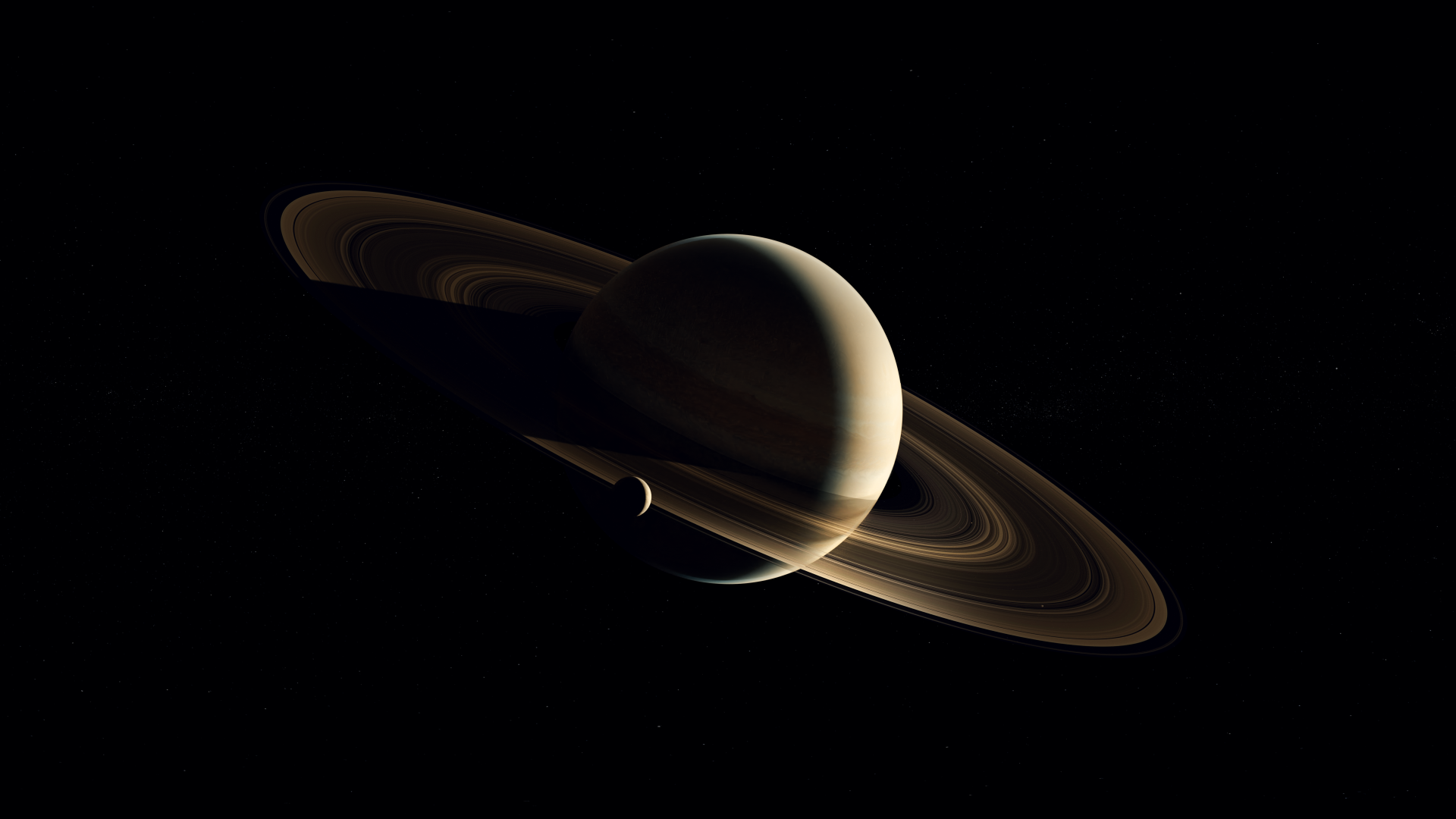
Where the orbital velocity of ring particles matches a precise fractional ratio with a nearby moon, powerful gravitational resonances occur. These periodic gravitational kicks continuously pump energy into the particles, sweeping them out of specific lanes and creating prominent gaps.

Ring Particle Velocity & Orbital Speed FAQs
Exploring the physics behind how fast Saturn's ring particles orbit
Ring particles travel at staggering speeds, averaging around 16 to 24 kilometers per second (about 36,000 to 54,000 mph) depending on their distance from Saturn.
No. According to Kepler's laws of orbital mechanics, particles closer to Saturn orbit much faster than those located farther out in the outer rings.
Saturn's immense mass creates a powerful gravitational pull that acts as the centripetal force required to keep the particles in a continuous, high-speed orbit.
Because they orbit at nearly identical speeds and directions, relative collision velocities are actually quite low (often just a few meters per second), causing gentle bumps rather than explosive smashes.
Only at one specific distance—synchronous orbit—do the ring particles match the speed of Saturn's internal rotation; everywhere else, the rings rotate faster or slower than the planet underneath.
- Horizon -

Saturn

Ring Particle Collision

Thickness / Scale Ratio

Shepherd Moon Gravity
Roche Limit Calc

Dust to Ice Ratio
Ring Orbital Speed

Hexagon Wind Speed

Saturn's Density

Helium Rain Energy

Diamond Rain Energy

Supersonic Jet Streams

Methane Rain Ratio

Human Flight on Titan

Hydrocarbon Lake Depth

Titan Buoyancy

Gravity Well

Atmospheric Opacity

Enceladus Geyser Height

Light Travel Delay
Saturn Season Tilt
/https://tf-cmsv2-smithsonianmag-media.s3.amazonaws.com/filer_public/ca/b0/cab0042a-70c0-4d60-a94a-20474eb1885b/gettyimages-560665807.jpg)
3D Model of Saturn
Saturn Mysteries
Sources
DIFFERENTIAL ROTATION
Inner rings (D-ring) orbit at ~**23.2 km/s**, while outer rings (A-ring) move at ~**16.4 km/s**. This speed difference prevents the rings from acting as a solid sheet.
RING VELOCITIESORBITAL FORMULA
Velocity is calculated as v ∝ 1/√r. As the distance (r) increases, the orbital velocity (v) must decrease to balance Saturn's gravity.
KEPLERIAN MATHCO-ROTATION POINT
There is a specific point where the rings orbit at the same speed as Saturn's rotation. Inside this point, the rings "lap" the planet's surface.
ROTATIONAL SYNC