Methene Rain
PLANETARY LAB: TITAN METHANE CYCLE
HYDROCARBON METEOROLOGY, LIQUID SEAS & ATMOSPHERIC PRECIPITATION
The Hydrocarbon Hydrological Cycle
Titan is the only world in the solar system besides Earth known to maintain stable bodies of surface liquid. Instead of a water cycle, Titan operates a complete methane and ethane cycle featuring evaporation, cloud formation, violent rainstorms, and fluid runoff carving river networks.
Continuous vaporization, cloud gathering, and surface precipitation.
Cryogenic conditions allowing methane to exist as liquid, gas, and solid.
Methane Sync
Condensation Mapping. Analyzing the P-T phase constant. New Horizons monitors the Volatile Buffer to track the methane gas-to-liquid ratio.
- 💧 State: Gas (Saturn) / Liquid (Neptune).
- ❄️ Threshold: 110 K at 1 Bar.
- 📊 Ratio: Latent Heat Condensation Sync.
Titan Sync
Hydrocarbon Mapping. Analyzing the 94 K triple-point constant. New Horizons monitors the Cryo-Buffer to track methane precipitation and lake stability.
- 🌧️ Process: Liquid Methane Precipitation.
- 🌊 Feature: Vast Hydrocarbon Lakes.
- ❄️ Temp: 94 K Cryogenic Sync.
Shield Sync
Molecular Mapping. Analyzing the 95:5 N2/CH4 ratio constant. New Horizons monitors the Haze Buffer to track the stability of Titan's organic protective shield.
- 🟧 Composition: 95% Nitrogen / 5% Methane.
- 🌫️ Result: Organic Tholin Haze Shield.
- ⚖️ Pressure: 1.5 Bar Surface Sync.
Velocity Sync
Kinetics Mapping. Analyzing the 1.6 m/s descent constant. New Horizons monitors the Drag Buffer to track the 6x speed reduction in Titan's dense atmosphere.
- Velocity: 1.6 m/s (6x Slower).
- Size: 1.0 cm (Double Earth Max).
- Gravity: 1.35 m/s² Low-G Sync.
Cycle Sync
Temporal Mapping. Analyzing the 1,000-year dormancy constant. New Horizons monitors the Flood Buffer to track the catastrophic methane release in Titan's arid regions.
- Frequency: 1,000 Years (Millennial Sync).
- Event: Massive Methane Flash Floods.
- Effect: Geomorphic Landscape Shaping.
ASTROPHYSICS / PLANETARY HYDROLOGY
Titan's Hydrocarbon Cycle
Saturn's largest moon, Titan, hosts a meteorological cycle functionally analogous to Earth's water cycle, but operating entirely with liquid hydrocarbons. Instead of water vapor condensing into rain clouds, Titan's atmosphere is rich in methane and ethane. At surface temperatures hovering around $-179^\circ\text{C}$ ($−290^\circ\text{F}$), methane reaches its triple point, allowing it to evaporate from liquid reservoirs, form dense tropospheric clouds, and precipitate down as liquid methane rain onto an icy bedrock terrain.
ASTROPHYSICS / SURFACE HYDROLOGY
Titan's Hydrocarbon Seas & Lakes
Unlike any other world in our solar system outside of Earth, Titan features stable bodies of liquid on its surface. Instead of water, these vast basins are filled with liquid methane and ethane, sculpted into sprawling northern seas like Kraken Mare and Ligeia Mare. River networks carve through the water-ice bedrock, draining into these terminal lakes and maintaining a closed fluid balance powered by atmospheric replenishment and subsurface seepage.
ASTROPHYSICS / ATMOSPHERIC CHEMISTRY
Titan's Atmospheric Photochemistry
The methane cycle on Titan is not a closed, permanent system; it requires constant chemical replenishment. Ultraviolet sunlight striking the upper atmosphere continuously breaks apart methane molecules, triggering complex photochemical reactions that synthesize organic hazes, tholins, and heavier hydrocarbons like ethane and acetylene. Without mechanisms returning sequestered hydrocarbons back into the atmosphere or deep interior recycling, solar photolysis would deplete Titan's atmospheric methane over tens of millions of years.
Sources
LOW-GRAVITY RAIN
Because Titan has low gravity and a thick atmosphere, methane raindrops grow up to **1 cm** wide—twice the size of Earth's—and fall as slowly as snowflakes.
TITAN ATOMSPHEREHYDROCARBON SEAS
Methane rain collects in massive polar lakes like **Kraken Mare**. These are composed of liquid methane and ethane, with depths exceeding 100 meters.
CASSINI RADARSURFACE EROSION
The Huygens probe discovered rounded pebbles and river drainage patterns, proving that liquid methane flows across the icy surface, carving it just like water on Earth.
HUYGENS LANDING
Titan Methane Rain Cycle FAQs
Investigating Saturn's largest moon, Titan, and its unique hydrocarbon weather system featuring liquid methane clouds, rain, rivers, and lakes
Titan features a closed meteorological cycle analogous to Earth's water cycle, but operating entirely with hydrocarbons where methane evaporates from liquid lakes, forms clouds, and precipitates down as liquid methane rain.
Titan orbits far away from the Sun within the Saturnian system, maintaining an average surface temperature of approximately -179°C (-290°F), which allows natural gas like methane to exist stably as a liquid.
Solar heat evaporates liquid methane from surface reservoirs, and atmospheric currents transport the vapor upward until it cools, condenses into droplets, and gathers into thick hydrocarbon storm clouds.
Cassini spacecraft observations reveal that Titan experiences rare, intense cloudbursts that drop heavy droplets of liquid methane, soaking the icy terrain and carving deep drainage channels into the landscape.
Runoff from methane precipitation carves winding river networks, carved canyons, and extensive lowland plains that empty into sprawling northern hydrocarbon seas like Kraken Mare and Ligeia Mare.
Solar ultraviolet light continuously breaks down atmospheric methane molecules high above Titan, creating ethane and other complex organic compounds that mix into the liquid cycle and replenish surface lakes.
Because Saturn and its moons take about 29 Earth years to orbit the Sun, Titan undergoes intense seasonal shifts, causing massive convective storms to migrate from pole to pole depending on the Saturnian year.
Titan is the only moon in the solar system with a dense atmosphere—composed primarily of nitrogen with a pressure 1.5 times that of Earth—which provides the necessary atmospheric pressure for stable liquid phases.
NASA's Cassini orbiter and ESA's Huygens probe mapped Titan's surface using radar and infrared imaging, directly detecting shoreline boundaries, river channels, and subsurface moisture during its historic 2005 descent.
Studying Titan's active organic chemistry provides vital clues about prebiotic conditions and planetary evolution, offering a planetary laboratory for chemistry that could exist under extreme cryogenic temperatures.
- Horizon -

Saturn

Ring Particle Collision

Thickness / Scale Ratio

Shepherd Moon Gravity
Roche Limit Calc

Dust to Ice Ratio
Ring Orbital Speed

Hexagon Wind Speed

Saturn's Density

Helium Rain Energy

Diamond Rain Energy

Supersonic Jet Streams

Methane Rain Ratio

Human Flight on Titan

Hydrocarbon Lake Depth

Titan Buoyancy

Gravity Well

Atmospheric Opacity

Enceladus Geyser Height

Light Travel Delay
Saturn Season Tilt
/https://tf-cmsv2-smithsonianmag-media.s3.amazonaws.com/filer_public/ca/b0/cab0042a-70c0-4d60-a94a-20474eb1885b/gettyimages-560665807.jpg)
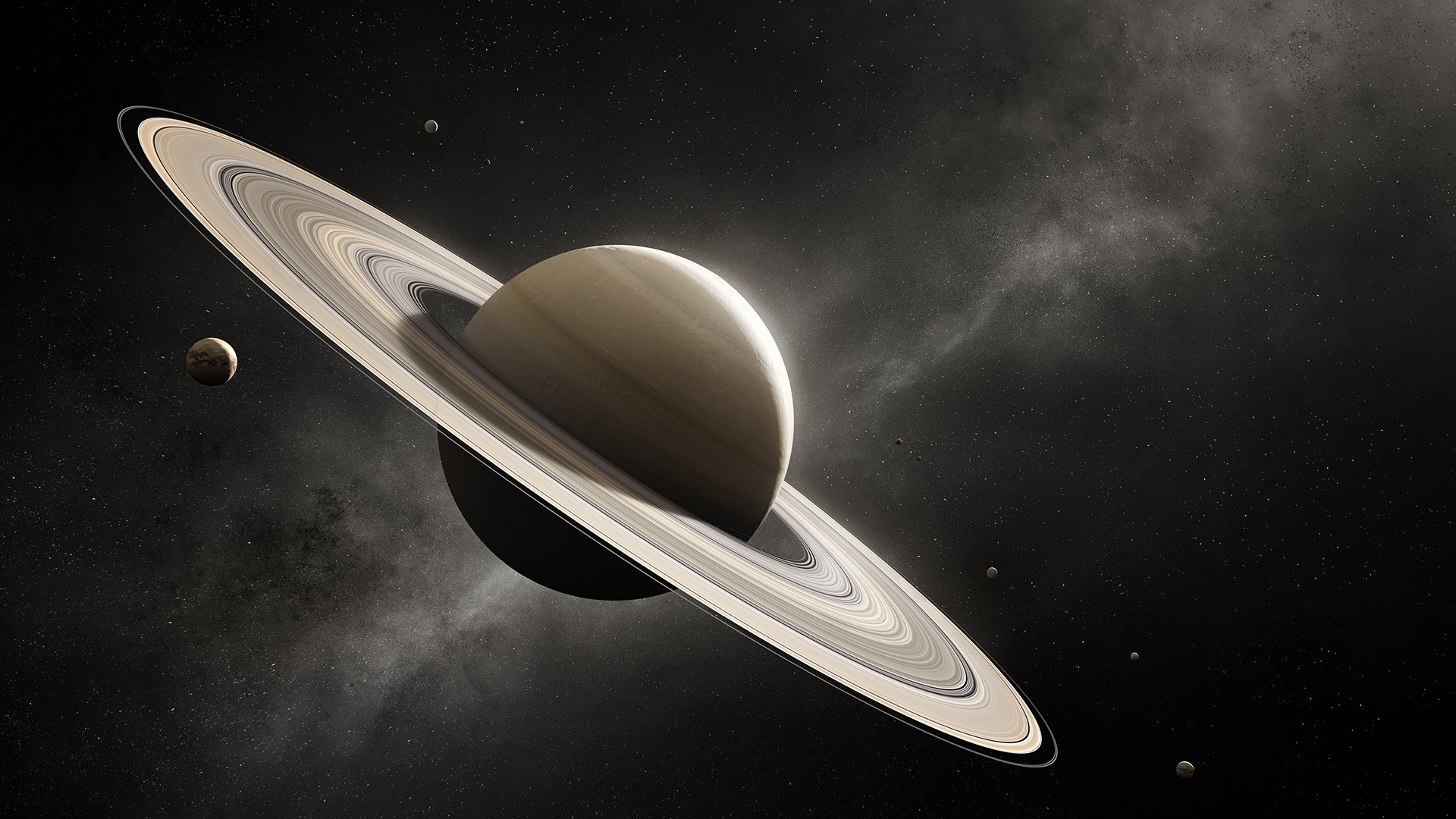
3D Model of Saturn