Hydrocarbon Lake
PLANETARY LAB: TITAN LAKES
KRAKEN MARE, LIGEIA LACUS & CRYOGENIC SEA COMPOSITION
Hydrocarbon Seas & Basins
Titan hosts extensive surface liquid bodies concentrated primarily in its polar regions. Unlike Earth's water basins, these expansive seas are filled with liquid methane, ethane, and dissolved nitrogen, creating an alien hydrological architecture unique in the solar system.
Titan's largest sea, spanning hundreds of thousands of square kilometers.
Maintained at 94 Kelvin (-179 degrees Celsius) under nitrogen pressure.
Depth Sync
Bathymetric Mapping. Analyzing the 300m / 1.35g liquid constant. New Horizons monitors the Volatile Buffer to track the pressure gradients of Kraken Mare.
- 📏 Max Depth: >300 Meters (Kraken Mare).
- 🧪 Liquid: 75% Methane / 25% Ethane.
- 🛰️ Method: RADAR Transparency Sync.
Kraken Sync
Volumetric Mapping. Analyzing the 300m / 400k sq km sea constant. New Horizons monitors the Abyssal Buffer to track the hydrocarbon reserves of Titan.
- 🌊 Volume: 60,000 km³ Hydrocarbons.
- 🕳️ Max Depth: >300 Meters (The Abyss).
- 🛰️ Radar: Complete Transparency Sync.
Kraken Sync
Chemical Mapping. Analyzing the 300m / Ethane-Rich constant. New Horizons monitors the Volatile Buffer to track the liquid density of Titan's largest sea.
- 📏 Min Depth: 300 Meters (1,000 ft).
- 🧪 Mix: High Ethane Concentration.
- 💎 Clarity: Extreme Radar Transparency.
Purity Sync
Radar Mapping. Analyzing the 97% CH4 / 160m depth constant. New Horizons monitors the Clarity Buffer to track the transparency of Ligeia Mare.
- 💎 Purity: Nearly 100% Pure Liquid Methane.
- 📡 Radar: Maximum Signal Transparency Sync.
- 🌊 Max Depth: ~160 Meters (Mapped to Floor).
Radar Sync
Bathymetric Mapping. Analyzing the 2.17cm / 1.29n radar constant. New Horizons monitors the Signal Buffer to track the time-of-flight from Titan's seafloor.
- 📡 Signal: 13.8 GHz (Ku-Band) Radar.
- ⏱️ Latency: Microsecond Time-of-Flight Sync.
- 🗺️ Output: 3D Seafloor Topography Mapping.
PLANETARY HYDROLOGY / EXOPLANETARY SEAS
The Liquid Hydrocarbon Basins of Titan
Titan’s high-latitude northern hemisphere hosts sprawling regional lake systems and massive seas, such as Kraken Mare, Ligeia Mare, and Punga Mare. Unlike terrestrial water bodies that are sustained by hydrological rainfall and sub-surface aquifers, these extraterrestrial basins consist almost entirely of liquid methane dissolved with ethane, propane, and atmospheric nitrogen. The shorelines exhibit intricate fjord systems and flooded river valleys, carved over eons by flowing liquid hydrocarbons cutting through fragile water-ice bedrock.
PLANETARY HYDROLOGY / WAVE DYNAMICS
Wave Action and Surface Properties
Cassini radar observations of Titan's liquid surfaces revealed something astonishing: gentle capillary waves and ripples stirred by seasonal methane winds. Because liquid methane has a significantly lower surface tension and viscosity than terrestrial water, even light breezes can generate wave propagation across seas like Ligeia Mare. These liquid hydrocarbon expanses behave with a mirror-like obsidian sheen, reflecting the dim sunlight filtering through the thick nitrogen atmosphere and creating an alien marine environment of breathtaking scale.
PLANETARY HYDROLOGY / SUBSURFACE INTERACTION
Bathymetry and Subsurface Seepage
Exploring the depths of Titan's hydrocarbon seas reveals complex bathymetric profiles and subterranean hydrology. Radar soundings indicate that Ligeia Mare reaches depths exceeding 160 meters, filled with exceptionally pure liquid methane. Similar to Earth's karst topography, Titan's porous water-ice bedrock allows liquid hydrocarbons to seep underground, dissolving soluble minerals and creating subterranean aquifers that regulate surface sea levels through long-term planetary seepage and seasonal evaporation cycles.
Sources
KRAKEN MARE
The largest sea on Titan is estimated to be at least **300 meters (1,000 ft)** deep near its center—deep enough for a specialized submarine to explore.
KRAKEN DATALIGEIA MARE
Cassini's radar easily pierced the clear liquid of Ligeia Mare, measuring a maximum depth of **160 meters (525 ft)** with a surprisingly smooth bottom.
LIGEIA BATHYMETRYPUNGA MARE
Punga Mare is roughly **120 meters** deep. Interestingly, these depths suggest the lakes are part of a moon-wide "methane table," similar to Earth's water table.
TITAN GEOLOGY
Titan Hydrocarbon Lakes FAQs
Examining the vast seas, liquid ethane-methane basins, and cryogenic shorelines found across Saturn's moon Titan
Titan is the only world besides Earth known to host stable bodies of liquid on its surface, consisting primarily of liquid methane and ethane rather than water.
With surface temperatures averaging around -179°C (-290°F), water is frozen solid like granite, whereas simple organic molecules like methane and ethane remain liquid under these extreme cryogenic conditions.
Titan's largest liquid reservoirs are designated as seas, with Kraken Mare being the most expansive—covering an area larger than Earth's Caspian Sea—alongside Ligeia Mare and Punga Mare.
The vast majority of Titan's lakes and polar seas are heavily concentrated in the high latitudes of the moon's northern hemisphere, while the southern polar region contains comparatively fewer liquid basins.
Cassini radar soundings revealed that major seas like Ligeia Mare reach depths of over 160 meters (500 feet), filled with exceptionally pure liquid methane mixed with dissolved nitrogen.
Data from spacecraft confirm that gentle winds across Titan's northern seas generate small surface waves, and Saturn's gravitational pull creates subtle tides within the liquid networks.
Lake basins often feature flooded river valleys, steep coastal cliffs carved into water-ice bedrock, and marshy lowlands saturated with organic sludge and liquid precipitates.
A closed hydrological cycle links the lakes to atmospheric methane rain, subterranean seepage, and polar weather patterns that continuously cycle liquid hydrocarbons across Titan's surface.
Researchers have occasionally spotted transient features known as "magic islands"—temporary bright patches in the seas caused by nitrogen bubbles, floating organic solids, or wind-driven waves.
Proposed future concepts include specialized submersible probes designed to plunge beneath the surface of Kraken Mare to sample chemical compositions and study sub-surface marine currents.
- Horizon -

Saturn

Ring Particle Collision

Thickness / Scale Ratio

Shepherd Moon Gravity
Roche Limit Calc

Dust to Ice Ratio
Ring Orbital Speed

Hexagon Wind Speed

Saturn's Density

Helium Rain Energy

Diamond Rain Energy

Supersonic Jet Streams

Methane Rain Ratio

Human Flight on Titan

Hydrocarbon Lake Depth

Titan Buoyancy

Gravity Well

Atmospheric Opacity

Enceladus Geyser Height

Light Travel Delay
Saturn Season Tilt
/https://tf-cmsv2-smithsonianmag-media.s3.amazonaws.com/filer_public/ca/b0/cab0042a-70c0-4d60-a94a-20474eb1885b/gettyimages-560665807.jpg)
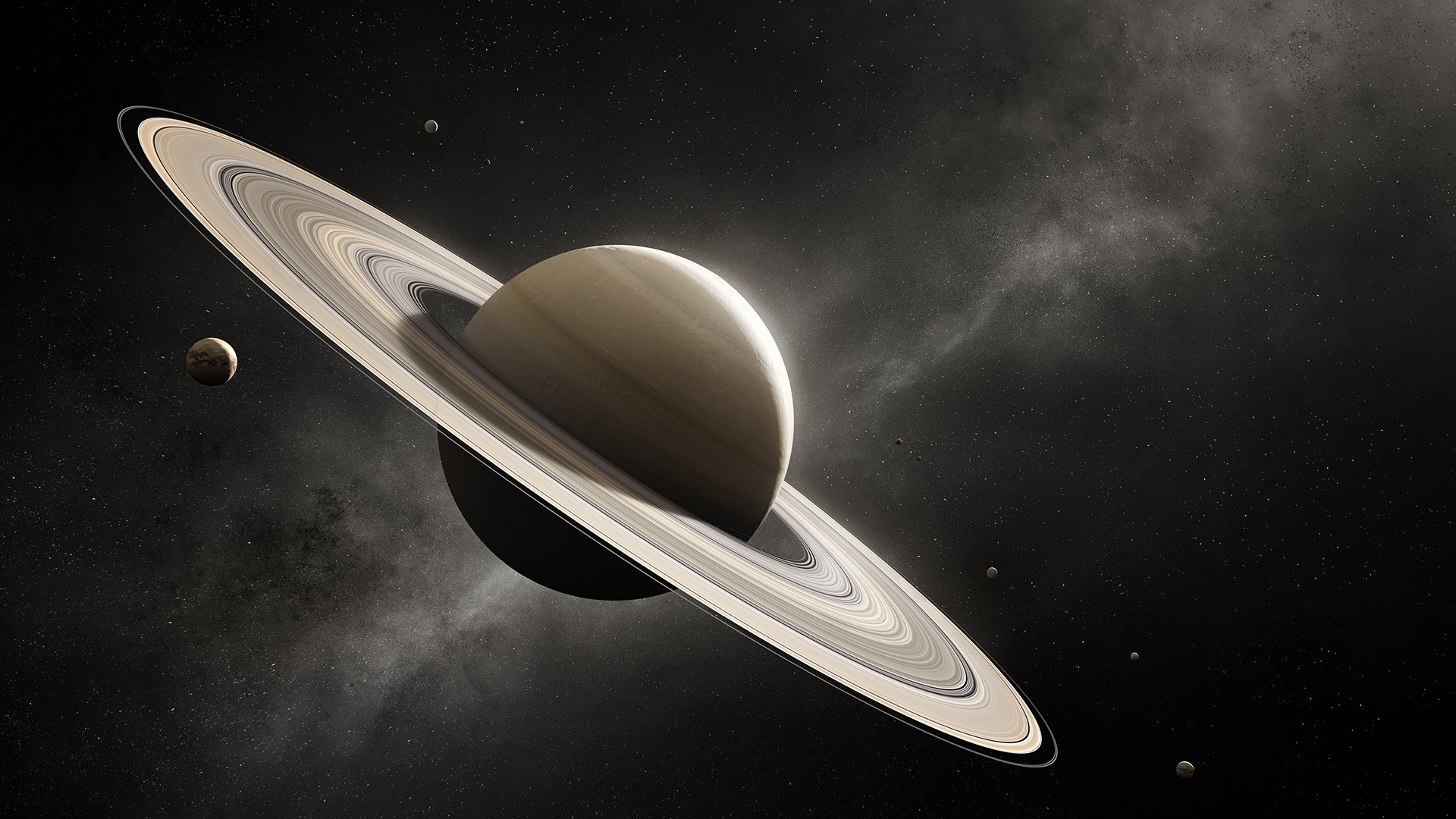
3D Model of Saturn