
Hexagon Wind Speed
SATURN POLAR HEXAGON
NORTHERN ATMOSPHERIC WAVE DYNAMICS
The Six-Sided Jet Stream
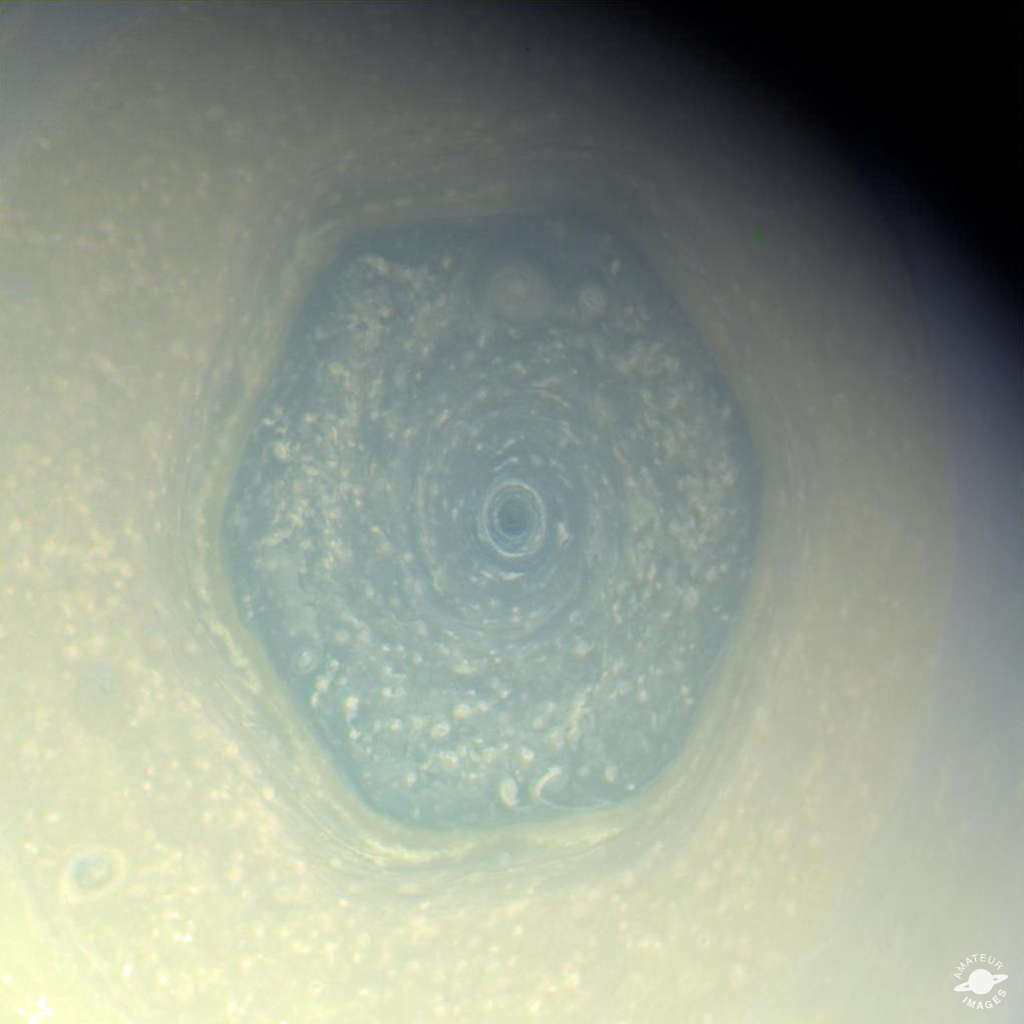
At Saturn's north pole sits a persistent, rotating hexagonal cloud pattern roughly 30,000 kilometers across. Driven by a high-speed jet stream shearing against atmospheric differentials, each straight side of the polygon is wider than planet Earth itself.
Four Earths could easily fit side-by-side inside the boundaries of this colossal geometric storm.
Super-rotating jet streams lock the wave pattern in place, maintaining its shape across decades of observation.
Flow Sync
Meteorological Mapping. Analyzing the 125 m/s jet stream constant that maintains the polar hexagon. New Horizons monitors the Rossby Wave Number to track geometric stability. s
- 🌪️ Velocity: 125 m/s (Standing Wave).
- 📐 Wave Number: k=6 (Hexagonal).
- 🧭 Status: Geometrically Locked.
Peak Velocity
Jet Stream Mapping. Analyzing the 450 km/h constant that defines the Hexagon's walls. New Horizons monitors the Phase Speed Sync to track decadal stability.
- 🏁 Max Speed: 450 km/h (Core Jet).
- 🛡️ Stability: Decadal Standing Wave.
- 🛰️ Data: Verified by Voyager & Cassini.
Scale Sync
Proportional Mapping. Analyzing the 30,000 km diameter constant. New Horizons monitors the Volumetric Buffer to track the 4x Earth-unit capacity.
- 🌍 Capacity: ~4 Earths (Cross-section).
- 📐 Width: 30,000 km (Hexagonal Edge).
- 🌪️ Nature: Permanent Polar Boundary.
Resonance Sync
Harmonic Integrity Mapping. Analyzing the C p = 0 constant that creates the standing wave geometry. New Horizons monitors the Thermal Gradient to track atmospheric "kinking."
- 🔥 Source: Deep Thermal Convection.
- 📐 Mechanism: Stationary Rossby Wave.
- 🔒 Result: Permanent Geometric Lock.
METEOROLOGY / POLAR DYNAMICS
THE PERPETUAL STORM
Encircling Saturn's north pole is a massive, six-sided jet stream roughly 30,000 kilometers wide. Driven by extreme atmospheric wind speeds and deep planetary rotation dynamics, this geometric wave pattern maintains its rigid shape year after year.
METEOROLOGY / DEEP ATMOSPHERE
THE DEEP ROOTED VORTEX
Unlike transient weather patterns on Earth, Saturn's hexagon extends thousands of kilometers down into the gas giant's atmosphere. Laboratory simulations and spacecraft gravity data reveal that deep zonal winds tether the geometric wave, allowing it to rotate synchronously with the planet's interior core.
METEOROLOGY / ATMOSPHERIC CHEMISTRY
THE COLOR-SHIFTING STORM
Over the course of Saturn's long 29-year orbit, the North Polar Hexagon undergoes dramatic color shifts—transitioning from a vibrant bluish hue to a striking golden amber. These changes are driven by seasonal sunlight exposure and photochemical reactions occurring in the upper atmosphere.


Saturn Hexagon FAQs
Unraveling the mysteries of the giant six-sided storm at the north pole
It is a persistent, massive hexagonal cloud pattern located at Saturn's north pole. It acts as a jet stream driving high-speed winds around a central hurricane.
The hexagon is gigantic—each of its six sides is about 14,500 kilometers (9,000 miles) long, making the entire structure wide enough to fit over two Earths inside.
Scientists believe it is formed by a complex fluid dynamics phenomenon known as a standing wave, which is driven by the planet's rotation and differing speeds of atmospheric jet streams.
Yes! Observations by the Cassini spacecraft showed the hexagon shifting from a bluish color to a golden-yellow hue over several years as Saturn's seasons transitioned and sunlight exposure increased.
No, the hexagon is entirely unique to the north pole. The south pole features a massive, distinct hurricane-like vortex, but it completely lacks the six-sided geometric boundary.
- Horizon -

Saturn

Ring Particle Collision

Thickness / Scale Ratio

Shepherd Moon Gravity
Roche Limit Calc

Dust to Ice Ratio
Ring Orbital Speed

Hexagon Wind Speed

Saturn's Density

Helium Rain Energy

Diamond Rain Energy

Supersonic Jet Streams

Methane Rain Ratio

Human Flight on Titan

Hydrocarbon Lake Depth

Titan Buoyancy

Gravity Well

Atmospheric Opacity

Enceladus Geyser Height

Light Travel Delay
Saturn Season Tilt
/https://tf-cmsv2-smithsonianmag-media.s3.amazonaws.com/filer_public/ca/b0/cab0042a-70c0-4d60-a94a-20474eb1885b/gettyimages-560665807.jpg)
3D Model of Saturn
Saturn Mysteries
Sources
JET STREAM VELOCITY
The winds within the hexagonal jet stream clock in at approximately **360 to 450 km/h** (about 220 to 280 mph).
CASSINI DATAROTATION PERIOD
The entire structure rotates at nearly the same rate as Saturn's internal rotation, roughly **10 hours and 39 minutes**.
ROTATIONAL MATHSTATIONARY WAVE
Unlike Earth's jet streams, the Hexagon is a **Rossby wave** that is geographically "locked" to the pole, remaining stable for decades.
FLUID DYNAMICS