
Dust To ICE
DUST TO ICE EVOLUTION
RING PURIFICATION & MATERIAL DYNAMICS
From Debris to Crystalline Ice
When icy moons are torn apart inside the Roche limit, the initial cloud of debris contains a mix of rocky silicates, carbon compounds, and volatile ices. Over eons, collisional grinding and plasma stripping refine this raw material into remarkably pure water ice.
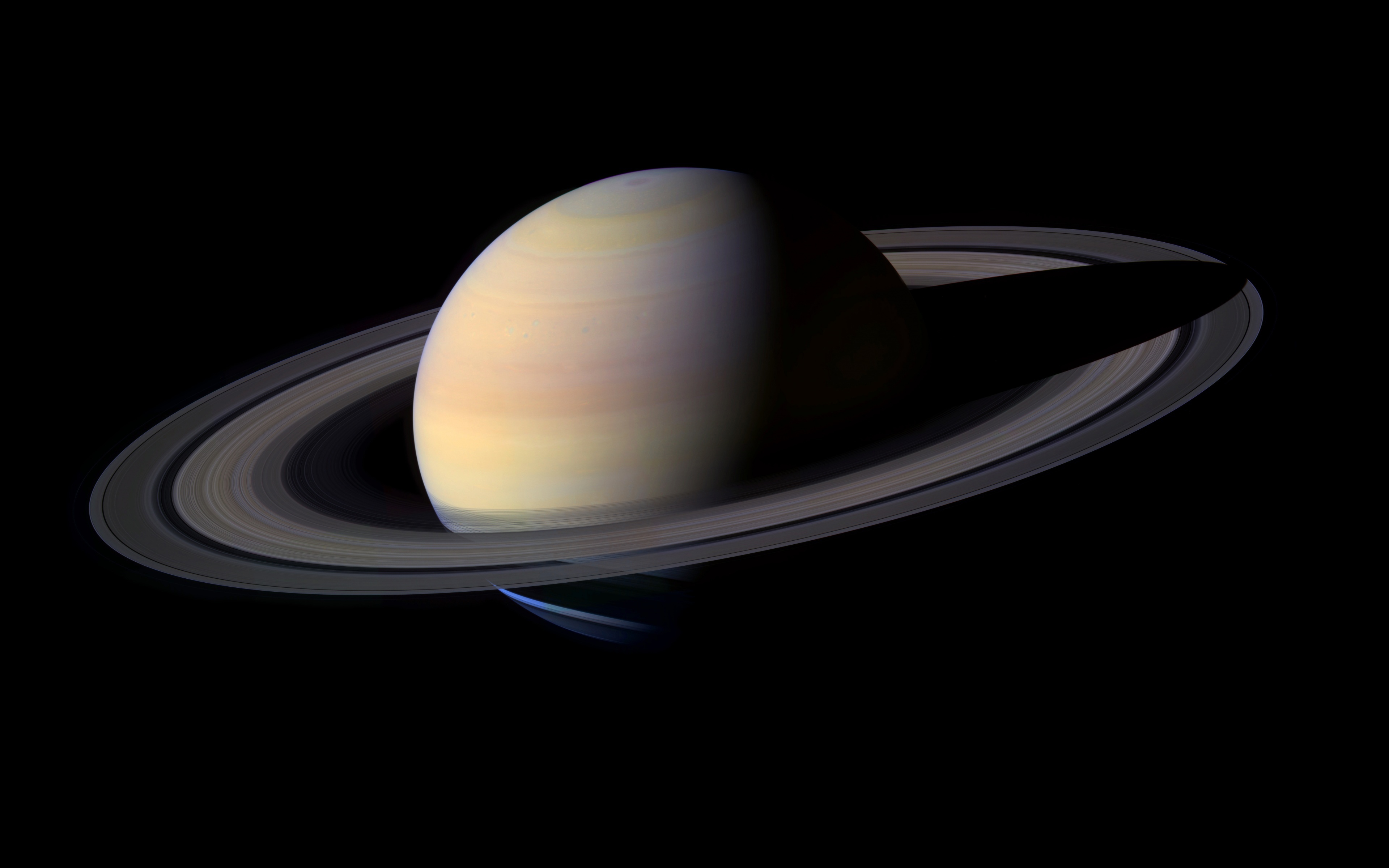
Primary ring structures reflect sunlight brilliantly due to the near-total absence of dark surface contaminants.
Freshly exposed ice surfaces ensure the rings shine brightly across the outer solar system.
Purity Sync
Spectral Composition Mapping. Analyzing the 99.9% Ice-to-Dust ratio. New Horizons monitors the Pollution Constant to track the "Age Sync" of the ring particles.
- ❄️ Ice: 99.9% Crystalline H2O.
- 🌑 Dust: Trace Silicates / Organics.
- ⏳ Result: Evidence for a Young Ring.
Purity Sync
Spectral Integrity Mapping. Analyzing the 99.9% H2O constant that defines Saturn's brilliance. New Horizons monitors the Pollution Horizons to track the "Age Sync" of the rings.
- ❄️ Purity: 99.9% Crystalline Ice.
- ✨ Albedo: 80% Solar Reflectivity.
- ⏳ Age: ~100 Million Year Sync.
Albedo Sync
Reflectivity Mapping. Analyzing the 0.80 Albedo constant generated by 99.9% water-ice purity. New Horizons monitors the Refraction Buffer to track solar feedback.
- 🌟 Albedo: 0.80 (High Reflectivity).
- 🧊 Medium: Crystalline Water Ice.
- 🛰️ Result: Earth-Visible Brilliance.
Pollution Sync
Cosmic Chronology Mapping. Analyzing the 1% Dust-to-Ice constant to track the ring age. New Horizons monitors the Meteoric Horizons to calibrate the cosmic clock.
- ☄️ Source: Micrometeoroid Rain.
- 📉 Effect: Albedo Decay / Darkening.
- ⏳ Clock: Indicates < 100M Year Age.
Age Sync
Temporal Integrity Mapping. Analyzing the 4.4 billion-year gap between Saturn and its rings. New Horizons monitors the Purity Constant to track the "Dinosaur Era" shatter event.
- 🦖 Origin: Post-Jurassic Shatter.
- ✨ Purity: 99.9% Ice (No Soot).
- 🔚 Future: Disappearing in ~100M years.
ASTROPHYSICS / COSMIC ORIGINS
FROM PRIMORDIAL DEBRIS
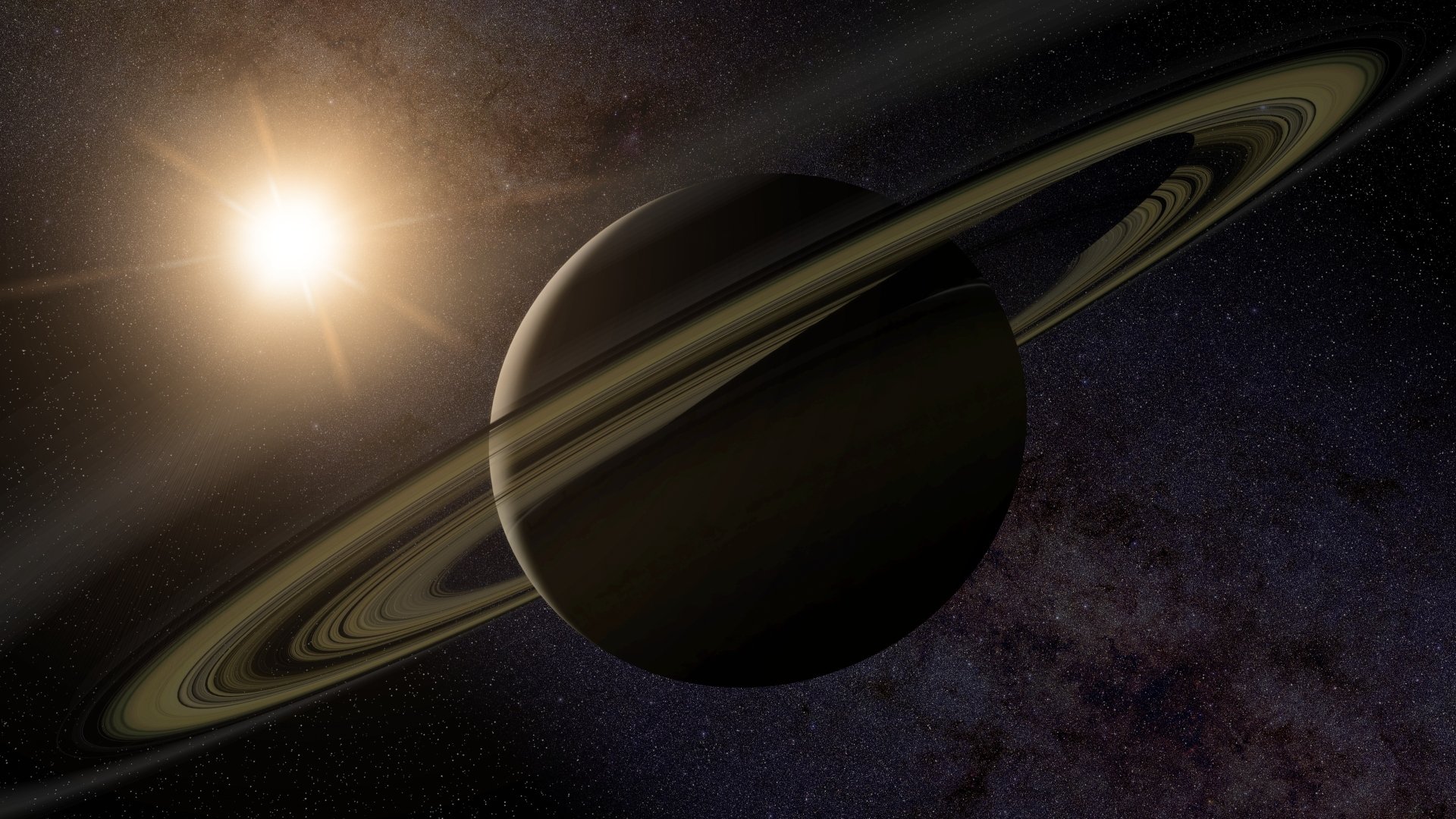
Long before humanity looked up at Saturn's magnificent splendor, the solar system's outer reaches were a chaotic battlefield of wandering comets and icy planetesimals. When a massive Kuiper Belt object strayed too close to the young gas giant, tidal forces initiated a complete physical transformation.

ASTROPHYSICS / SPECTRAL PURIFICATION
THE REFINING FIRE OF SPACE
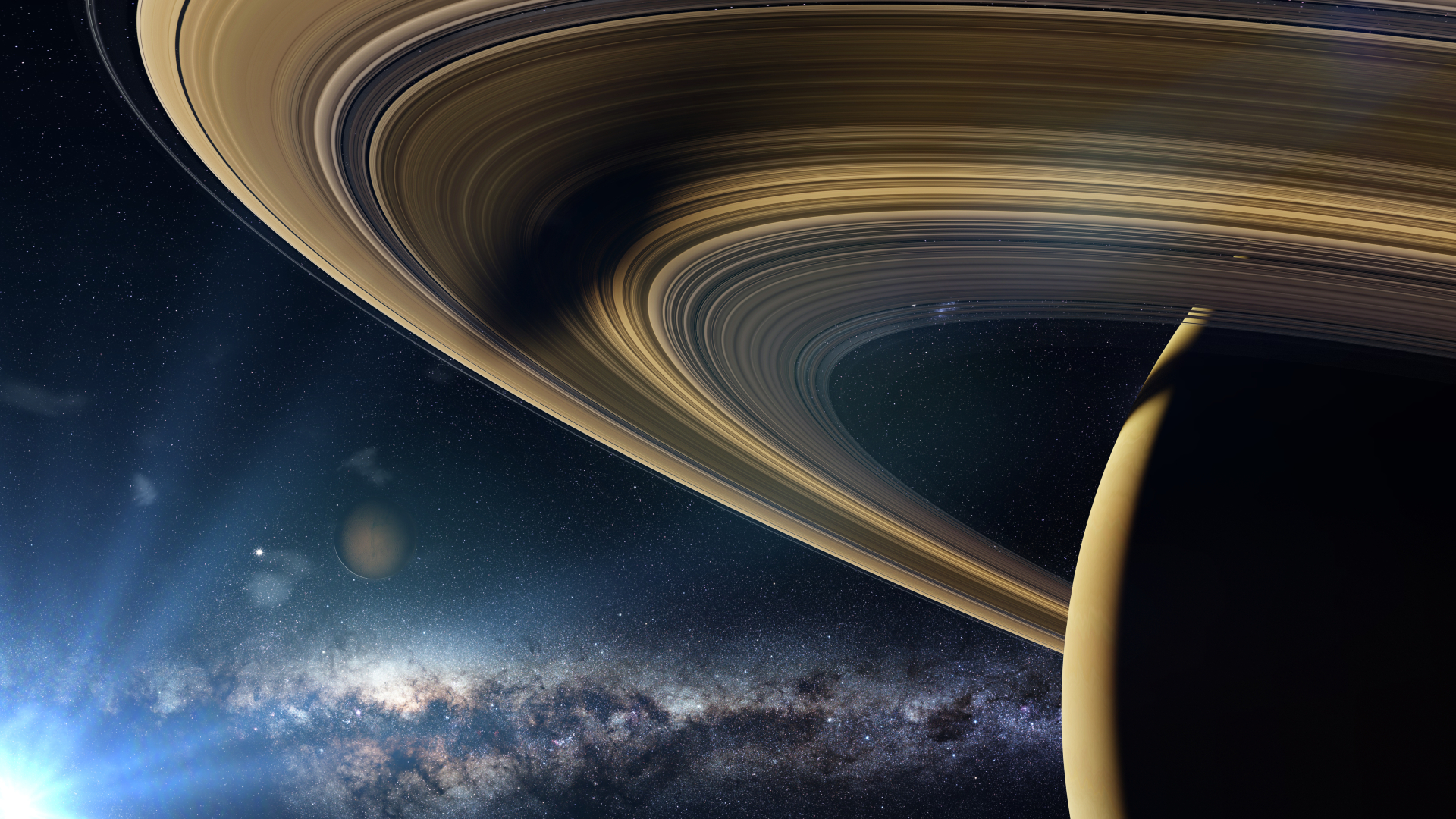
Saturn's rings are subjected to a relentless onslaught of cosmic rays, ultraviolet solar radiation, and microscopic interplanetary dust. Over eons, this constant weathering strips away outer silicate layers, continually exposing fresh, highly reflective water ice underneath.
ASTROPHYSICS / ATMOSPHERIC DRAINAGE
THE VANISHING RINGS
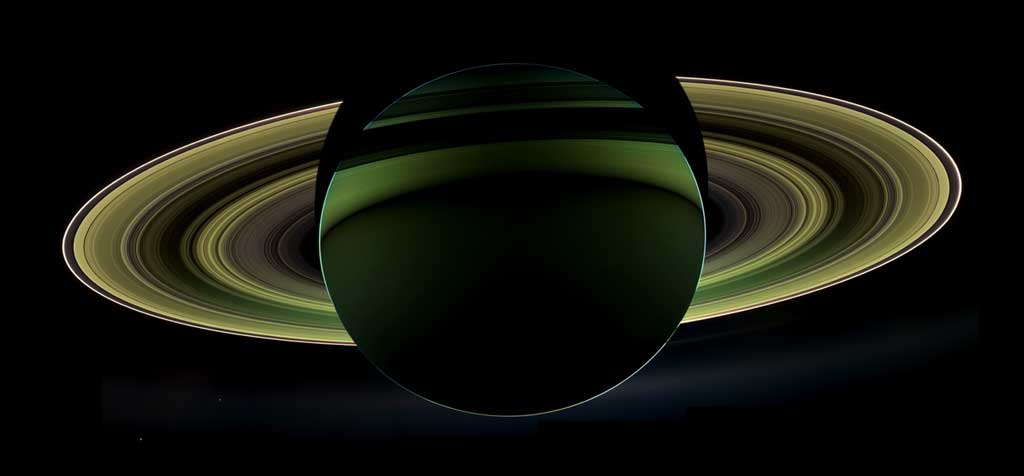
Saturn's rings are not permanent fixtures of the solar system. Data from the Cassini spacecraft's Grand Finale orbits revealed a continuous downward drain of water ice and charged particles channeled along magnetic field lines directly into the planet's upper atmosphere.

From Dust to Ice: Ring Composition FAQs
Tracing the evolution and material transformation of cosmic particles
In cold space environments, ambient water vapor and other volatile gases freeze directly onto the surfaces of microscopic silicate and carbonaceous dust grains.
While they are roughly 99% pure water ice, they also contain small amounts of rocky silicate dust, carbon compounds, and tholins that give parts of the rings subtle color variations.
Constant bombardment by micrometeoroids and solar radiation pulverizes ring material, kicking up dark dust that mixes with pristine ice over millions of years.
Primordial material started as a mix of interstellar dust and ice grains, which later coalesced into larger icy parent bodies before being torn apart by tidal forces.
Yes, vaporization from impacts and sublimation causes particles to shed ice, while collisions with other fragments and vapor redeposition allow them to accrete new material.
- Horizon -

Saturn

Ring Particle Collision

Thickness / Scale Ratio

Shepherd Moon Gravity
Roche Limit Calc

Dust to Ice Ratio
Ring Orbital Speed

Hexagon Wind Speed

Saturn's Density

Helium Rain Energy

Diamond Rain Energy

Supersonic Jet Streams

Methane Rain Ratio

Human Flight on Titan

Hydrocarbon Lake Depth

Titan Buoyancy

Gravity Well

Atmospheric Opacity

Enceladus Geyser Height

Light Travel Delay
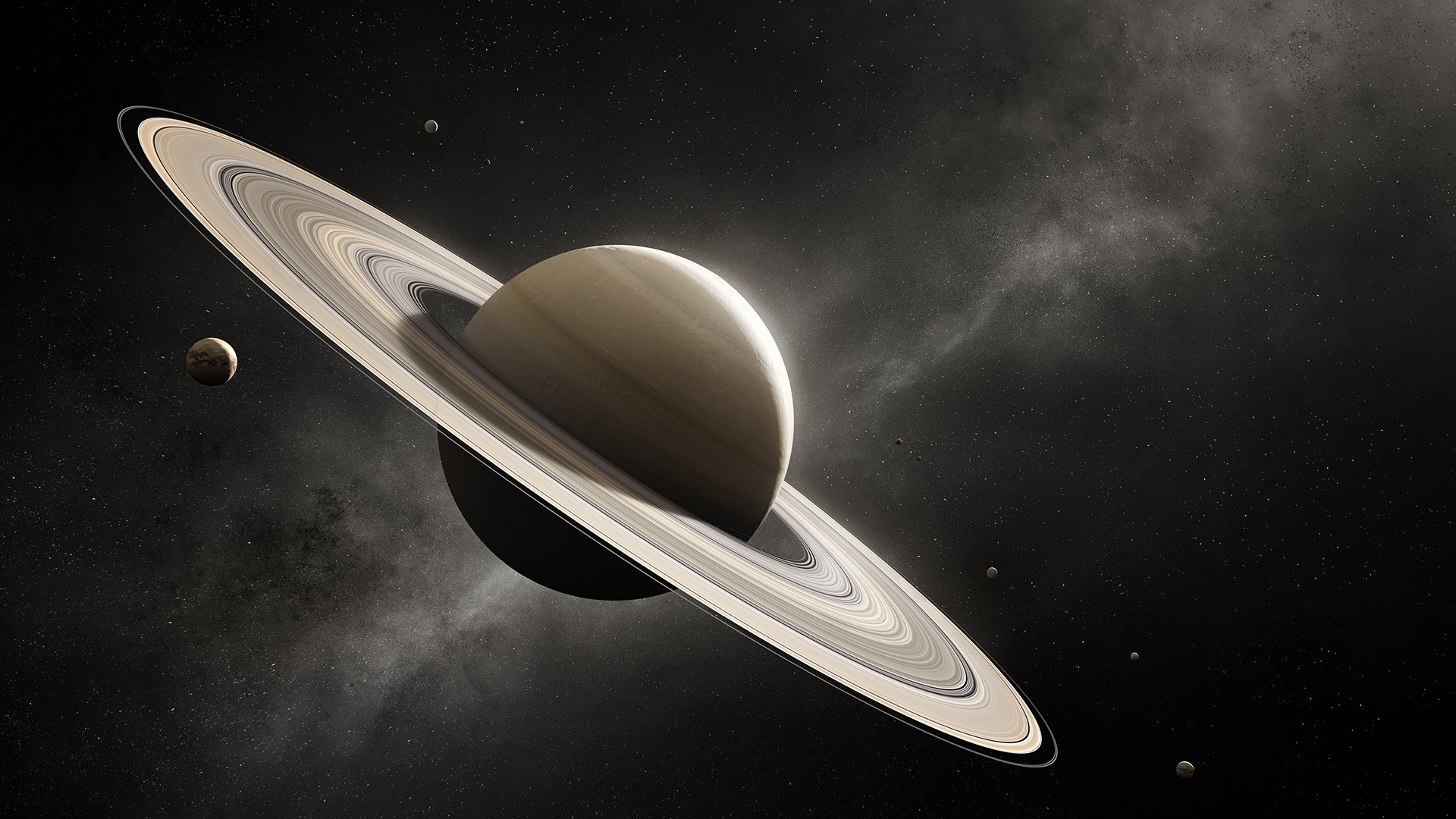
Saturn Season Tilt
/https://tf-cmsv2-smithsonianmag-media.s3.amazonaws.com/filer_public/ca/b0/cab0042a-70c0-4d60-a94a-20474eb1885b/gettyimages-560665807.jpg)
3D Model of Saturn
Saturn Mysteries
Sources
THE POLLUTION PROBLEM
Space is filled with dark "micro-meteoroid" dust. Over time, this dust hits the rings and "pollutes" the clean ice, making it darker and redder.
RING AGINGALBEDO MEASUREMENTS
Saturn's rings have a high Albedo (reflectivity) of **0.2 to 0.6**. This brightness suggests the ice is very fresh and hasn't been dusty for long.
SPECTRAL DATAYOUNG RINGS THEORY
Because there is so little dust, many scientists believe the rings are only **10 to 100 million years old**—meaning they formed when dinosaurs were on Earth!
CHRONOLOGY