Diamond Rain
PLANETARY LAB: DIAMOND RAIN
METHANE DISSOCIATION, CARBON CRYSTALLIZATION & ICE GIANT INTERIORS
The Diamond Rain Phenomenon
Deep within ice giants like Neptune and Uranus, extreme pressures and temperatures strip hydrogen atoms away from methane molecules. The remaining carbon atoms compress into solid diamond crystals that precipitate and sink toward the rocky core.
Solid diamond precipitation falling through deep fluid mantles.
Ideal thermodynamic conditions found thousands of kilometers deep.
Diamond Sync
Phase Mapping. Analyzing the 10 GPa pressure constant. New Horizons monitors the Carbon Buffer to track the methane-to-gemstone transition.
- ⚡ Catalyst: Lightning-induced soot.
- 💎 Process: Solid Diamond Precipitation.
- 🌊 Result: Liquid Carbon Sea Sync.
Diamond Sync
Carbon Phase Mapping. Analyzing the 10 GPa pressure constant. New Horizons monitors the Molecular Buffer to track the methane-to-gemstone transition.
- ⚡ Catalyst: High-Voltage Methane Cleaving.
- 💎 Process: Solidified Diamond Rain.
- 📏 Threshold: 30,000 km Phase Shift.
Gemstone Sync
Molecular Mapping. Analyzing the 10 GPa lattice constant. New Horizons monitors the Carbon Buffer to track the methane-to-gemstone evolution.
- 🌩️ Catalyst: lightning-Induced Methane Cleave.
- 🧱 Transition: Soot to Graphite to Diamond.
- 🔒 Result: Solid Tetrahedral Lock.
Anvil Sync
Pressure Mapping. Analyzing the 10 GPa threshold. New Horizons monitors the Atmospheric Anvil to track the 100,000x Earth pressure constant.
- 💎 Threshold: 10 Billion Pascals.
- ⚖️ Ratio: 100,000x Earth Surface.
- 🔒 Result: Permanent Crystalline Lock.
Diamond Sea Sync
Thermal Phase Mapping. Analyzing the 8,000 K melt constant. New Horizons monitors the Core Buffer to track the solid-to-liquid carbon transition.
- 🌡️ Melt Point: > 8,000 K (Deep Interior).
- 🌊 State: Liquid Metallic Carbon.
- ⚡ Function: Secondary Core Conductivity.
PLANETARY PHYSICS / DIAMOND RAIN ON ICE GIANTS
THE METHANE CRACKING ZONE
Deep beneath the turbulent, hydrogen-rich atmospheres of Uranus and Neptune, immense barometric pressures tear apart simple hydrocarbon molecules, stripping away hydrogen and forcing pure carbon atoms to crystallize into solid diamonds.

PLANETARY PHYSICS / DIAMOND PRECIPITATION
THE FALLING GEMSTONE MANTLE
Once methane molecules are cracked and pure carbon is forced into dense crystal lattices, heavy diamond stones begin an epic, slow-motion descent through thousands of kilometers of slushy, superionic ice mantles toward the planetary core.

PLANETARY PHYSICS / EXOPLANETARY ASTROPHYSICS
THE COSMICBUNDANCE OF DIAMOND WORLDS
Far from being unique oddities in our solar system, ice giants are among the most common types of planets discovered in the galaxy, suggesting that planetary-scale diamond precipitation is a widespread cosmic reality.


Diamond Rain On Gas Giants FAQs
Discovering the extreme atmospheric chemistry that turns methane into solid gemstones deep within Saturn and Jupiter
Diamond rain is a meteorological phenomenon where extreme pressures and temperatures deep inside planets like Saturn and Jupiter crystallize carbon compounds into solid diamond gemstones that fall toward the core.
Lightning storms in Saturn's upper atmosphere break methane molecules down into free carbon soot. As this carbon descends, mounting atmospheric pressure compresses it into solid graphite and ultimately pure diamond crystals.
Yes! As the diamonds plunge even deeper toward the scorching hot core, temperatures eventually rise high enough to melt the solid gems into a liquid carbon ocean.
Planetary models confirm that Saturn and Jupiter provide the ideal atmospheric pressures and carbon-rich chemistry for diamond rain, while ice giants like Uranus and Neptune experience similar extreme carbon crystallization.
Planetary scientists estimate that around 1,000 tons of diamond material are produced and precipitated across Saturn every single year.
Advanced laboratory shock-wave experiments successfully replicated the precise temperature and pressure conditions found inside gas giants, proving that carbon naturally forms stable diamond structures under those extremes.
Initial fragments start out as microscopic soot grains that grow into larger gemstone chunks as they aggregate and fall through the dense hydrogen layers.
Massive electrical storms act as the catalyst, supplying the high energy required to crack atmospheric methane ($CH_4$) molecules apart and release free carbon atoms.
No, harvesting is impossible because the diamond formation occurs thousands of kilometers deep where extreme pressure and heat would instantly crush any spacecraft.
Key search phrases include: diamond rain on Saturn, methane breakdown and carbon crystallization, gas giant interior chemistry, and planetary gemstone precipitation.
Sources
LIGHTNING CATALYST
Saturn's massive storms produce intense lightning that zaps methane gas ($CH_4$), stripping away hydrogen and leaving behind clouds of elemental carbon (soot).
STORM DYNAMICSCOMPRESSION PHASE
As the soot falls deeper, atmospheric pressure turns it into graphite. At ~6,000 km depth, the pressure reaches **100,000 atmospheres**, squeezing it into solid diamonds.
PHASE DIAGRAMSLIQUID DIAMOND
In the extreme heat near the core (~30,000 km deep), diamonds likely melt. Some theories suggest "diamond rain" turns into a sea of liquid carbon.
THERMAL PROFILES- Horizon -

Saturn

Ring Particle Collision

Thickness / Scale Ratio

Shepherd Moon Gravity
Roche Limit Calc

Dust to Ice Ratio
Ring Orbital Speed

Hexagon Wind Speed

Saturn's Density

Helium Rain Energy

Diamond Rain Energy

Supersonic Jet Streams

Methane Rain Ratio

Human Flight on Titan

Hydrocarbon Lake Depth

Titan Buoyancy

Gravity Well

Atmospheric Opacity

Enceladus Geyser Height

Light Travel Delay
Saturn Season Tilt
/https://tf-cmsv2-smithsonianmag-media.s3.amazonaws.com/filer_public/ca/b0/cab0042a-70c0-4d60-a94a-20474eb1885b/gettyimages-560665807.jpg)
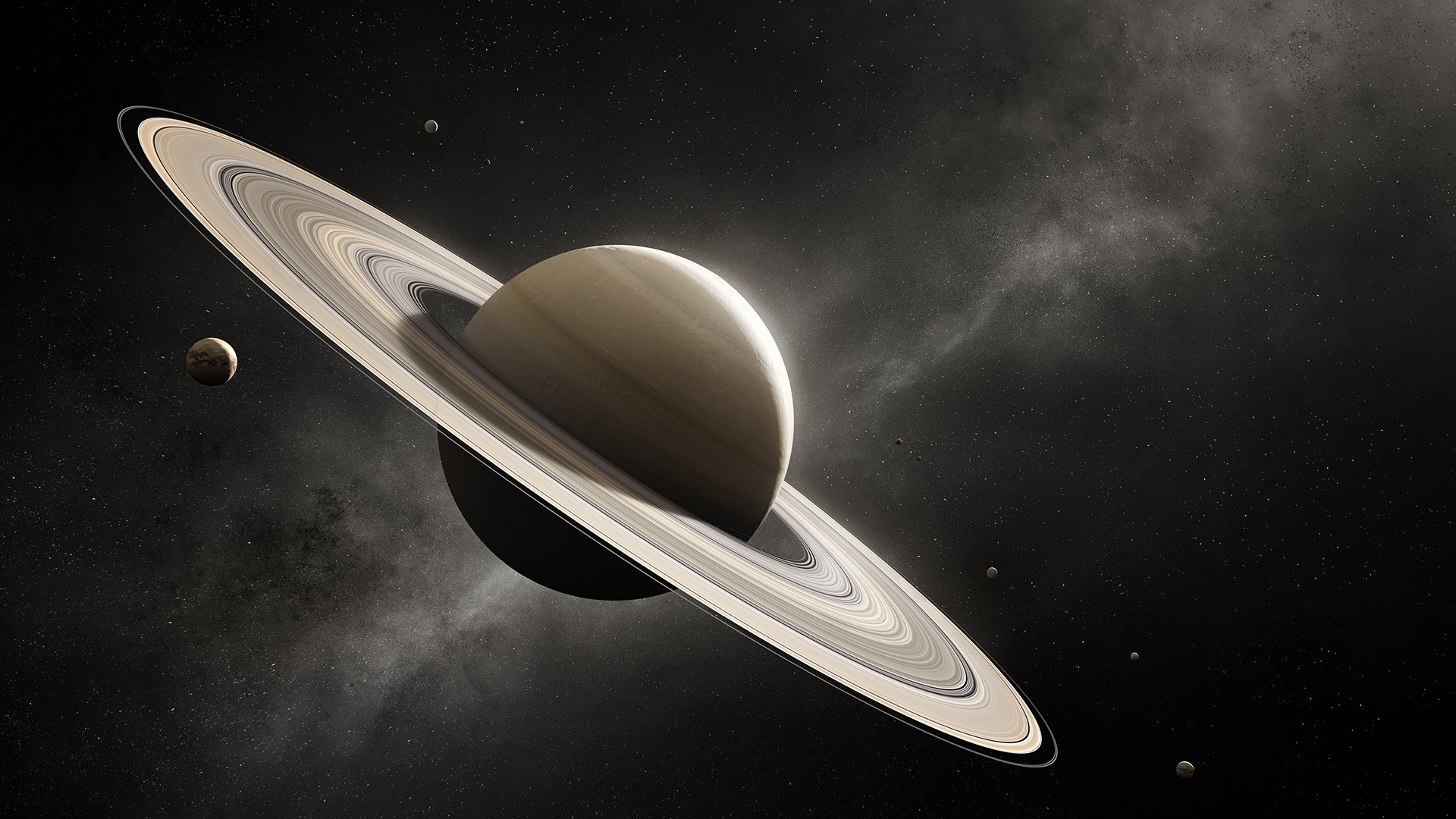
3D Model of Saturn