
Neptune Sonic Wind
NEPTUNIAN SUPERSONIC WINDS
EXTREME ATMOSPHERIC SHEAR & JET STREAMS
The Fastest Winds in Space
Neptune's atmosphere plays host to the most intense weather systems known, with zonal winds reaching supersonic speeds over 2,100 kilometers per hour. Remarkably, these jet streams blow in a retrograde direction—contrary to the planet's rotation.
Winds whip across the cloud tops at nearly 600 meters per second, shattering terrestrial records.
Air currents stream in the opposite direction of the planet's spin, driven by deep-seated thermal energy.
Sonic Wind
Supersonic Chaos. Neptune's atmosphere moves faster than the speed of sound, driven by a 5,000°C internal furnace.
- 🌪️ Max Speed: 2,100 km/h (Mach 1.6).
- 🚀 Power: Driven by internal heat Horizons.
- 📉 Friction: Near-zero drag environment.
Standard Aeroshield
Surviving the Entry. To reach the 1-Bar Zone, a craft must first survive a 11km/s dive through CO2 plasma using advanced ablative shielding.
- 🌡️ Ablation: Carbon Phenolic dissipates GigaJoules of heat.
- ⚖️ G-Load: Withstands up to 100g of deceleration.
- 🛡️ Chemical: Post-entry Teflon coat protects from acid.
Stabilized Carbon
Atomic Shielding. By doping carbon lattices with stabilizing elements, we create hulls that are immune to acid and 100x stronger than steel.
- 🧪 Anti-Corrosive: Naturally repels H2SO4 molecules.
- ⚡ Self-Healing: Horizons-state lattice repairs micro-cracks.
- ⚖️ Density: Ultra-lightweight for maximum buoyancy.
Ion-Anchor Hull
Magnetic Station-Keeping. By gripping the ionized atmosphere with electromagnetic fields, the Ion-Anchor prevents habitats from being swept away by supersonic winds.
- 🌀 Counter-Drift: Neutralizes 360 km/h wind loads.
- 🛡️ Faraday Layer: Integrated protection for residents.
- ⚡ Active Horizons: Dynamic adjustment for storm stability.
Kinetic Drag
Structural Resistance. In the 360 km/h winds of Venus, kinetic drag isn't just a force—it's a constant structural battle for stability.
- 📐 V-Squared: Drag quadruples every time speed doubles.
- 🏗️ Load: A 50m² wall faces 60+ kN of force.
- 🛡️ Shape: Cd optimization is vital for survival.
ASTRONOMY / ATMOSPHERIC DYNAMICS
THE SUPERSONIC JETSTREAM
Despite orbiting in the frigid depths of the outer solar system, Neptune defies planetary physics by generating violent, high-altitude jetstreams that blow at supersonic velocities, outstripping the fiercest storms on Earth by nearly seventeen times.

ASTRONOMY / ZONAL WIND DYNAMICS
RETROGRADE JETSTREAMS
Neptune’s wind structure is defined by extreme zonal flows. While equatorial winds blow gently in the direction of the planet's rotation, high-latitude winds reverse completely, ripping backward at hypersonic speeds against the planetary spin.

ASTRONOMY / VORTEX DYNAMICS
THE DARK VORTICES
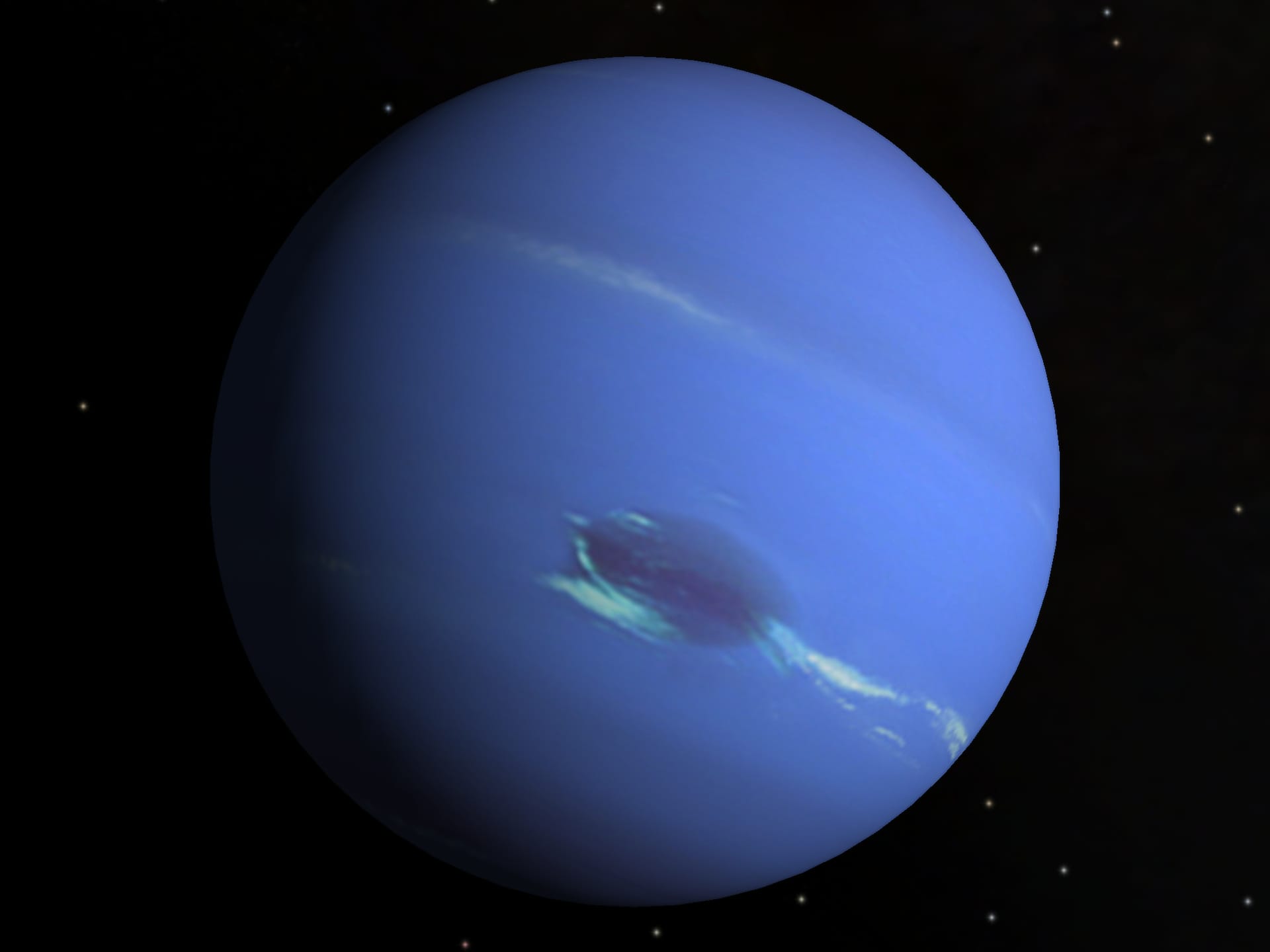
When Neptune's blistering supersonic jetstreams shear against one another, they tear open colossal, continent-sized storm systems. These dark anticyclonic vortices roam the azure atmosphere like planetary hurricanes before mysteriously dissolving.


Neptune's Supersonic Winds FAQs
Understanding the extreme atmospheric dynamics of the outermost giant
Neptune's winds are the fastest recorded in the solar system, reaching speeds of approximately 2,100 kilometers per hour (1,300 mph).
Yes, in Neptune's cold upper atmosphere, the speed of sound is much lower than on Earth. At these speeds, the winds are indeed supersonic, moving faster than the local sound barrier.
The exact cause remains a mystery, but researchers believe the low temperatures, internal heat flow from the planet's core, and lack of surface friction allow winds to build up massive momentum.
Primarily, the strongest winds blow in wide bands that travel in the direction opposite to the planet's rotation (retrograde), circling the globe near the equator.
Astronomers track the movement of giant cloud features and storms across Neptune's disk over long periods using high-resolution imaging from the Hubble Space Telescope and ground-based observatories.
Explore Tools!
Neptune

Supersonic Winds

Triton Retrograde Orbit

Signal Delay (Speed of Light)
Great Dark Spot

Internal Heat Radiator

Triton Geyser Height

Cloud Top Gravity

Density Comparison

"Scooter" Cloud

Atmospheric Velocity

Solar Distance Flux
Escape Velocity

Possibility of Life

View 3D Neptune
Sources
LOW FRICTION
Because Neptune lacks a solid surface, there is no topography to create friction and slow down the moving gas layers.
WIND DYNAMICSINTERNAL HEAT
Neptune's mysterious internal heat source drives the convection that fuels these massive, high-speed jet streams.
ENERGY BALANCEMACH NUMBER
In Neptune's cold atmosphere, the speed of sound is lower, making these winds move at supersonic Mach numbers.
FLUID MECHANICS