
Scooter Clouds
NEPTUNE SCOOTER CLOUDS
HIGH-SPEED METHANE-ICE FORMATIONS & VOYAGER 2 DISCOVERY
The "Scooter" Cloud Feature
Discovered during Voyager 2's historic 1989 flyby, "Scooter" is a bright, white wispy cloud formation that earned its nickname because it raced eastward across Neptune’s southern hemisphere faster than surrounding large storm systems like the Great Dark Spot.
A high-altitude cloud band outpacing underlying vortex structures.
Imaged during humanity's single close-range encounter with the ice giant.
The Scooter
Atmospheric Sprint. This erratic methane cloud earned its name by "scooting" around Neptune faster than any other visible feature, completing a circuit in just 16.8 hours.
- ⏱️ Rotation: 16.8 hours (Planet-leading).
- ☁️ Makeup: High-altitude methane ice.
- 🏁 Delta: 1.5 hours faster than the Great Dark Spot.
Supersonic Drift
Relative Velocity Profile. The Scooter’s 16.8-hour rotation allowed it to lap the Great Dark Spot every 8.5 days, slicing through Neptune's atmosphere at a supersonic pace.
- ⏱️ Rotation Period: 16.8 Hours.
- 🏁 Lead Time: 1.5h faster than the GDS.
- 🔄 Lapping Cycle: 205 hours to clear 360°.
Ice Cloud Nature
Methane Brilliance. Formed from frozen methane crystals 50km above the main deck, the Scooter glows by reflecting high-altitude sunlight against the deep blue void.
- 💎 Makeup: Solid Methane Ice Crystals.
- ☀️ Albedo: High reflectivity (Cirrus-like).
- 🌑 Shadows: Casts shadows 50km deep.
Historic Flyby
The 1989 Discovery. Captured by Voyager 2, the Scooter proved that Neptune isn't just a cold blue rock—it is a violent, internally-driven laboratory of supersonic physics.
- 📡 Mission: Voyager 2 Grand Tour (1989).
- 📸 Capture: First high-res methane cirrus images.
- 🌀 Impact: Confirmed 2,100 km/h wind speeds.
NEPTUNE / ATMOSPHERIC PHENOMENA
THE SCOOTER: NEPTUNE'S FAST-MOVER
The "Scooter" is a bright, fast-moving methane-ice cloud found in Neptune’s atmosphere. Named for its rapid circulation around the planet, it completes a full rotation every 16 hours—significantly faster than the Great Dark Spot. This feature provides vital data on the intense wind speeds and dynamic meteorological processes that define the Ice Giants of our solar system.
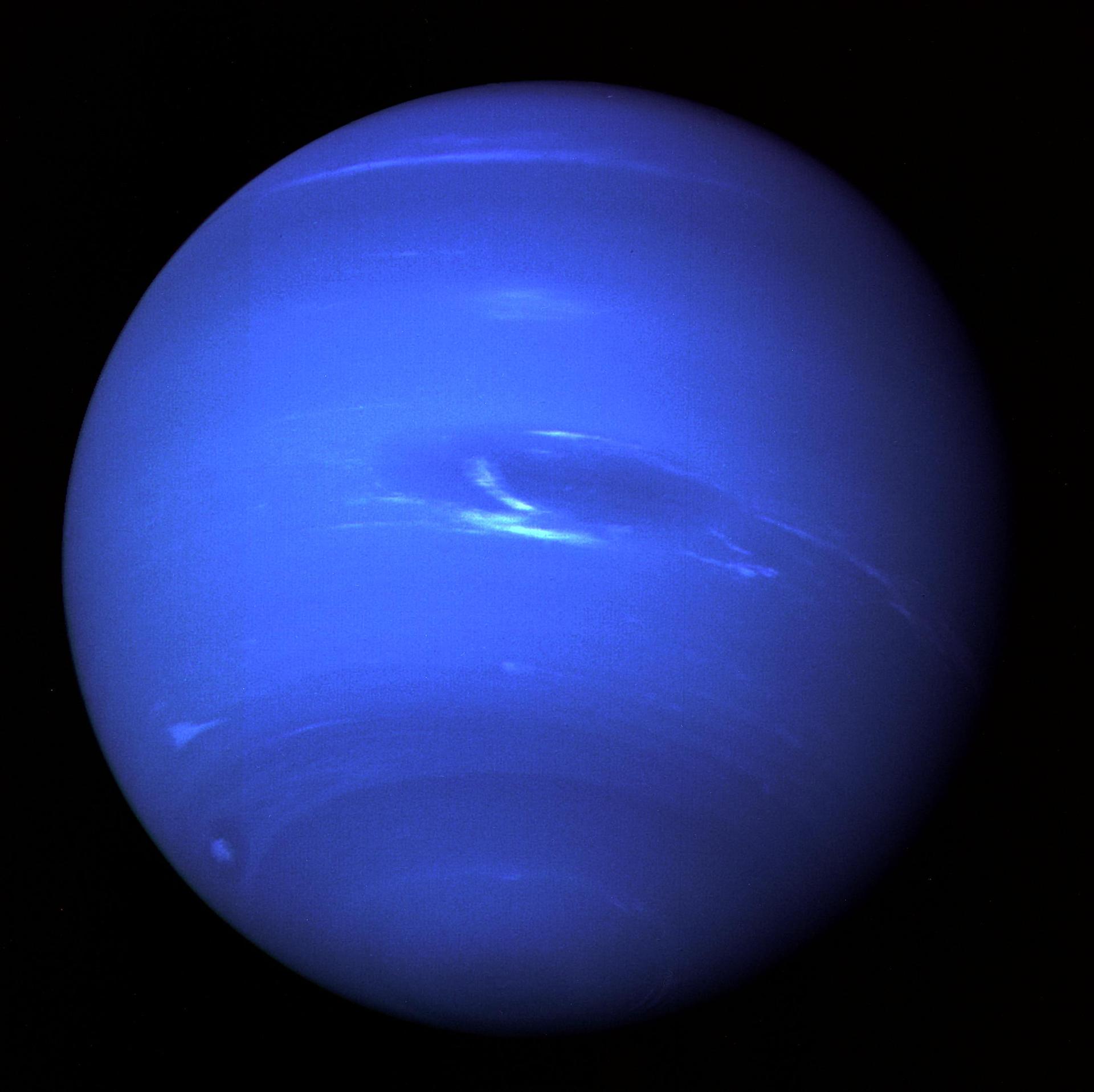
NEPTUNE / ATMOSPHERIC CONTRAST
SCOOTER VS. GREAT DARK SPOT
While the Scooter is a high-speed, transient feature, the Great Dark Spot represented a massive, stable anticyclonic storm system—similar to Jupiter’s Great Red Spot. The Scooter's rapid movement and shifting position contrast sharply with the localized, persistent nature of dark storms. Understanding this variance is crucial for modeling Ice Giant meteorology, as these features reveal how energy is transported throughout the planet's thick, turbulent atmosphere.

The Scooter Cloud Mystery
The 'Scooter' is a rapidly moving cloud feature that zips around Neptune, completing a full circuit in just 16 hours. Explore the physics of these high-altitude methane ice clouds and how they trace the violent, swirling winds of the planet's southern hemisphere.
DISCOVER THE CLOUDSSources
COMPOSITION
Scooter is likely a cirrus-like cloud composed of methane ice crystals, high in Neptune's troposphere.
VOYAGER FINDINGSVELOCITY
It "scooted" past other features because it was embedded in a different atmospheric jet stream layer.
WIND PHYSICSPHANTOM FEATURE
Like the Great Dark Spot, Scooter was a transient feature and is no longer visible in modern Hubble observations.
HUBBLE ARCHIVEOrbital Drift

Animated sequence showing the rapid transit of the "Scooter" relative to the Dark Spot.
Cloud Structure
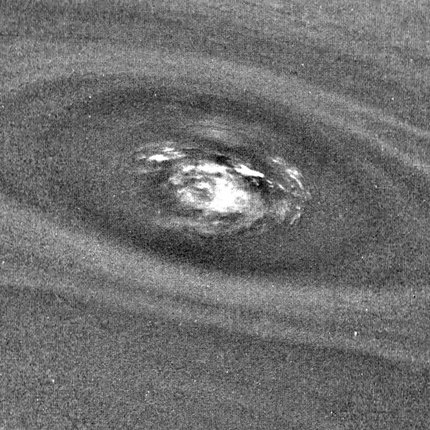
Methane-ice crystal formations at the edge of the tropospheric cloud deck.
Motion Data
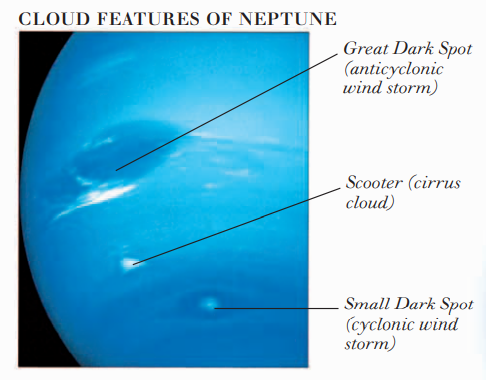
Rotation Period: 16 Hours (Fastest visible feature)
Composition: Condensed Methane (CH₄) Ice
Altitude: High-altitude Cirrus-like clouds

Neptune's Scooter Cloud FAQs
Facts about Neptune's fast-moving storm system and atmospheric dynamics
The "Scooter" is a white, fast-moving cloud feature in Neptune's southern atmosphere that was first discovered by Voyager 2 during its 1989 flyby.
It earned the nickname because it zipped around the planet much faster than nearby storms like the Great Dark Spot, appearing to scoot past them.
The cloud system moves at extreme speeds, circling the entire planet relative to Neptune's interior rotation in about 16 hours.
They form as high-altitude methane ice clouds floating above the deeper main cloud decks, catching direct sunlight.
Unlike persistent dark vortices, these bright cloud features can evolve, stretch, or dissipate relatively quickly due to powerful wind shears.
Neptune's winds are driven by an internal heat source combined with extremely low atmospheric friction, reaching supersonic velocities up to 2,000 km/h.
During the 1989 observations, the Scooter was tracked trailing just south of the Great Dark Spot, providing scientists a point of reference for atmospheric motion.
NASA's Voyager 2 spacecraft spotted the feature during its historic close-range flyby of the ice giant in August 1989.
While Voyager 2 captured close-up details, the Hubble Space Telescope regularly tracks dynamic high-altitude cloud bands and transient features resembling the Scooter.
They prove that despite its great distance from the Sun, Neptune possesses a surprisingly active, violent, and fast-changing meteorological environment.
Try Tools!

Neptune

Supersonic Winds

Triton Retrograde Orbit

Signal Delay (Speed of Light)
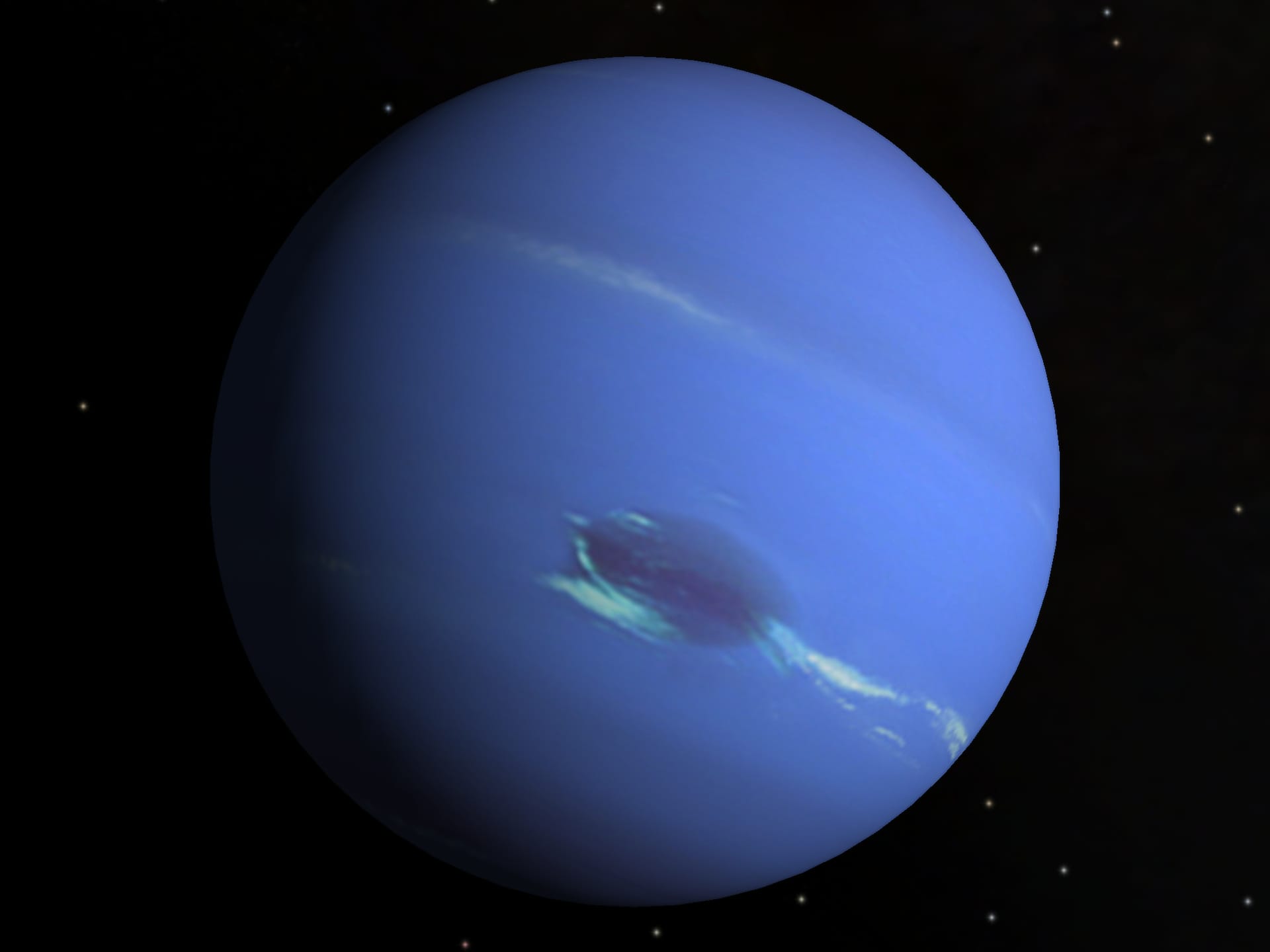
Great Dark Spot

Internal Heat Radiator

Triton Geyser Height

Cloud Top Gravity

Density Comparison

"Scooter" Cloud

Atmospheric Velocity

Solar Distance Flux
Escape Velocity

Possibility of Life
