
Neptune
PLANET NEPTUNE
SUPERSONIC WINDS & ICE GIANT DYNAMICS
The Windy Ice Giant
Neptune is the eighth and most distant major planet orbiting our Sun. As a dense ice giant, its vibrant azure appearance comes from atmospheric methane absorbing red light, driven by the fastest recorded supersonic winds in the entire solar system.
Atmospheric jet streams roar at nearly twice the speed of sound, whipping dark storm systems across the planet.
Orbiting over 4.5 billion kilometers from the Sun, a single Neptunian year takes roughly 165 Earth years.
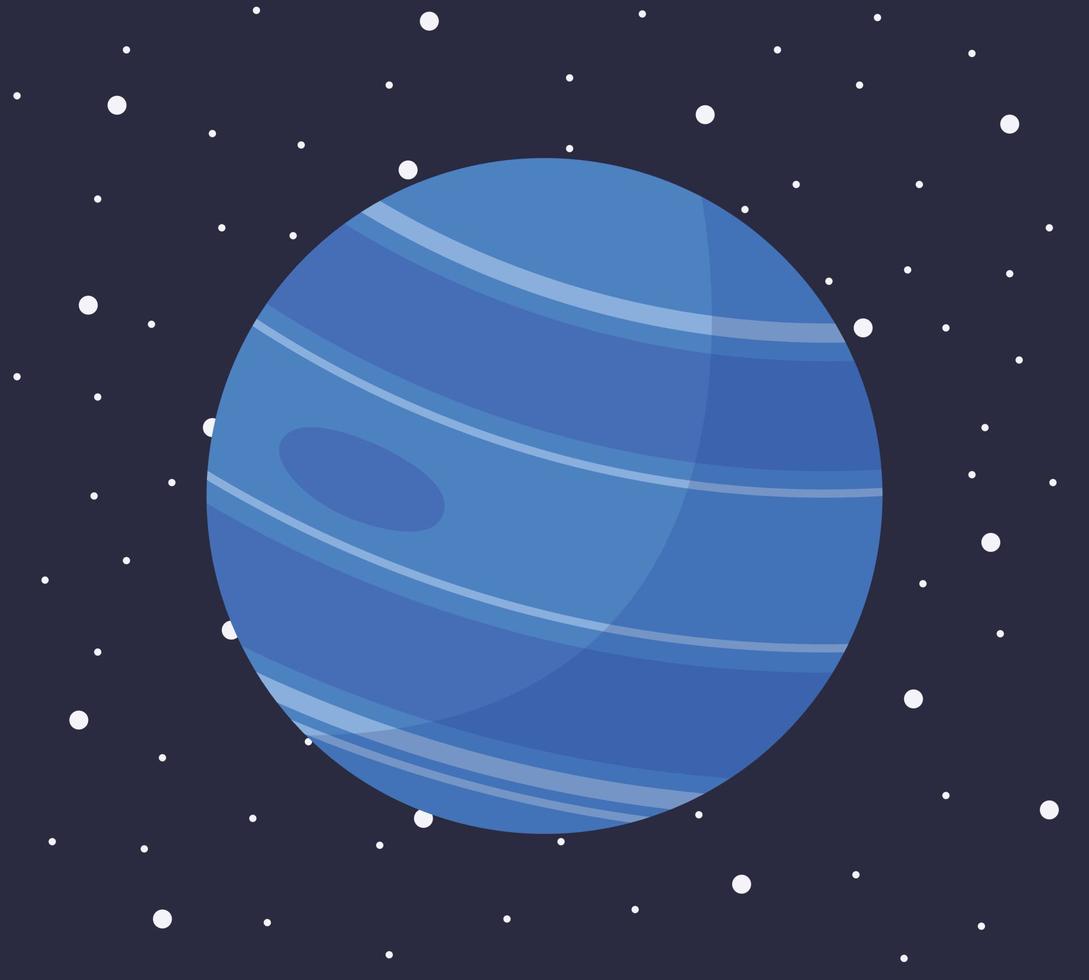
Neptune
The Wind Giant. A distant, frozen world where the winds scream at supersonic speeds and the atmosphere is a deep, methane blue.
- 💎 Atmosphere: Hydrogen, Helium, and Methane.
- 🌀 Weather: Home to the Great Dark Spot.
- 🛰️ Discovery: Predicted by math before being seen.
Neptune Ice
Beyond the Freezing Point. Neptune's "ice" isn't cold—it's a hot, superionic fluid where diamonds form and oxygen locks into crystals.
- 🧪 Composition: Water, Ammonia, and Methane.
- ⚡ State: Superionic (conducting protons).
- ✨ Pressure: Crushes Carbon into Diamond rain.
Internal Heat
The Frozen Furnace. Despite being 4.5 billion km from the Sun, Neptune's core is nearly as hot as the solar surface.
- 🌡️ Core Temp: Estimated at 5,100°C.
- 💎 Friction: Diamond rain generates thermal energy.
- 🌀 Drive: Heat powers 2,000 km/h winds.
Sonic Wind
Supersonic Chaos. Neptune's atmosphere moves faster than the speed of sound, driven by a 5,000°C internal furnace.
- 🌪️ Max Speed: 2,100 km/h (Mach 1.6).
- 🚀 Power: Driven by internal heat, not the Sun.
- 📉 Friction: Zero-drag fluid environment.
Retrograde Orbit
Triton's Path. Locked in a backward orbit, Neptune's largest moon is a captured world from the Kuiper Belt on a slow-motion collision course.
- 🔄 Direction: Opposite to Neptune's rotation.
- 📉 Fate: Spiraling inward due to tidal friction.
- 🌑 Origin: A captured KBO (Kuiper Belt Object).
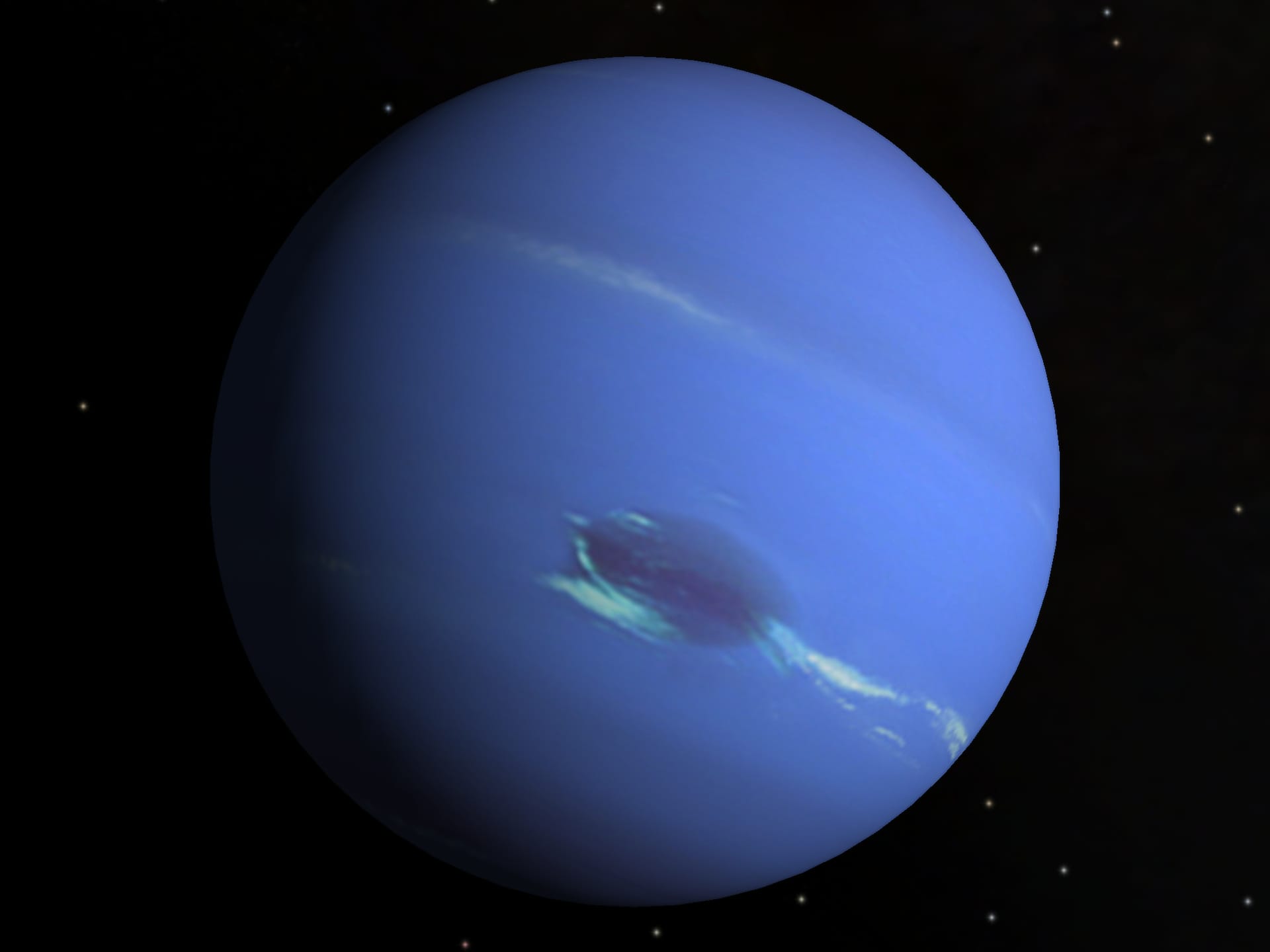
Great Dark Spot
The Vanishing Storm. An Earth-sized window into Neptune's depths, the Great Dark Spot is a testament to the planet's supersonic atmospheric energy.
- 🌪️ Type: High-pressure Anticyclone.
- 📉 Nature: Transient (appears and disappears).
- ☁️ Altitude: Forms beneath methane cirrus clouds.
Cryo Geysers
High-Altitude Eruptions. Nitrogen gas erupting from beneath Triton's ice can reach 8km high, carried by the moon's low gravity and thin air.
- 📏 Height: Up to 8,000 meters.
- 🧪 Material: Nitrogen gas and carbon dust.
- 🌬️ Drift: Trails stretch for 150km.
The Scooter
Atmospheric Fast-Lane. This bright methane cloud outpaced every other feature on Neptune, "scooting" around the planet in under 17 hours.
- ⏱️ Rotation: 16.8 Hours (Super-fast).
- ☁️ Material: High-altitude Methane Ice.
- 🏎️ Velocity: Faster than the Great Dark Spot.
Solar Distance
The Inner Circle. Venus orbits in a near-perfect circle 108 million km from the Sun, receiving nearly double the solar energy of Earth.
- 📏 Avg Distance: 0.72 AU (108M km).
- 🌀 Orbit: Most circular in the solar system.
- ⚡ Energy: 1.9x Earth's solar Horizons.
ASTRONOMY / PLANETARY SCIENCE
THE WINDSWEPT ICE GIANT
Neptune is the eighth and most distant major planet orbiting our Sun. As a frigid ice giant, it features supersonic winds, a striking azure complexion powered by atmospheric methane absorption, and a mysterious internal heat source.

ASTRONOMY / PLANETARY PHYSICS
THE ICY INTERIOR & DYNAMICS
Beneath Neptune's turbulent cloud tops lies a crushing mantle of superionic water, ammonia, and methane fluids. Coupled with a wildly tilted magnetic field and mathematical discovery, the ice giant challenges traditional planetary models.

ASTRONOMY / MOONS & RINGS
TRITON & THE DARK RINGS
Surrounding Neptune is a faint system of dark planetary rings and an eclectic collection of natural satellites. Chief among them is Triton, a captured Kuiper Belt world featuring nitrogen geysers and a retrograde orbit.

ASTRONOMY / SPACE EXPLORATION
VISITING THE ABYSS
Due to its immense distance from Earth, Neptune remains the least-explored gas or ice giant in our solar system. Only a single spacecraft has ever broken the threshold to study its cloud decks, rings, and magnetic anomalies up close.

ASTRONOMY / ATMOSPHERIC MYSTERIES
THE SHIFTING SKIES
Modern space observatories like the James Webb Space Telescope are unlocking new secrets about Neptune's dynamic atmosphere, infrared thermal signatures, and mysterious cloud cycles from Earth's cosmic backyard.

ASTRONOMY / EXTREME CHEMISTRY
THE DIAMOND RAIN
Deep beneath Neptune's swirling cloud decks and crushing fluid mantles lies a surreal realm of high-pressure physics, where methane molecules are violently torn apart to forge solid precipitation of pure carbon.

ASTRONOMY / PLANETARY CORES
THE HEAVY METAL CORE
At the absolute center of Neptune lies a dense, scorching core composed of molten rock and heavy metals. Subjected to extreme gravitational compression, this hidden heart sustains temperatures hotter than the surface of the Sun.


Neptune Exploration FAQs
Discover the cold, windy mysteries of the solar system's outermost giant
Neptune is classified as an ice giant because its interior is made up of a hot, dense fluid of "icy" materials—water, methane, and ammonia—above a rocky core.
Neptune has the fastest planetary winds in the solar system, reaching speeds of up to 2,100 kilometers per hour (1,300 mph).
Yes, Neptune has a faint, dark ring system. They are composed mostly of ice particles coated with silicate or carbon-based material, which makes them difficult to see.
Neptune has 16 known moons. The largest is Triton, which is unique because it orbits in the opposite direction to the planet's rotation.
Only one: NASA's Voyager 2 spacecraft flew past Neptune in 1989, providing our only close-up images and data of the planet, its rings, and its moons.
Sources
ATMOSPHERE
Mostly Hydrogen and Helium with traces of Methane. Home to the fastest winds in the solar system (2,100 km/h).
ATMOSPHERIC DATATEMPERATURE
Average temperature of **-214°C**, though it has an internal heat source that radiates twice the energy it receives.
THERMAL STATSORBITAL CYCLE
One year on Neptune lasts about **165 Earth years**. It has only completed one full orbit since its discovery in 1846.
ORBITAL DATAExplore Tools!
Neptune

Supersonic Winds

Triton Retrograde Orbit

Signal Delay (Speed of Light)
Great Dark Spot

Internal Heat Radiator

Triton Geyser Height

Cloud Top Gravity

Density Comparison

"Scooter" Cloud

Atmospheric Velocity

Solar Distance Flux
Escape Velocity

Possibility of Life
