
Atmosphere Logs
NEPTUNE ATMOSPHERE LOGS
STRATIGRAPHIC PROFILES, COMPOSITION & THERMAL DYNAMICS
Primary Composition Profile
Neptune's atmosphere is rich in molecular hydrogen (approx. 80%) and helium (approx. 19%), with trace amounts of methane (~1.5%). The presence of methane absorbs red wavelengths of light, giving the ice giant its striking deep azure-blue appearance.
Dominant primordial gas making up the bulk of the upper envelope.
Deep supercritical fluid layers rich in water, ammonia, and methane ices.
Atmospheric Velocity
Supersonic Extremes. Neptune’s winds defy logic, reaching 2,100 km/h. Driven by internal heat, these storms turn the planet into the solar system’s fastest wind tunnel.
- 🌪️ Peak: 2,100 km/h (Supersonic).
- 🔄 Flow: Retrograde (Opposite rotation).
- ⚡ Source: Internal thermal convection.
Extreme Jets
Velocity Vector. At 2,100 km/h, Neptune's jet streams outpace fighter jets. With no solid surface to provide friction, these supersonic winds wrap the planet in a permanent high-speed vortex.
- 🚀 Speed: 2,100 km/h (1,300 mph).
- 🔄 Flow: Retrograde / Counter-rotation.
- 💎 Friction: Near-zero (No solid surface).
Breaking Sound
Mach 1.3+ Detected. On Neptune, the speed of sound is a lower hurdle. The winds don't just blow—they create supersonic shockwaves that heat the atmosphere and defy terrestrial limits.
- 🔊 Local Speed: ~1,620 km/h.
- 💥 Impact: Continuous sonic shockwaves.
- 🌡️ Result: Kinetic-to-Thermal energy conversion.
Convection Engine
Internal Power. Radiating 2.6x the heat it receives from the Sun, Neptune is a self-powered weather machine, fueled by primordial heat and deep-mantle physics.
- 🔥 Output: 2.6x Solar Absorption.
- 🌀 Effect: Supersonic Atmospheric Drive.
- 💎 Fuel: Diamond rain & gravitational compression.
PLANETARY SCIENCE / ATMOSPHERE LOGS NEPTUNE
THE VOLATILE ENVELOPE LOGS
Archival mission logs from Voyager 2 and deep-space telescope observations reveal an active, hydrogen-rich atmosphere laced with heavier hydrocarbons and frozen volatile compounds, maintaining extreme thermal and barometric gradients.

PLANETARY SCIENCE / ATMOSPHERE LOGS NEPTUNE
STRATOSPHERIC THERMAL PROFILES
Telemetry logs mapping Neptune's thermal profile reveal severe temperature swings between the freezing tropopause and the warmer thermospheric boundaries, driven by internal heat radiation and solar ultraviolet interactions.

PLANETARY SCIENCE / ATMOSPHERE LOGS NEPTUNE
GLOBAL VORTICES & STORMS
Final atmospheric logs synthesize data on Neptune's planetary storm systems, revealing gigantic dark vortices and migrating high-altitude cloud bands powered by deep interior convection currents.

Sources
RETROGRADE JETS
Neptune's strongest winds at the equator blow westward (retrograde), opposite to the planet's rotation, reaching 600 m/s.
JET STREAM DATAVISCOSITY PARADOX
In such cold temperatures (-214°C), the atmosphere has very low viscosity (friction), allowing winds to accelerate unchecked.
FLUID DYNAMICSCONVECTIVE DRIVE
Internal heat from the core creates powerful vertical convection, which is translated into horizontal velocity by the Coriolis effect.
THERMAL FORCING
Neptune Atmosphere Logs FAQs
Historical and scientific logs tracking Neptune's atmospheric composition and pressure data
Atmospheric logs show that Neptune's outer envelope consists predominantly of hydrogen (~80%) and helium (~19%), with roughly 1.5% methane gas.
Probes and remote logs track atmospheric depth using radio occultation experiments, measuring how radio signals bend and fade as they pass through varying pressure levels.
Voyager 2 telemetry logs documented the fastest planetary winds ever recorded in the solar system, peaking near 2,100 kilometers per hour.
Thermal logs indicate that temperatures at the cloud tops drop to around -214°C (59 Kelvin), making it one of the coldest places in the solar system.
Pressure logs show a rapid increase from fractions of a bar at the upper boundary to millions of bars deep within the planetary interior.
Infrared observation logs show that Neptune radiates roughly 2.6 times more energy than it receives from the Sun, indicating an active internal heat source.
Long-term telescopic logs from Hubble reveal that Neptune experiences extreme seasons lasting over 40 Earth years, shifting cloud brightness and band patterns.
Photochemical logs demonstrate that ultraviolet sunlight breaks down methane molecules in the upper stratosphere, forming smog-like hydrocarbon hazes.
Planetary scientists typically use the 1-bar pressure level as the effective "surface" reference point for Neptune, given its lack of a solid terrestrial crust.
Proposed dedicated flagship orbiter and probe concepts are currently studied by space agencies to dive deeper and refresh our legacy Voyager atmospheric logs.
Try Tools!

Neptune

Supersonic Winds

Triton Retrograde Orbit

Signal Delay (Speed of Light)
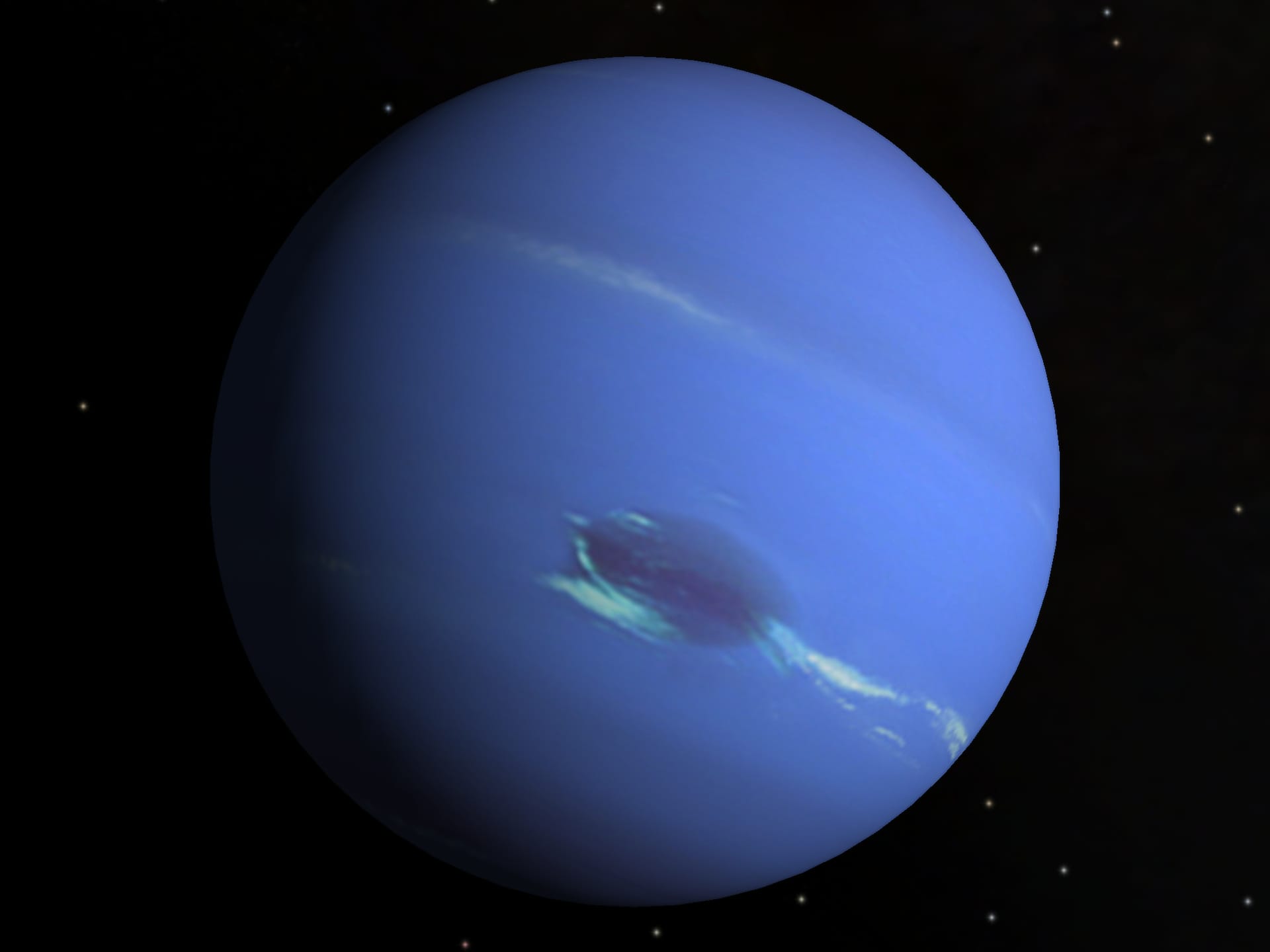
Great Dark Spot

Internal Heat Radiator

Triton Geyser Height

Cloud Top Gravity

Density Comparison

"Scooter" Cloud

Atmospheric Velocity

Solar Distance Flux
Escape Velocity

Possibility of Life
