NEW

Supersonic Winds
NEW

Triton Retrograde Orbit
NEW

Signal Delay (Speed of Light)
NEW
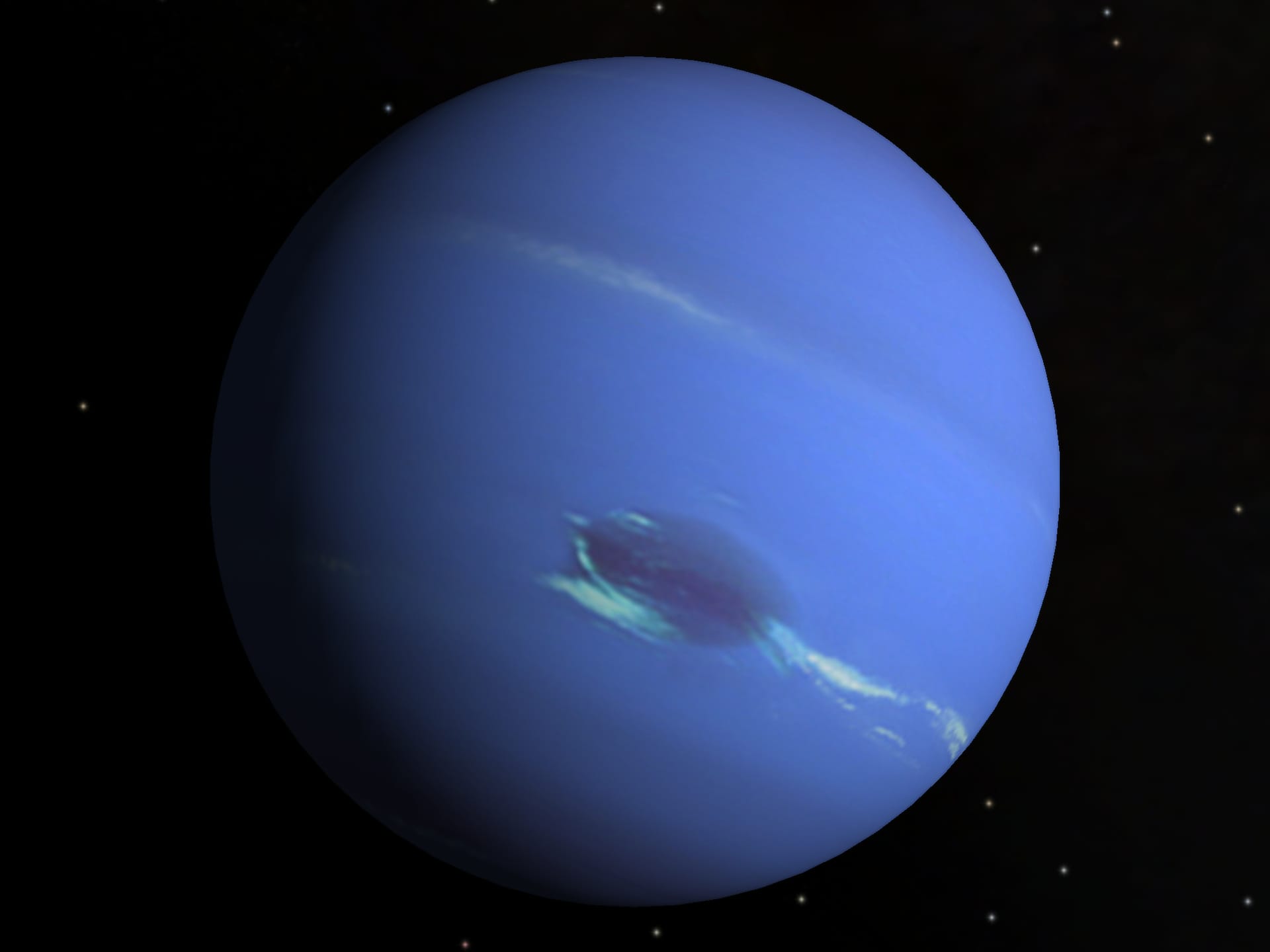
Great Dark Spot
NEW

Internal Heat Radiator
NEW

Neptune exhibits the highest sustained wind speeds in the solar system, with zonal jets exceeding 600 m/s. These phenomena are governed by the interaction of atmospheric rotation and thermal buoyancy. To model the stability and lifespan of these massive anti-cyclonic vortices, we utilize the Navier-Stokes equations adapted for a rotating spherical reference frame. By analyzing the vorticity equation, we can quantify the energy dissipation rates that define the longevity of features like the Great Dark Spot.
On Neptune, the Coriolis effect acts as a primary stabilizer for anti-cyclonic vortices. As parcels of fluid move toward or away from the equator, they experience an apparent deflection proportional to the planetary rotation rate. In high-latitude regions, this leads to the formation of Rossby waves—large-scale meandering flows that regulate heat transport. The stability of Neptune's dark spots is contingent on the balance between the pressure gradient force and the Coriolis force, defined by the Geostrophic balance equation: f * v = (1/rho) * (dp/dx). When this balance is disrupted, the vortex undergoes rapid deformation.
Neptune's internal heat source, which radiates more energy than the planet receives from the Sun, is the primary driver of its extreme atmospheric activity. This heat flux triggers convective plumes that rise from the deep interior, providing the kinetic energy required to sustain long-lived vortex structures. The vertical transport of latent heat during condensation cycles reinforces these vortices against frictional decay. The stability of these plumes is determined by the Richardson number, expressed as Ri = N^2 / (du/dz)^2, where N is the Brunt-Vaisala frequency. If Ri is too low, shear instabilities disrupt the vortex core.
Neptune’s atmospheric vortices are dynamic entities that frequently interact, shear, and merge. When two anti-cyclonic vortices approach one another, their mutual velocity fields lead to a capture process governed by the conservation of potential vorticity. The merging dynamic is essentially a non-linear process where smaller eddies are subsumed by larger structures, increasing the total vorticity of the primary storm. This is mathematically represented by the change in the stream function, where the interaction velocity is proportional to the vortex intensity and the inverse square of their separation distance.
This diagnostic interface provides the computational framework for evaluating the energetic evolution of planetary vortices. By integrating input parameters—such as local wind shear, potential temperature gradients, and pressure anomalies—this system models the storm's lifespan and structural integrity against atmospheric dissipation.
Quantify the energy localized within the vortex core: KE = 0.5 * rho * (u^2 + v^2).
Calculate the deformation radius L_R = NH / f to define the horizontal scale of stable atmospheric disturbances.
zeta = (del x u) . k
PV = (zeta + f) * (theta / dp)
Ri = N^2 / (du/dz)^2
Vortex core instability detected: Potential temperature gradient mismatch implies impending shear-induced dissipation.
Neptune's atmospheric system exhibits remarkable climate stability punctuated by periodic storm re-emergence. Unlike the static features of larger gas giants, Neptunian vortices appear, vanish, and reappear on timescales dictated by seasonal solar forcing and deep-seated convective cycles. This re-emergence is hypothesized to be a result of the relaxation of potential vorticity gradients, where the atmosphere periodically returns to a state of equilibrium, followed by the injection of new convective energy. The fundamental timescale is characterized by the Rossby wave relaxation period: T = 2 * pi * R / (c), where R is the planetary radius and c is the zonal wave speed.

Stay updated with the latest astronomical discoveries, space mission updates, and community events from HORIZONS. It is an honor to have you join our journey through the stars.