Parker Solar Probe
PARKER SOLAR
TOUCHING THE SUN
Braving the Heat
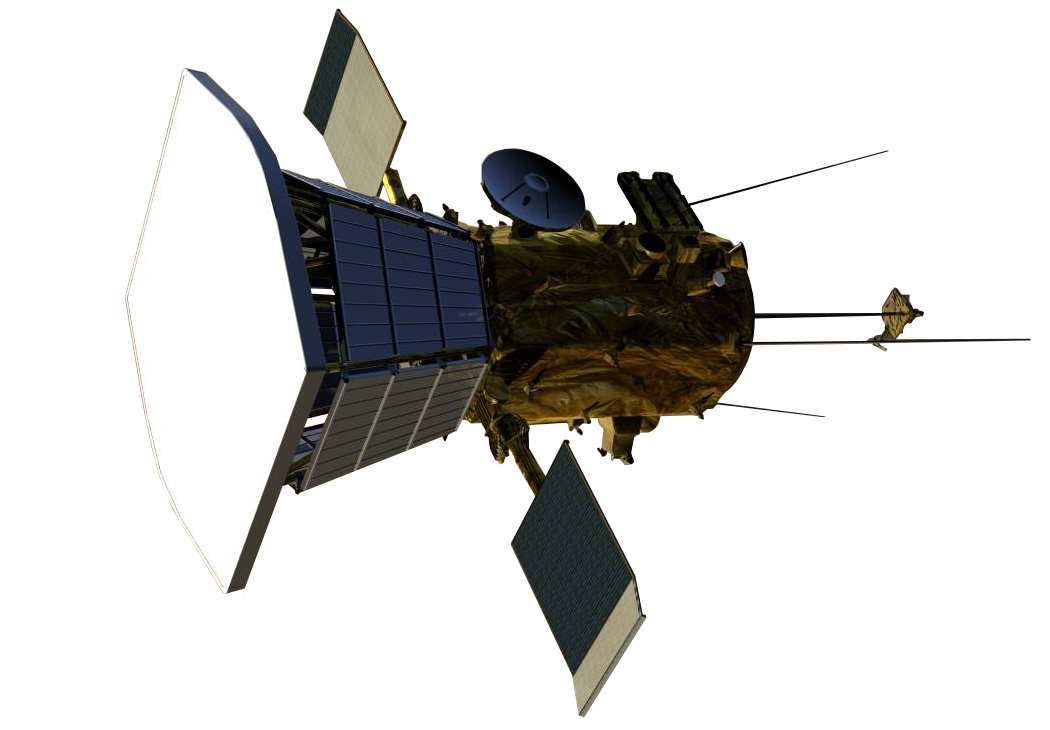
Launched in 2018, the Parker Solar Probe travels through the Sun's outer atmosphere (Corona) to study solar wind and high-energy particles.
Fastest human-made object.
Temperature of the heat shield.
Thermal Sync
Carbon Mapping. Monitoring the TPS (Thermal Protection System) to track the 1,370°C solar interface.
- 🛡️ Shield: 4.5-Inch Carbon Composite.
- 🔥 External: 2,500°F Solar Flux Sync.
- ❄️ Internal: 30°C Payload Buffer.
Velocity Sync
Kinetic Mapping. Tracking the Perihelion buffer as the probe reaches 690,000 km/h.
- 🚀 Speed: 191 km/s Orbital Sync.
- ☄️ Gravity: Venus Assist Protocol.
- ⏱️ Record: Fastest Kinetic Buffer.
Plasma Sync
Magnetic Mapping. Monitoring the FIELDS instrument to track solar wind acceleration.
- 🧲 Fields: EMF Induction Sync.
- 🌬️ Wind: Supersonic Ion Protocol.
- 🌀 Corona: Alfvén Surface Buffer.
Proximity Sync
Distance Mapping. Monitoring the solar-approach buffer at 3.8 million miles from the surface.
- ☀️ Distance: 9.86 Solar Radii Sync.
- 🛰️ Orbit: Highly Elliptical Protocol.
- 🌌 Corona: Outer Atmosphere Buffer.
Power Sync
Solar Mapping. Managing the retractable solar arrays and autonomous cooling buffer.
- 🔋 Array: Shadow-Retraction Sync.
- 💧 Cooling: Deionized Water Protocol.
- 🧠 Logic: Self-Correction Buffer.
SOLAR PHYSICS / PARKER SOLAR PROBE
TOUCHING THE SOLAR CORONA
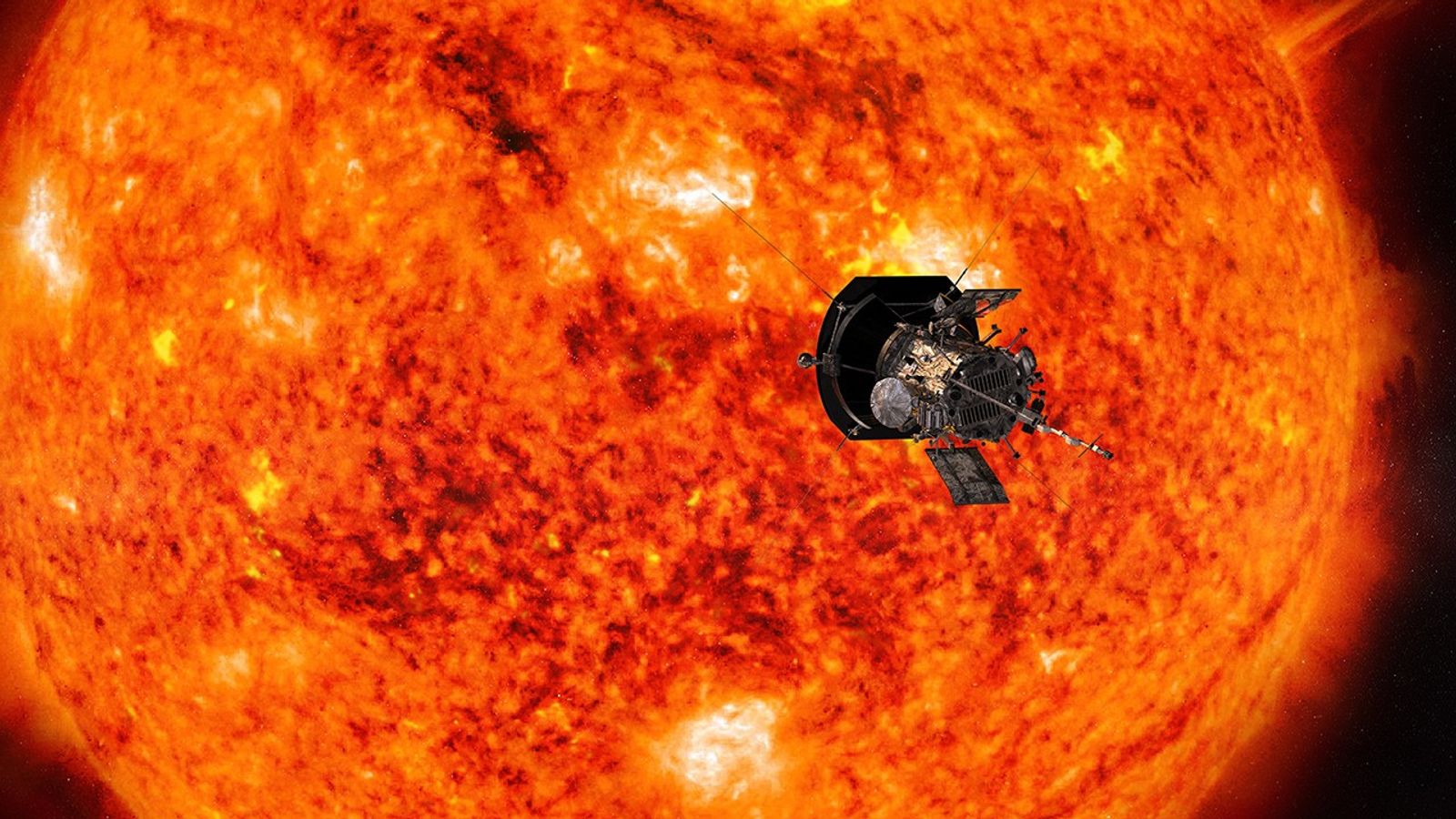
As humanity's boldest venture into stellar meteorology, NASA's Parker Solar Probe uses repeated Venus gravity assists to plunge directly into the Sun's blistering outer atmosphere, unlocking the physics of solar wind acceleration and coronal heating.
SOLAR PHYSICS / ORBITAL MECHANICS
SHIELDING & VENUS ASSISTS
Reaching the Sun requires shedding orbital speed so the spacecraft falls closer to the star. By utilizing repeated Venus flybys over several years, the probe progressively tightens its solar orbit while hiding behind a revolutionary heat shield.

SOLAR PHYSICS / DISCOVERIES & VELOCITY
REWRITING STELLAR PHYSICS
Diving through the Alfvén critical surface—the boundary where solar wind breaks free from the Sun's magnetic grip—Parker has captured unprecedented telemetry on magnetic switchbacks, coronal structure, and record-shattering velocities.

Solar & Deep Space Speed Records
Parker Solar Probe Data Logs • Comparative Velocity & Distance MetricsA clear look at humankind’s fastest exploration vehicles. Metrics cover launch mass, max speed records, and closest approach parameters for structural comparison.
| Mission & Agency | Launch Mass | Max Speed |
|---|---|---|
|
Parker Solar Probe NASA
Solar Corona Explorer
|
0 kg | 0 km/h |
|
Helios 2 NASA / KWU
Solar Orbital Probe
|
0 kg | 0 km/h |
|
Juno NASA
Jovian Polar Orbiter
|
0 kg | 0 km/h |
|
New Horizons NASA
Pluto & Kuiper Belt Flyby
|
0 kg | 0 km/h |
Sources
THERMAL PROTECTION (TPS)
An 8-foot-wide, 4.5-inch-thick carbon-carbon composite shield. It protects the craft from temperatures reaching nearly **1,370°C** while keeping the instruments at a cool **29°C**.
SHIELD SPECSRECORD VELOCITY
Using Venus gravity assists, Parker reaches speeds up to **692,000 km/h** (430,000 mph). This is fast enough to travel from Tokyo to New York in under a minute.
MISSION LOGALFVÉN SURFACE
The probe's mission is to locate where solar winds transition from sub-Alfvénic to super-Alfvénic, helping solve the mystery of why the corona is hotter than the surface.
CORONA DATA
Parker Solar Probe FAQs
Exploring humanity's historic mission to touch the Sun and analyze solar wind dynamics
The Parker Solar Probe traces how energy and heat move through the solar corona and investigates what accelerates the solar wind and energetic particles.
During its closest approach perihelion passes, the probe sweeps to within approximately 3.8 million miles (6.1 million kilometers) of the Sun's surface.
It features a 4.5-inch-thick (11.4 cm) carbon-composite thermal protection system shield that keeps instruments behind it at comfortable room temperatures despite external heat over 2,500°F.
Driven by Venus gravity assists, it reaches record-breaking velocities exceeding 430,000 miles per hour (700,000 kilometers per hour), making it the fastest human-made object.
It is named after Eugene Parker, the pioneering astrophysicist who first predicted the existence of supersonic solar wind in 1958.
The spacecraft executes multiple Venus gravity-assist flybys over its mission lifecycle to gradually shrink its orbital ellipse and pull closer to the Sun.
Suite packages include magnetometers, plasma analyzers, energetic particle detectors, and wide-field imagers designed to capture direct measurements of solar corona plasma.
Understanding coronal heating helps scientists forecast dangerous space weather events that can disrupt satellite communications, power grids, and astronaut safety on Earth.
NASA successfully launched the Parker Solar Probe aboard a Delta IV Heavy rocket from Cape Canaveral on August 12, 2018.
It is the first NASA spacecraft to fly directly through the sun's atmosphere (the corona), effectively becoming the first mission to "touch" a star.
Recommended Tools
View AllLoading recommended tools...