Newton
- Gravity -

FOUNDATIONS / PHYSICS
NEWTON'S LAWS: ARCHITECTURE OF MOTION
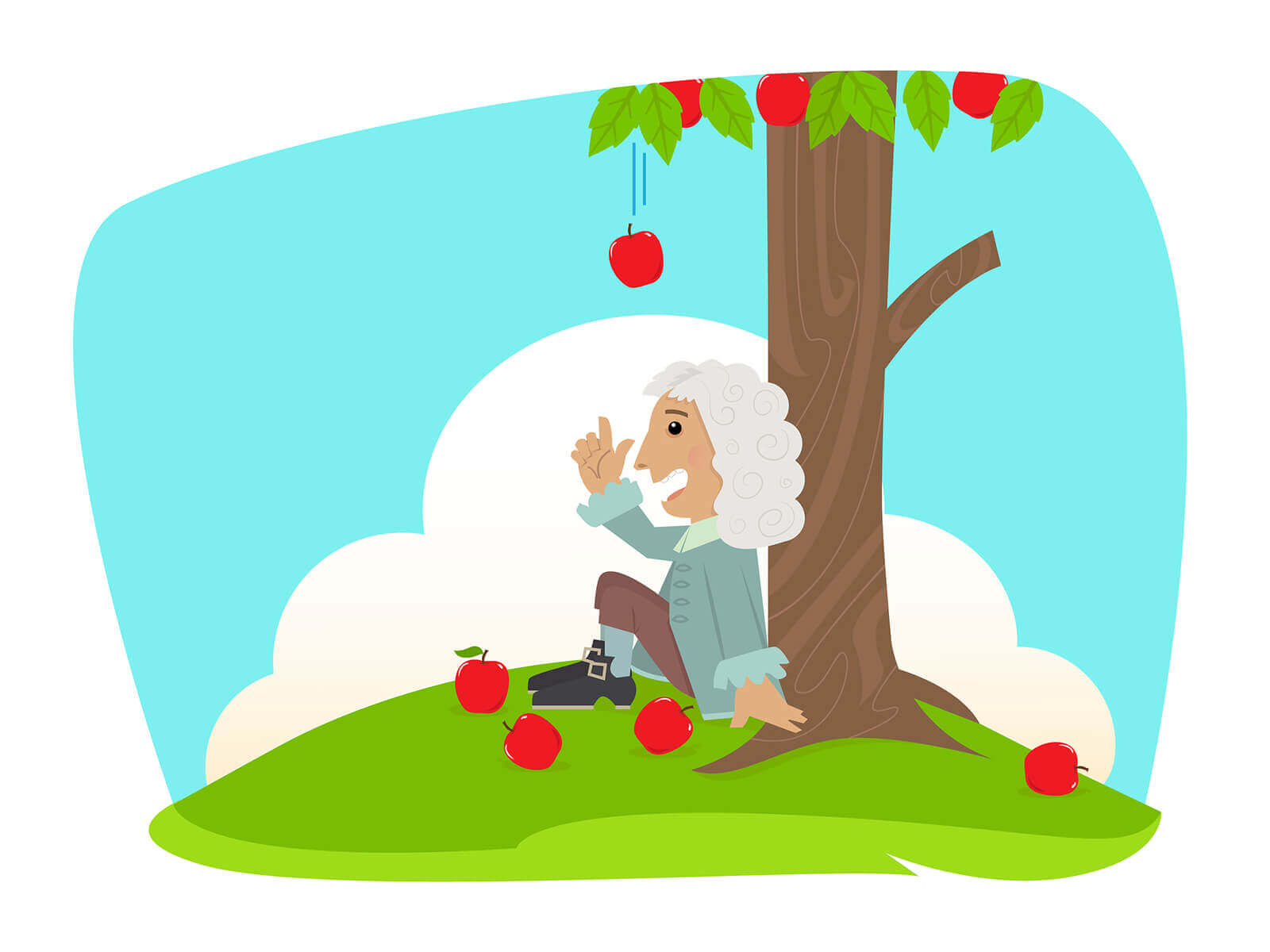
Isaac Newton’s three laws of motion are the fundamental rules governing the universe. For New Horizons, these aren't just equations—they are the blueprints for how we move through the vacuum of space. By mastering inertia, the relationship between force and acceleration, and the principle of action and reaction, we gain the capability to launch vehicles, calculate trajectories, and sustain long-duration space flight.
FOUNDATIONS / PHYSICS
NEWTON'S 1ST LAW: INERTIA
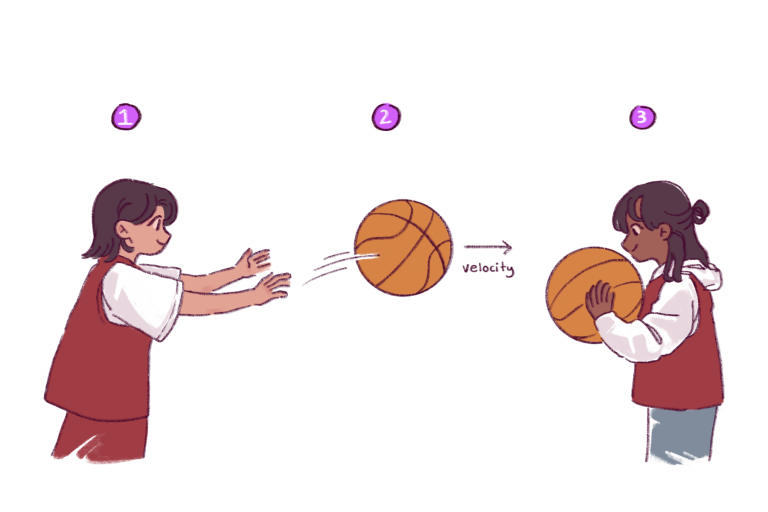
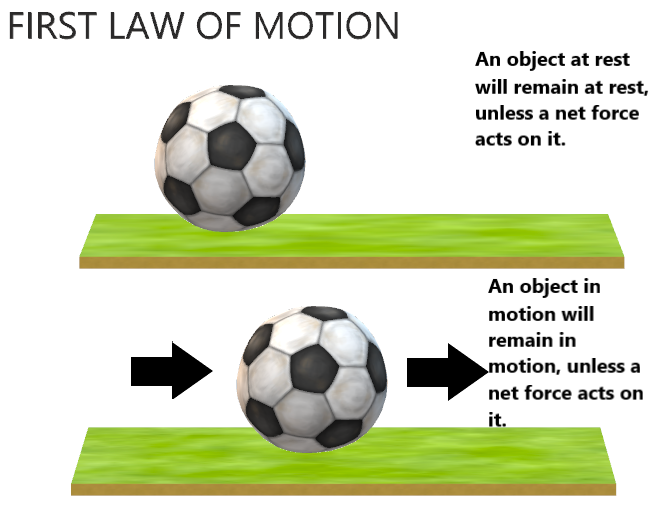
Newton's First Law states that an object will remain at rest or continue to move at a constant velocity unless acted upon by an external force. In the vacuum of space, this law is the foundation of long-distance travel. Once a spacecraft reaches orbit or deep space, it requires no continuous fuel to maintain its state of motion. This allows New Horizons missions to "coast" across vast interplanetary distances, reserving precious fuel for critical trajectory corrections and orbital insertions.
FOUNDATIONS / PHYSICS
NEWTON'S 2ND LAW: FORCE & ACCELERATION
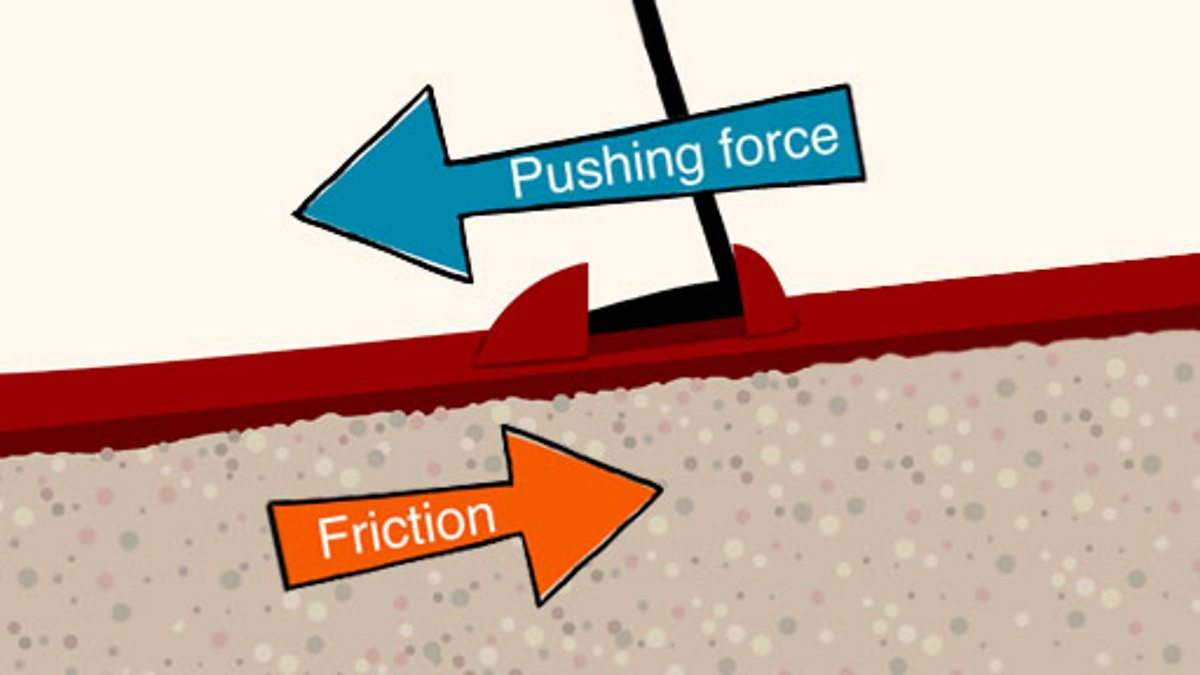
Newton's Second Law provides the fundamental equation for rocket engineering: $F = ma$. It defines the relationship between the force applied, the mass of the vehicle, and the resulting acceleration. In aerospace, this is the core of propulsion design. To achieve escape velocity, we must generate thrust ($F$) that overcomes both the vehicle's mass ($m$) and the overwhelming force of gravity, necessitating precise engineering of engine output and structural weight reduction.

FOUNDATIONS / PHYSICS
NEWTON'S 3RD LAW: ACTION & REACTION
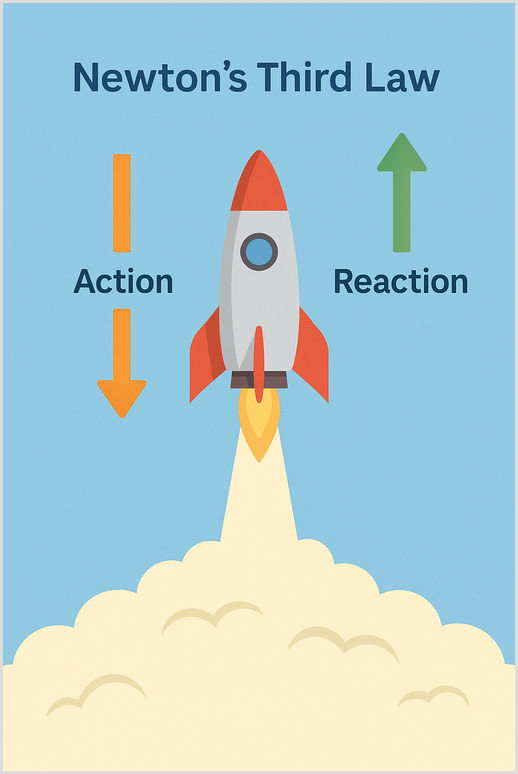
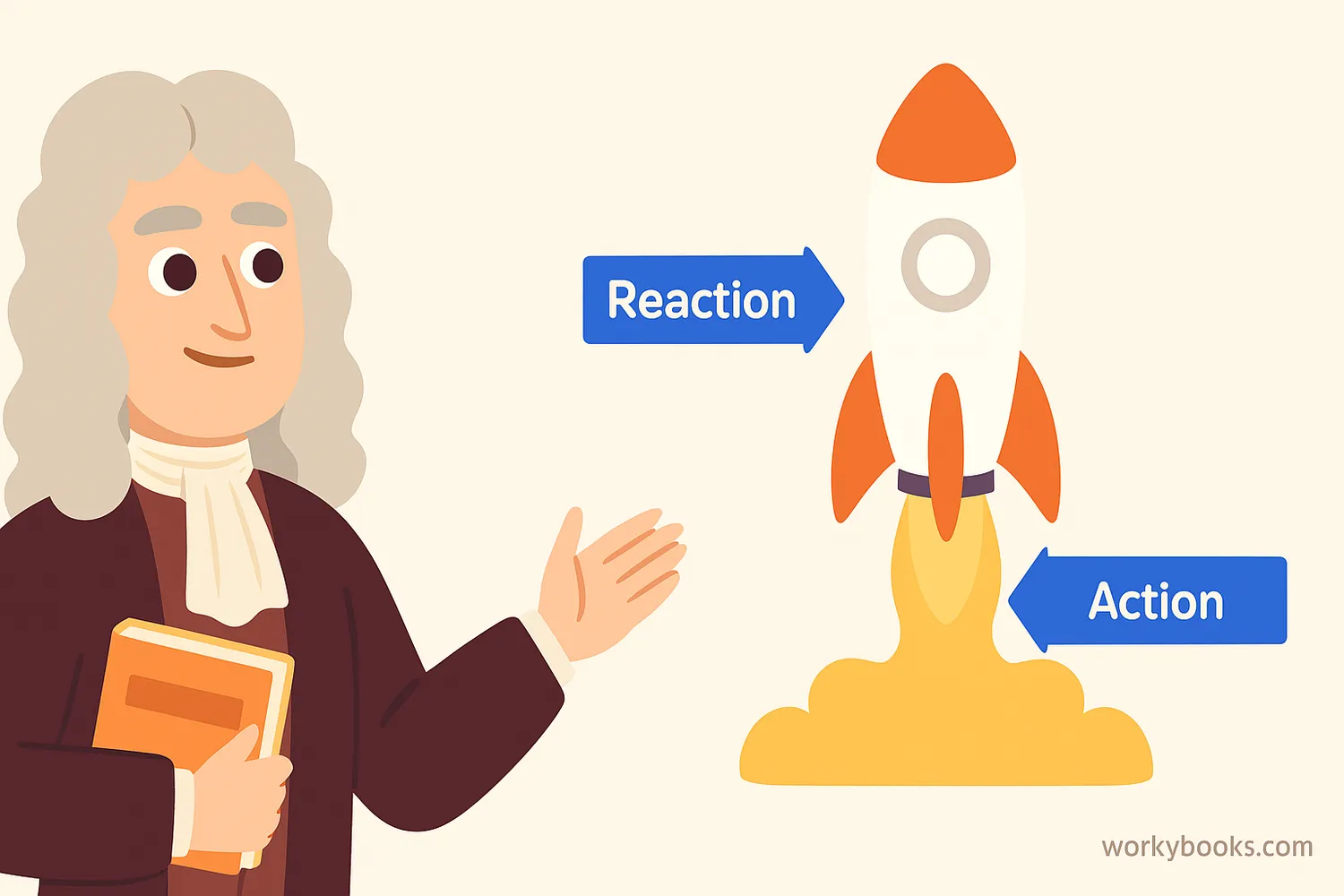
Newton's Third Law states that for every action, there is an equal and opposite reaction. In the context of aerospace, this is the singular principle that makes flight possible. By expelling high-velocity propellant gases out of the engine nozzle (the action), the rocket experiences an equal and opposite force that pushes it forward (the reaction). This fundamental interaction is how we generate the thrust necessary to overcome gravity and traverse the deep-space void.
FOUNDATIONS / PHYSICS
CONSERVATION OF MOMENTUM
The principle of conservation of momentum is the physical bedrock of rocket propulsion. It dictates that within a closed system, total momentum remains constant. For a rocket to gain forward momentum, it must eject mass (propellant) backward with high velocity. The governing equation is simply p = mv, where momentum (p) is the product of mass (m) and velocity (v). By accelerating mass out of the nozzle, the rocket gains an equal amount of momentum in the opposite direction.

PHET INTERACTIVE
Explore forces, mass, and motion dynamically with real-time laboratory simulations from CU Boulder.
SIMULATEPHYSICS CLASSROOM
Detailed algebraic breakdowns, vector components, and foundational tutorials covering all three laws.
STUDYNASA AERODYNAMICS
See Newton's laws applied directly to modern aerospace flight, rocket propulsion, and lift dynamics.
EXPLOREENCYCLOPEDIA DATA
Comprehensive historical context tracking the formulation of the Principia Mathematica in 1687.
HISTORYKHAN KINEMATICS
Step-by-step mathematical derivations of force equations, tension problems, and free-body diagrams.
PRACTICEMIT LECTURES
University-level deep dives into classical mechanics, rotational dynamics, and complex inertial reference frames.
ADVANCEDHYPERPHYSICS MAP
A hyper-linked concept network exploring net force, vector additions, and gravitational interactions.
ANALYZEOPENSTAX TEXTBOOK
Free, peer-reviewed textbook modules dealing with friction, centripetal acceleration, and mass inertia.
READLIBRETEXTS FORCE
Calculus-based derivations and multi-body problems analyzing action-reaction variable matrices.
DERIVECOMPUTATION ENGINE
Instantly compute dynamic load distributions, vector magnitudes, and acceleration rates on the fly.
COMPUTEJoin Our Newsletter
Stay updated with the latest astronomical discoveries, space mission updates, and community events from HORIZONS. It is an honor to have you join our journey through the stars.