Newton Second Law
NEWTON'S SECOND LAW
DYNAMICS & MOTION VECTOR ANALYSIS
The Force Equation
Newton's second law defines the relationship between the force applied to an object, its mass, and its resultant acceleration. The acceleration of an object is directly proportional to the net force acting on it and inversely proportional to its mass.
Where F is Force (Newtons), m is mass (kg), and a is acceleration ($m/s^2$).
Heavier objects require significantly more force to achieve the same rate of acceleration.
Dynamics Sync
Motion Mapping. Analyzing the Force / Mass / Acceleration constant. New Horizons monitors the Kinetic Buffer to track the relationship between energy and inertia.
- ⚡ Force: Net Energy Input Sync.
- 📦 Mass: Inertial Resistance Buffer.
- 🚀 Acceleration: Rate of Velocity Change.
Vector Sync
Mathematical Mapping. Analyzing the F / m / a constant. New Horizons monitors the Equation Buffer to track the precise relationship between force vectors and inertial mass.
- ➡️ Sum: Resultant Force Vector Sync.
- ⚖️ Proportional: Force-Acceleration Calibration.
- 📉 Inertia: Inverse Mass Resistance Buffer.
Inertia Sync
Resistance Mapping. Analyzing the $1/m$ inverse constant. New Horizons monitors the Mass Buffer to track how inertial resistance limits acceleration.
- ⚖️ Inverse: Acceleration-to-Mass Scaling Sync.
- 🧱 Inertia: High-Mass Acceleration Dampening.
- 📉 Buffer: Resistance-to-Motion Protocol.
Unit Sync
Standard Mapping. Analyzing the N / kg / m/s² constant. New Horizons monitors the Dimensional Buffer to ensure all physical values are calibrated to the SI standard.
- ⚖️ Force: Newton (N) Derived Sync.
- 🧱 Mass: Kilogram (kg) Base Buffer.
- 🚀 Accel: m/s² Propagation Protocol.
CLASSICAL MECHANICS / DYNAMICS
THE EQUATION OF MOTION
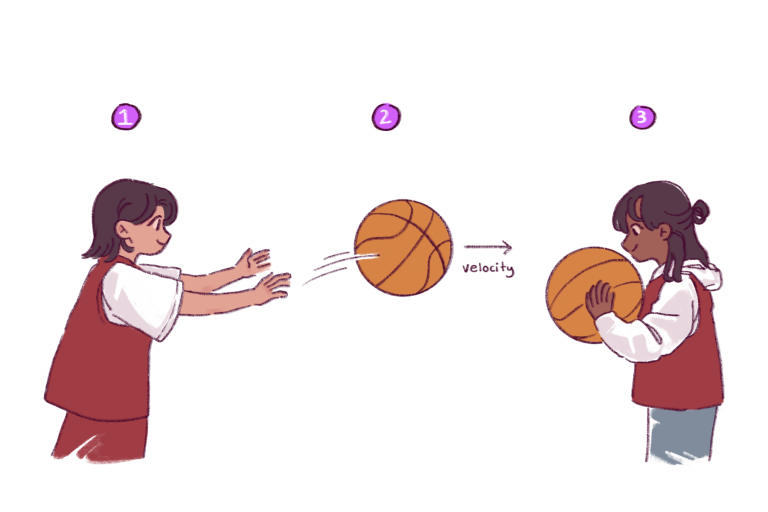
Newton's Second Law is expressed by the famous equation F = ma. It states that the acceleration of an object is directly proportional to the net force acting upon it and inversely proportional to its mass. If you apply a constant force to an object with more mass, it will accelerate less; if you apply more force, it will accelerate more.

ACADEMIC FUNDAMENTALS / DYNAMICS
THE SYLLABUS BREAKDOWN
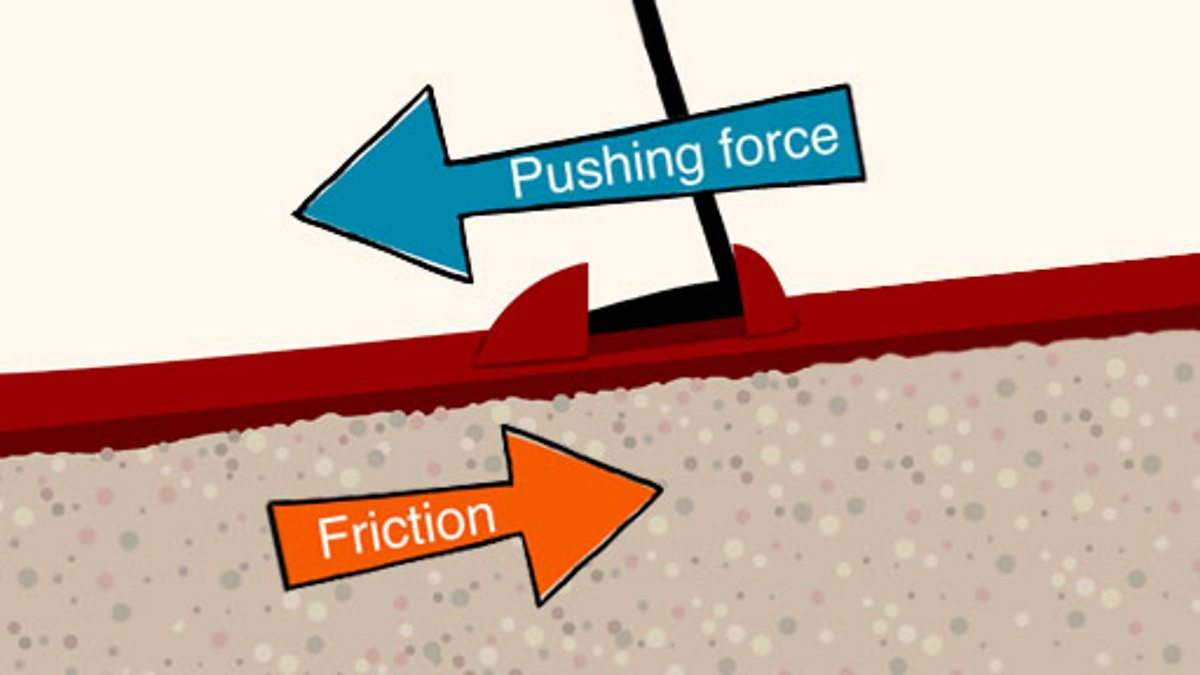
In the classroom, F = ma is rarely presented in isolation. Standard syllabi focus on Free Body Diagrams (FBDs), where you account for all forces (gravity, friction, tension, normal force) acting on a single object. The "net force" in the equation is the vector sum of all these individual forces.
ADVANCED DYNAMICS / MOMENTUM
THE MOMENTUM LINK
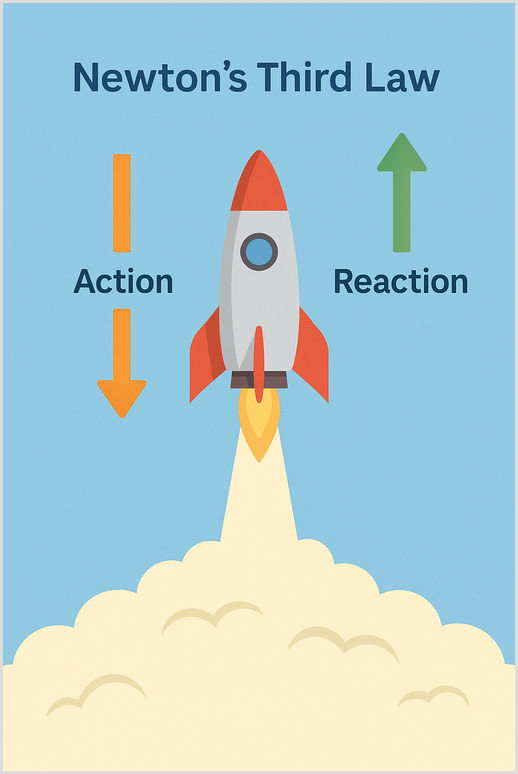
Newton originally defined his second law not just as Force equals mass times acceleration, but as the rate of change of momentum (Force equals change in momentum divided by change in time). Momentum represents the "quantity of motion" an object possesses. This perspective is essential for academic exams as it allows you to solve complex problems involving collisions, impulses, and systems where mass changes over time.