NEW

Supersonic Winds
NEW

Triton Retrograde Orbit
NEW

Signal Delay (Speed of Light)
NEW
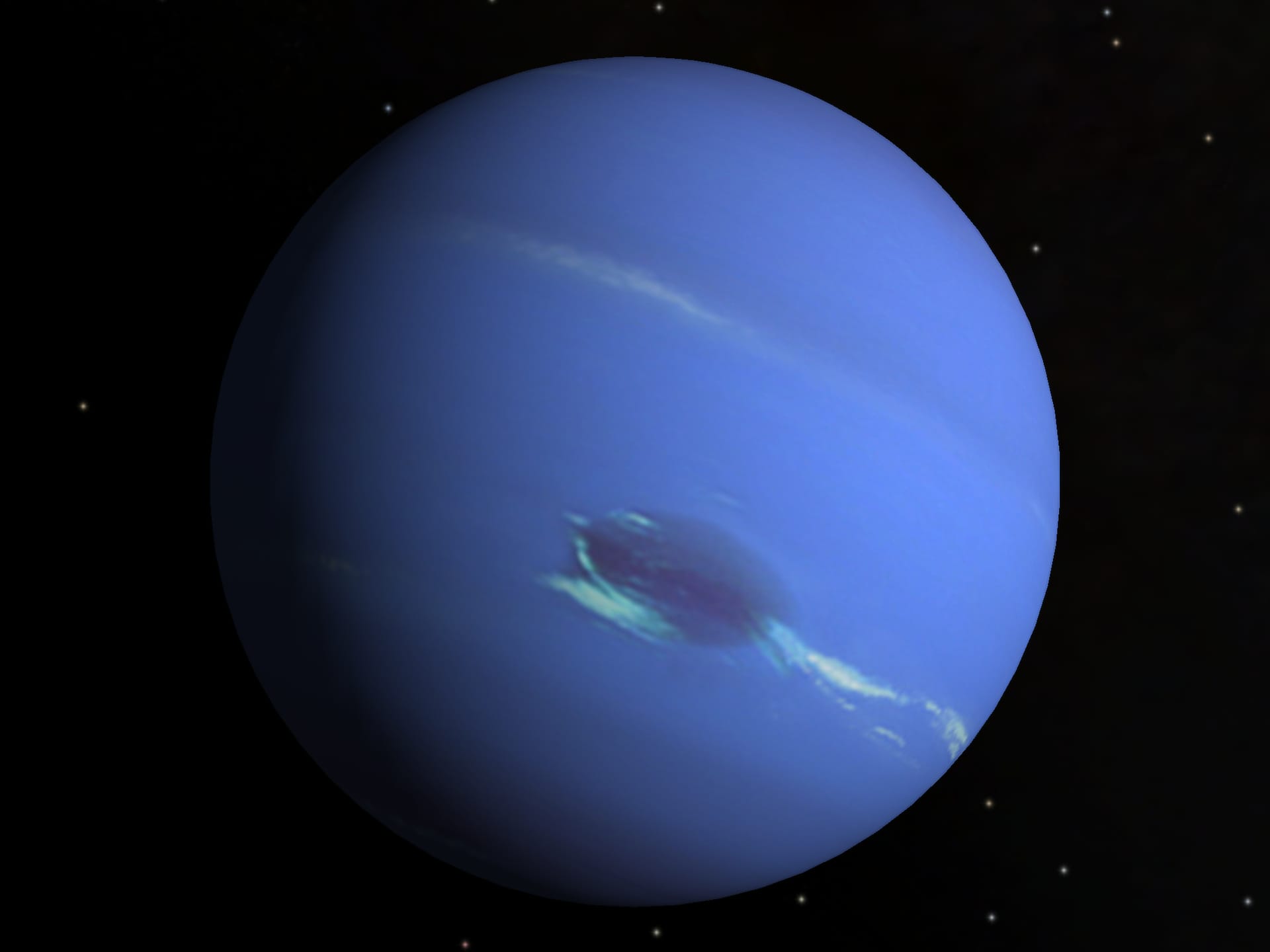
Great Dark Spot
NEW

Internal Heat Radiator
NEW

Neptune exhibits a planetary energy balance where the emitted thermal radiation exceeds the absorbed solar radiation by a factor of approximately 2.6. This internal heat flux, estimated at roughly 0.43 ± 0.04 W/m2, implies the planet is still undergoing significant gravitational contraction and potential differentiation of heavier materials toward the core. The total heat budget is modeled as the sum of residual heat from planetary formation, potential radioactive decay, and latent heat release from phase changes within the high-pressure interior.
The massive internal heat flux is transported outward primarily through vigorous convection in the deep, hydrogen-helium-rich interior. As internal temperature gradients become sufficiently steep, the fluid becomes unstable to buoyant motion, initiating convective overturning. The efficiency of this transport is described by the Nusselt number (Nu), which relates the total heat transport to the conductive heat transport. Convective plumes carry thermal energy toward the radiative-convective boundary, where this heat is eventually radiated into space at the cloud tops.
Beyond gravitational contraction, the internal heat budget of Neptune is partially sustained by phase transitions occurring within its deep, high-pressure layers. Specifically, the dissociation of molecules like water and ammonia at extreme pressures (and subsequent recombination) acts as a local source of latent heat. This process is governed by the Clausius-Clapeyron relation, which predicts that the release of latent heat (L) significantly alters the local adiabatic lapse rate. As these fluids move through the pressure-temperature (P-T) space of the interior, they undergo phase changes that effectively "buffer" the cooling rate of the planet, contributing to the observed excess heat flux.
The thermal profile of Neptune’s atmosphere is determined by a balance between radiative cooling and convective heating. In the deeper, optically thick regions, convection is the dominant mode of energy transport, maintaining an adiabatic temperature gradient. As we move upward into the stratosphere, the atmosphere becomes optically thin, and radiative processes take over. The transition point, the radiative-convective boundary, is where the lapse rate transitions from adiabatic to radiative. This equilibrium is maintained by the requirement that the net radiative flux must equal the internal heat flux at the top of the atmosphere, represented by the equation: F_rad + F_conv = sigma * T^4.
This diagnostic interface enables the modeling of Neptune's planetary heat budget. By integrating input parameters—such as internal heat flux, radiative cooling rates, and convective stability—this system models the vertical thermal gradient. Use this tool to cross-reference heat transport efficiency (Nusselt number) with the structural integrity of the radiative-convective boundary.
Evaluate the Nusselt number (Nu) to determine the ratio of convective to conductive heat transport in the deep interior.
Calculate the buoyancy frequency (N) to define the vertical stability of the atmospheric layers against convective overturning.
F_total = sigma * T^4
Nu = Q_total / Q_conductive
N^2 = (g / theta) * (d_theta / dz)
Energy imbalance detected: Internal heat flux exceeds radiative cooling estimate; suggests ongoing gravitational contraction or phase transition enrichment.
The secular cooling of Neptune is governed by the gradual depletion of its internal energy reservoirs. As the planet loses heat to space at the top of the atmosphere, the interior undergoes slow, quasi-static cooling. This long-term evolution is modeled by the heat capacity of the deep interior (Cv) and the rate of cooling (dT/dt). The cooling time scale, tau = T / (dT/dt), is on the order of billions of years, suggesting that Neptune's internal heat source remains highly potent. The secular cooling path is intricately linked to the gravitational settling of heavier elements (like helium rain) toward the core, which releases potential energy and further sustains the observed internal flux.

Stay updated with the latest astronomical discoveries, space mission updates, and community events from HORIZONS. It is an honor to have you join our journey through the stars.