Hubble Space Telescope
HUBBLE SPACE
OUR WINDOW TO THE UNIVERSE
Looking Back in Time
Launched in 1990, Hubble orbits 340 miles above Earth, free from atmospheric distortion. It has changed our understanding of the universe's age and expansion.
Collecting light for 30+ years.
Still providing vital data.
Visual Sync
Temporal Mapping. Monitoring the Ultra-Deep-Field buffer to track galaxies from 13.4 billion years ago.
- 🌌 Resolution: Sub-Arcsecond Detail Sync.
- 📸 Exposure: Multi-Wavelength Protocol.
- ⏳ Legacy: Early-Universe Buffer.
Service Sync
Modular Mapping. Monitoring the instrument upgrade buffer to track five Shuttle servicing missions.
- 🔧 Hardware: COSTAR Correction Sync.
- 🛰️ Docking: STS-Payload Protocol.
- 🔋 Lifecycle: Multi-Decade Buffer.
Expansion Sync
Kinetic Mapping. Monitoring the Hubble-Constant buffer to track the rate of universal expansion.
- 📐 Metric: Parsec-Distance Sync.
- 🔴 Physics: Redshift Velocity Protocol.
- 📏 Scale: Hubble-Law Buffer.
Power Sync
Energy Mapping. Monitoring the dual solar arrays to track 2,800 Watts of orbital power generation.
- ☀️ Harvest: Photovoltaic Sync.
- 🔋 Storage: Nickel-Hydrogen Protocol.
- ⚡ Logic: Dark-Side Discharge Buffer.
Galaxy Sync
Expansion Mapping. Monitoring the Deep-Field Buffer to track thousands of galaxies within a single, dark void.
- 🌌 Target: Ultra-Deep Space Sync.
- ⏳ Exposure: Multi-Day Integration Protocol.
- 🔭 Scale: Cosmic-Frontier Buffer.
ASTROPHYSICS / HUBBLE SPACE TELESCOPE
THE ORBITAL EYE ON THE COSMOS
Freed from the blurring effects of Earth's atmosphere, the Hubble Space Telescope has spent over three decades peering deep into the cosmos, capturing ultra-sharp imagery that reshaped our understanding of cosmic expansion, star birth, and galaxy evolution.

ASTROPHYSICS / SERVICING & DISCOVERIES
SERVICING MISSIONS & DEEP FIELDS
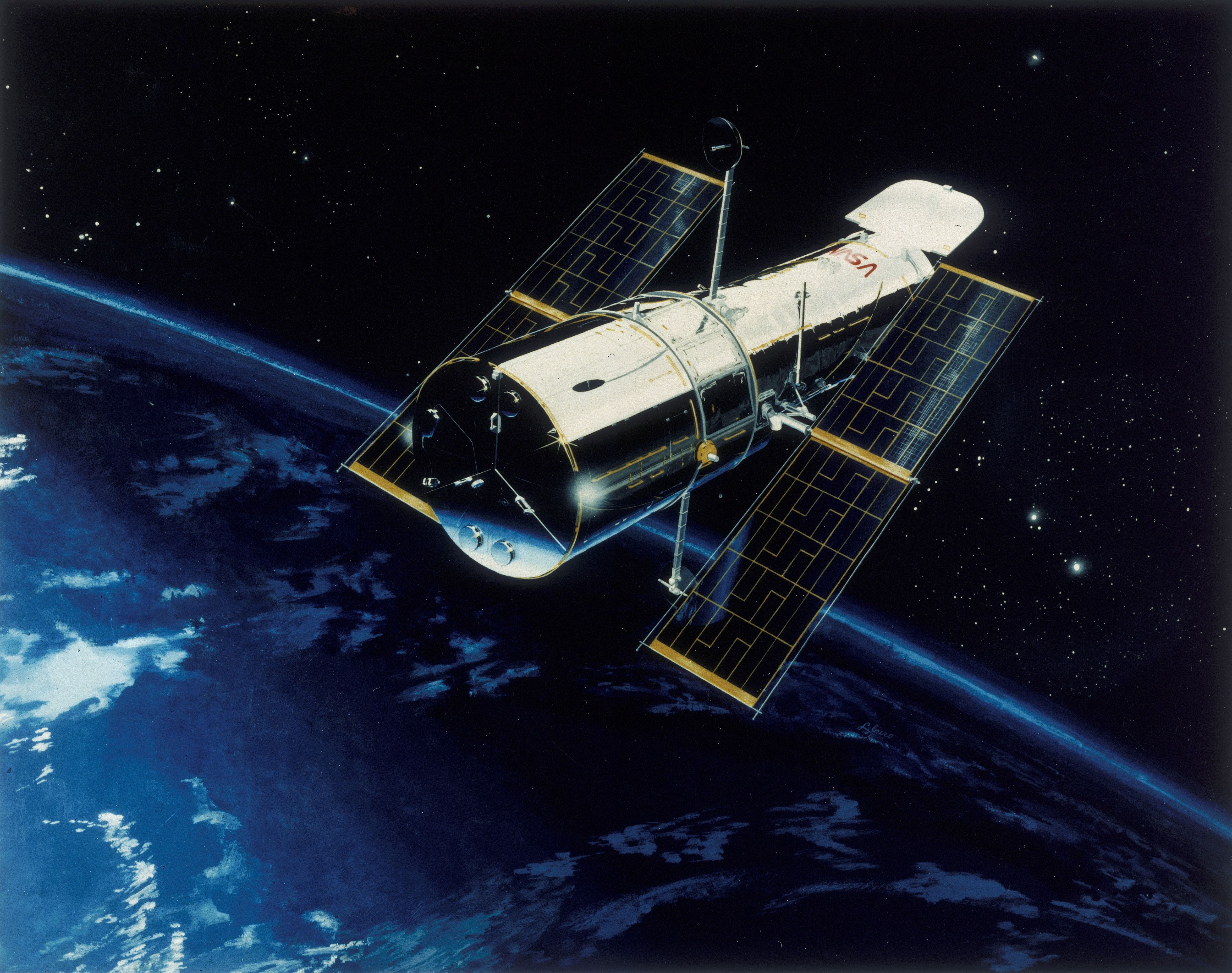
Designed from the ground up for orbital maintenance, Hubble underwent five historic Space Shuttle servicing missions that replaced degraded hardware, integrated advanced optics, and enabled iconic deep-field surveys.
ASTROPHYSICS / LEGACY & ICONIC IMAGERY
PILLARS OF CREATION & BEYOND
Beyond its raw scientific datasets, Hubble captured the public imagination with breathtaking portraits of stellar nurseries like the Pillars of Creation, establishing a cultural legacy that continues alongside newer observatories.

Space Observatory Optics
Hubble & Successors • Comparative Aperture & Resolution MetricsA clear look at the "eyes" of deep space. Metrics cover primary mirror diameter, wavelength range, and operational distance from Earth for structural comparison.
| Observatory & Agency | Aperture | Distance |
|---|---|---|
|
Hubble NASA / ESA
Visible & UV Space Telescope
|
0 mm | 0 km |
|
JWST NASA / ESA / CSA
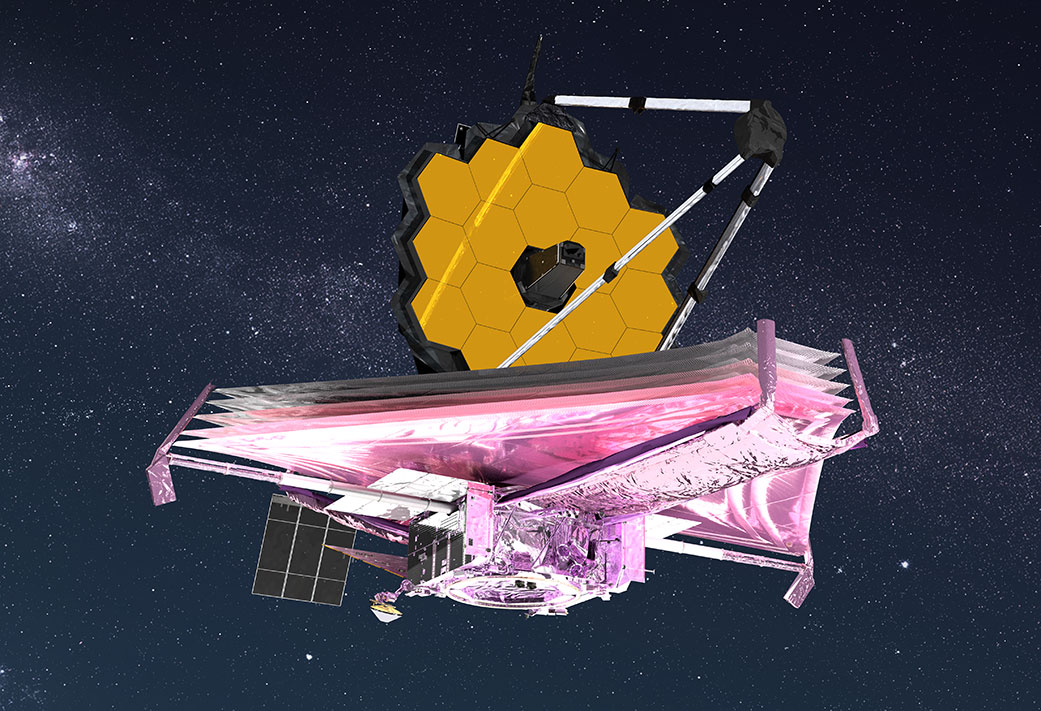
Infrared Space Observatory
|
0 mm | 0 km |
|
Spitzer NASA
Infrared Space Telescope
|
0 mm | 0 km |
|
Kepler NASA
Exoplanet Explorer
|
0 mm | 0 km |
Sources
PRIMARY MIRROR
A **2.4-meter (7.9 ft)** mirror that collects light from the deep universe. Despite an initial flaw, it was corrected by astronauts during a 1993 servicing mission.
OPTICS DATADEEP FIELD IMAGING
By staring at a tiny, "empty" patch of sky for days, Hubble revealed thousands of distant galaxies, proving the universe is far more crowded than we thought.
COSMIC DATASERVICING MISSIONS
Hubble is unique because it was designed to be repaired in orbit. Five Space Shuttle missions upgraded its cameras, sensors, and gyroscopes over 19 years.
MISSION HISTORY
Hubble's "Eye of God" Nebula FAQs
Uncovering the science behind the iconic Helix Nebula captured by the Hubble Space Telescope
Popularly known as the "Eye of God" or "Eye of Sauron," it is officially designated as the **Helix Nebula (NGC 7293)**, a large planetary nebula.
It is located roughly 700 light-years away from Earth in the constellation Aquarius, making it one of the closest planetary nebulae to our solar system.
It forms when a sun-like star exhausts its nuclear fuel, shedding its outer layers of gas into space while its core collapses into a hot white dwarf.
Although it resembles a flat eye or bubble from Earth's vantage point, astronomers have discovered it is actually a trillion-mile-long cylinder or hourglass shape viewed nearly end-on.
At its center sits a scorching white dwarf star, whose intense ultraviolet radiation causes the surrounding shell of expanding gas to fluoresce and glow brightly.
High-resolution Hubble imagery exposed thousands of mysterious, delicate gaseous "cometary knots" packed with cometary tails radiating outward from the central star.
It gives astronomers a direct preview of what our own Sun will experience roughly 5 billion years from now when it finishes burning through its hydrogen reserves.
The glowing ring structure spans several light-years across, with its outer gaseous boundaries stretching even further into the interstellar medium.
The color variations trace different elements and temperatures: hot blue gases glow closer to the core, while cooler red/orange hydrogen and nitrogen emissions outline the outer ring.
By measuring the rate at which the gas shell expands outward, scientists estimate that the planetary nebula formed approximately 10,600 years ago.
Recommended Tools
View AllLoading recommended tools...