Chandrayan 3
CHANDRAYAAN-3
INDIA'S LUNAR TRIUMPH
Landing on the South Pole
A historic mission by ISRO that successfully landed the Vikram lander and Pragyan rover near the lunar south pole on August 23, 2023.
"National Space Day" in India.
Most cost-effective lunar mission.
Lander Sync
Touchdown Mapping. Monitoring the Vikram descent buffer to track the historic landing at 69.37°S.
- 🌕 Target: Lunar South Pole Sync.
- 📉 Velocity: Soft-Landing Protocol.
- 🛡️ Legs: Impact-Absorption Buffer.
Rover Sync
Mobility Mapping. Monitoring the Pragyan wheel buffer to track regolith chemical composition.
- 🚜 Drive: Six-Wheel Kinetic Sync.
- 🔦 Laser: LIBS Element Protocol.
- 👣 Imprint: ISRO-Logo Buffer.
Thermal Sync
Regolith Mapping. Monitoring the ChaSTE probe buffer to track lunar surface temperature gradients.
- 🌡️ Probe: Subsurface Heat Sync.
- ❄️ Cryo: Ice-Volatility Protocol.
- 📉 Data: -10cm Depth Buffer.
Element Sync
Atomic Mapping. Monitoring the APXS spectrometer buffer to track Sulfur (S) and metal presence.
- 🟡 Detection: Sulfur Signature Sync.
- 🧬 Alpha: Particle-X Protocol.
- ⚛️ Isotope: Chemical-Grid Buffer.
Habit Sync
Spectro-Polarimetry Mapping. Monitoring the SHAPE instrument buffer to track Earth-like exoplanet signatures.
- 🌍 Earth: Habitable-Signature Sync.
- 📡 Orbiter: Relay-Communication Protocol.
- ♾️ Orbit: Lunar-Gateway Buffer.
LUNAR EXPLORATION / CHANDRAYAAN-3
CONQUERING THE SOUTH POLE
Launched by the Indian Space Research Organisation (ISRO), Chandrayaan-3 marked a historic triumph by successfully landing the Vikram lander and Pragyan rover near the rugged, resource-rich lunar south pole.
LUNAR EXPLORATION / SURFACE OPERATIONS
VIKRAM & PRAGYAN IN ACTION
Following a flawless touchdown, the Vikram lander deployed its payload ramp, allowing the solar-powered Pragyan rover to roll onto the lunar regolith and begin active compositional mapping of the southern highlands.

LUNAR EXPLORATION / SCIENTIFIC LEGACY
THE GLOBAL SCIENTIFIC LEGACY
Chandrayaan-3's triumph reshaped the geopolitics of space exploration, establishing India as a pioneer in polar lunar landings and providing invaluable data for future resource utilization and crewed missions.

Lunar Missions Breakdown
Chandrayaan-3 Data Logs • Comparative Key SpecificationsA clear look at landmark lunar exploration missions. Metrics cover total mass, payload capacity, and operational parameters for structural and educational comparison.
| Mission & Agency | Total Mass | Payload / Landed |
|---|---|---|
|
Chandrayaan-3 ISRO
Lander (Vikram) + Rover (Pragyan)
|
0 kg | 0 kg |
|
Apollo 11 NASA
Command & Lunar Module
|
0 kg | 0 kg |
|
Chang'e 5 CNSA
Sample Return Mission
|
0 kg | 0 kg |
|
Luna 24 USSR
Uncrewed Sample Return
|
0 kg | 0 kg |
|
SLIM JAXA
Smart Lander
|
0 kg | 0 kg |
Sources
VIKRAM LANDER
Named after Vikram Sarabhai, the father of India's space program. It successfully executed a precision descent from lunar orbit to the surface.
LANDER DATAPRAGYAN ROVER
A six-wheeled robotic vehicle that deployed from the lander to study lunar soil. It confirmed the presence of **Sulphur** on the moon's surface.
ROVER SPECSPROPULSION MODULE
The module that carried the lander to 100km lunar orbit. It also hosted the **SHAPE** instrument to study Earth's habitability from a lunar distance.
MISSION LOG
Chandrayaan-3 Mission FAQs
Exploring India's historic lunar south pole landing and rover expedition
Chandrayaan-3 aimed to demonstrate safe, soft landing on the lunar surface, deploy a rover to conduct in-situ chemical analysis, and showcase end-to-end lunar exploration capabilities.
The Vikram lander successfully touched down on the lunar south pole region on August 23, 2023, making India the fourth country to land on the Moon.
The lander was named **Vikram** (meaning valor) in honor of Dr. Vikram A. Sarabhai, and the solar-powered rover was named **Pragyan** (meaning wisdom).
The south pole features permanently shadowed craters that are expected to contain large quantities of water ice and critical mineral resources for future space exploration.
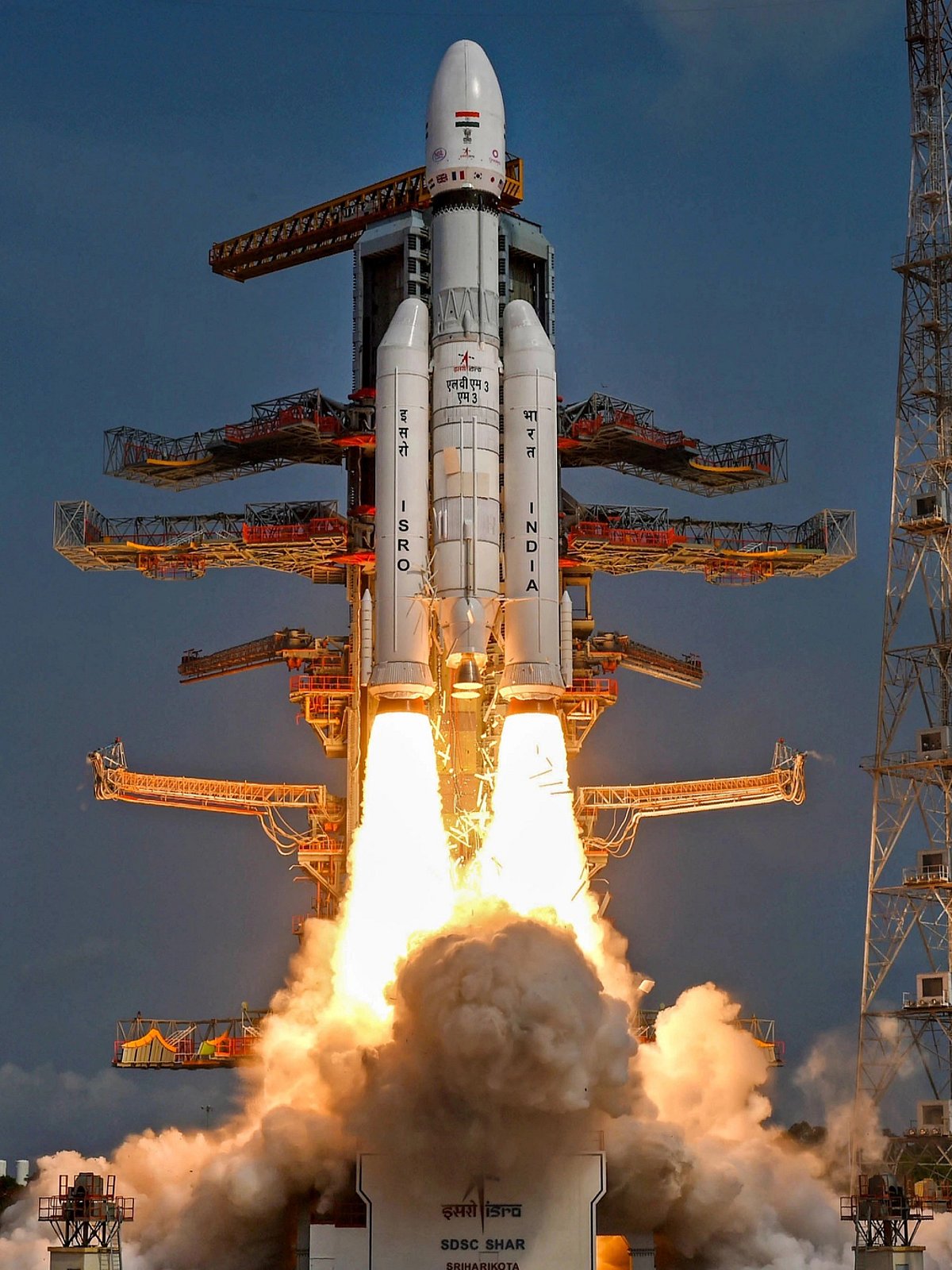
The mission was launched aboard the LVM3-M4 (Launch Vehicle Mark 3) heavy-lift rocket from the Satish Dhawan Space Centre in Sriharikota, India.
Payloads included spectroscope devices (LIBS and APXS) for elemental analysis, thermophysical sensors, and seismometers to study lunar soil and plasma density.
Both the lander and rover were engineered to operate for one lunar day, which is equivalent to roughly 14 Earth days, before sunset plunged the site into darkness.
Spectroscopic measurements confirmed the presence of sulfur, iron, oxygen, and other elements in the lunar soil near the south pole, matching expectations.
Chandrayaan-3 omitted an orbiter (relying on the existing Chandrayaan-2 orbiter for relay) and featured structural upgrades, stronger legs, and improved software fault-tolerance for landing.
The mission was designed, developed, and successfully managed by the **Indian Space Research Organisation (ISRO)**.