Mercury Weight
PLANETARY LAB: MERCURY WEIGHT & GRAVITY
PLANETARY MASS ($3.30 \times 10^{23}\text{ kg}$), SURFACE ACCELERATION & HUMAN SCALE CONVERSION
Mass & Gravitational Weight Metrics
Because Mercury is the smallest terrestrial planet, its total mass is only a fraction of Earth's. Combined with its small radius, this creates a surface gravity roughly 38% of Earth's, meaning any object or human weighs significantly less on the mercurian surface.
Gravitational pull relative to Earth's baseline acceleration.
Apparent body weight reduction standing on Mercury's crust.
The Innermost World
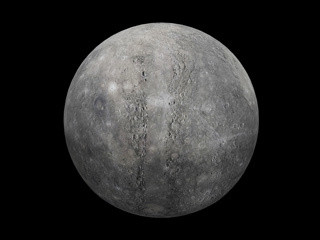
Solar System Pioneer. Mercury is the smallest and closest planet to the Sun, orbiting through an extreme environment shaped by intense solar radiation and fierce gravitational forces.
Geological Profile: This heavily cratered, rocky body shares visual similarities with Earth's Moon while possessing a massive metallic core hidden beneath its dusty crust.
- 🌕 Heavily cratered, moon-like rocky surface.
- ☀️ Closest orbital path to our Sun.
Planetary Mass
Compact Scale. Mercury has a total mass of approximately $3.3 \times 10^{23}$ kilograms, which is only about 5.5 percent of Earth's total mass.
Compact Dimensions: Despite being larger than dwarf planets like Pluto, its small volume makes it the second densest planet in our solar system due to its heavy iron composition.
- ⚖️ Total mass is just 5.5% of Earth's mass.
- 📦 Highly compact volume and high density.
Surface Gravity
Reduced Gravitational Pull. Mercury’s surface gravity is $3.7 \, \text{m/s}^2$, which is roughly 38 percent of Earth's gravitational pull.
Your Weight on Mercury: If you step onto the surface of Mercury, your physical weight would drop dramatically—meaning a 100 kg person would effectively weigh only 38 kg.
- ⬇️ Surface gravity is 38% of Earth's value.
- 👤 Significant weight reduction for visitors.
The Iron Core
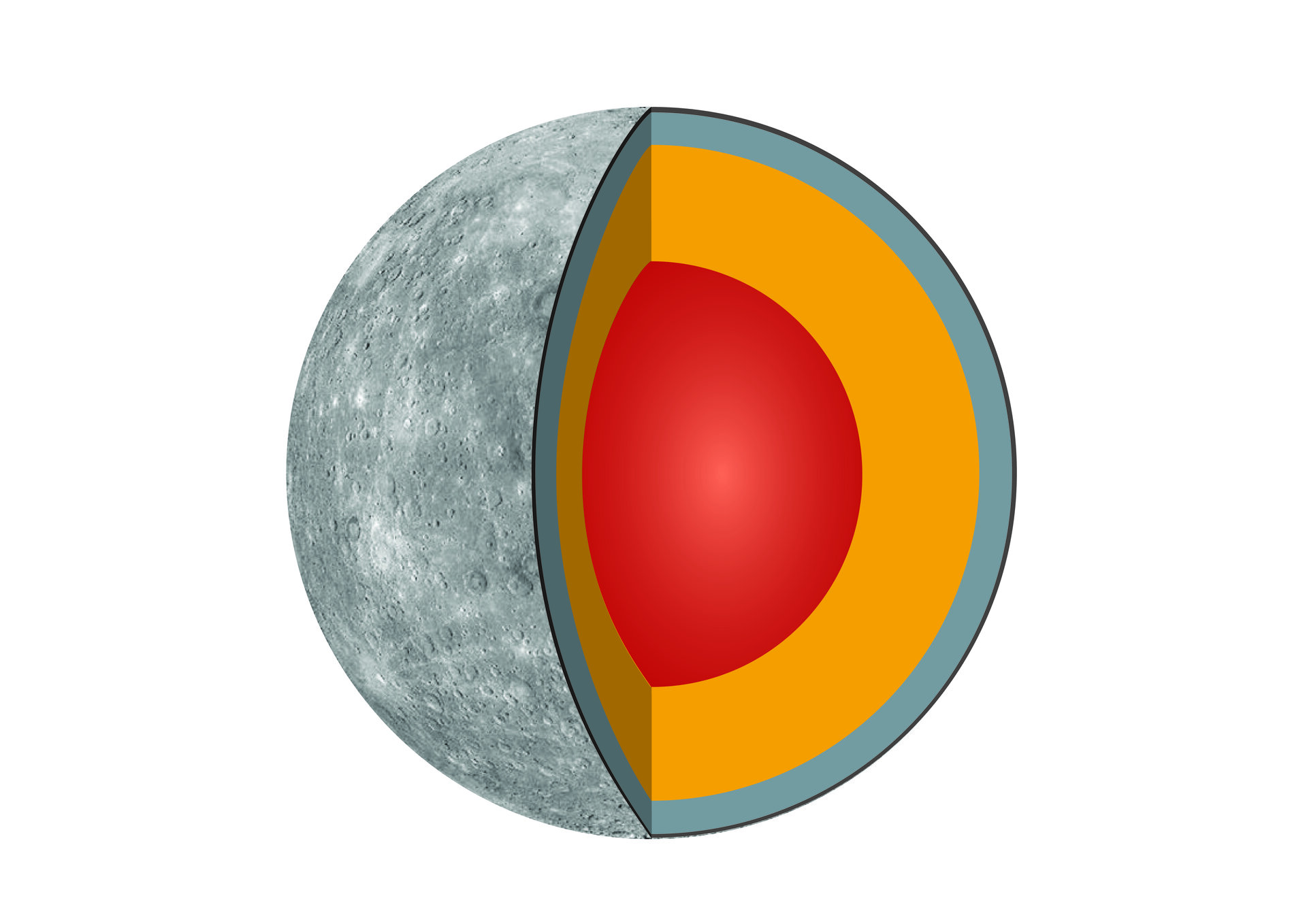
Metallic Heart. Mercury is dominated by a gigantic metallic iron core that takes up about 85 percent of the planet's radius.
Density Driver: This disproportionately large core explains why Mercury is exceptionally dense despite its small overall size and mass.
- ⚙️ Iron core spans 85% of planetary radius.
- 💎 Explains high internal density.
Orbital Velocity
Fast-Paced Orbit. Mercury zips around the Sun faster than any other planet, completing a full orbit in just 88 Earth days.
Eccentric Path: Its highly elliptical orbit brings it as close as 47 million kilometers and as far as 70 million kilometers from the Sun, causing massive variations in solar heating.
- ⏱️ Completes one solar orbit in 88 days.
- 🔄 Highly elliptical orbital trajectory.
Thermal Extremes
Scorching and Freezing. Because Mercury lacks a substantial atmosphere to trap heat, surface temperatures swing wildly from a scorching 430 degrees Celsius during the day down to -180 degrees Celsius at night.
Temperature Range: This extreme 610-degree fluctuation represents the most severe thermal range experienced anywhere in the solar system.
- 🔥 Reaches daytime highs of 430°C.
- ❄️ Plunges to -180°C in shadowed craters.
The Exosphere
Ultra-Thin Atmosphere. Mercury has an exosphere rather than a true atmosphere, composed of atoms blasted off its surface by solar wind and meteorite impacts.
Elemental Composition: This fragile envelope consists primarily of oxygen, sodium, hydrogen, helium, and potassium, which constantly escape into space due to low gravity.
- 💨 Extremely thin surface exosphere layer.
- ✨ Replenished constantly by solar wind bombardment.
Space Exploration
Visiting the Inner Planet. Studying Mercury requires overcoming intense solar gravity wells, making it one of the most challenging destinations in the solar system for spacecraft.
Historic Probes: Following flybys by Mariner 10 and detailed orbital mapping by MESSENGER, modern missions like ESA and JAXA's BepiColombo continue to unlock the mysteries of Mercury's mass and core.
- 🚀 Challenging solar gravity trajectory.
- 🛰️ Mapped by Mariner, MESSENGER, and BepiColombo.
PLANETARY MASS / TERRESTRIAL GRAVITY
The Compact Gravitational Profile of Mercury
As the smallest terrestrial planet in our solar system, Mercury possesses a mass and volume drastically smaller than Earth. With a total mass roughly 0.055 times that of Earth, the innermost planet concentrates a dense, oversized iron core within a relatively thin rocky mantle. This unique internal composition generates a compact yet distinct gravitational field, establishing the foundation for how orbital mechanics and surface weight dynamics operate across its heavily cratered terrain.
PLANETARY MASS / SURFACE ACCELERATION
Surface Gravity and Weight Reduction
Because of its modest mass and smaller planetary radius, Mercury's surface gravity is substantially weaker than Earth's. Surface gravitational acceleration sits at approximately 3.7 meters per second squared, which translates to roughly 38 percent of Earth's standard gravity. For an exploratory mission or landed surface asset, this means any heavy equipment or human crew member would experience a dramatic reduction in effective weight, scaling down physical loads while requiring specialized surface traction techniques across the dusty regolith.
PLANETARY MASS / ESCAPE DYNAMICS
Escape Velocity and Ascent Efficiency
The reduced gravitational potential of Mercury translates directly into highly favorable escape dynamics for exploratory spacecraft. With an escape velocity of approximately 4.3 kilometers per second—less than half of Earth's requirement—departing the surface or executing sample return missions requires vastly smaller propellant mass fractions and delta-v budgets. This low-energy escape threshold transforms Mercury into an accessible stepping stone for inner solar system navigation, reducing the structural mass penalty for future landers.
Sources
PLANETARY MASS
Mercury's mass is $3.30 \times 10^{23}$ kg, which is about 5.5% of Earth's mass.
NASA FACT SHEETSURFACE GRAVITY
Gravity on Mercury is 3.7 m/s². You would weigh only 38% of your Earth weight there.
GRAVITY SPECSDENSITY ANALYSIS
Mercury is the second densest planet (5.43 g/cm³), meaning it is "heavy" for its small size.
CORE DENSITY
Mercury Weight, Mass & Surface Gravity FAQs
Examining Mercury's planetary mass, low surface gravity, weight comparisons relative to Earth, and internal density characteristics
Mercury has a total mass of about 3.3 times 10 to the 23rd power kilograms, which is roughly 5.5 percent of Earth's total mass.
Because Mercury's surface gravity is about 38 percent of Earth's, a person who weighs 100 pounds on Earth would weigh approximately 38 pounds on Mercury.
Although Mercury's massive iron core makes it exceptionally dense, its small overall radius limits its total mass, keeping its surface gravitational pull relatively weak.
Mercury's surface gravitational acceleration is 3.7 meters per second squared, compared to Earth's standard acceleration rate of 9.8 meters per second squared.
Mercury is the smallest and least massive of the four inner rocky planets in our solar system, carrying significantly less mass than Venus, Earth, or Mars.
Mercury features an oversized metallic iron core that takes up about 85 percent of the planet's radius, packing a tremendous amount of dense matter into a compact volume.
Because objects weigh less than half of what they do on Earth, heavy tools, rovers, and building materials would feel remarkably light and easy to maneuver.
The actual planetary mass remains constant, but the gravitational pull exerted on Mercury by the Sun changes slightly as it travels along its elliptical orbit.
Researchers calculate Mercury's mass by tracking minute gravitational perturbations and Doppler shifts in radio signals from passing spacecraft like MESSENGER.
Positioned closest to the proto-Sun, intense solar radiation and high-velocity stellar winds blew away primordial gas and dust, leaving behind only dense refractory materials.

What is Mercury

Mercury Weight
Mercury Age

Jump Height

Mercury Distance

Day/Night Temp

Solar Intensity

Sun Visual Size

Double Sunrise

Travel Time

Messenger Simulation

Orbit Insertion

Signal Delay (Comms)

Mercury Precession
Iron Core Ratio

Gravity Well
Magnetosphere Shield

Thermal Expansion
Underground Living

Oxygen for Base

Solar Energy Harvest
Mercury Ice Hunter
Solar Radiation

Heavy Machinery
Mercury Mysteries