
Orbital Overlap
ORBITAL OVERLAP LOGIC
NEPTUNE CROSSING RESONANCE MATRIX
3:2 Mean Motion Resonance
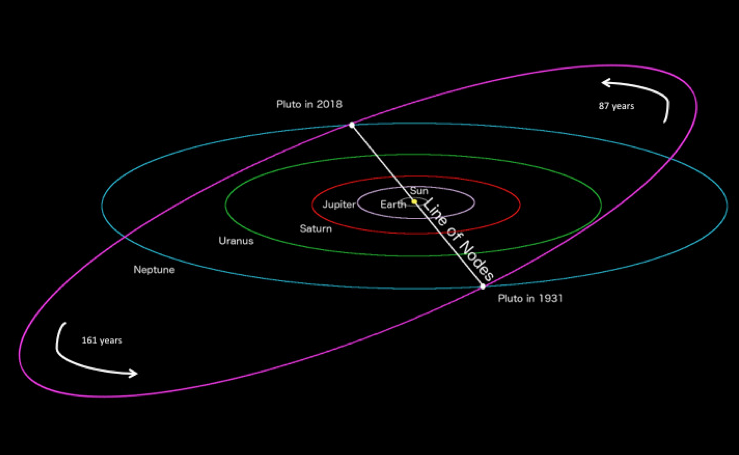
Although Pluto's elliptical path crosses inside Neptune's orbit, they can never collide. They are locked in a stable 3:2 orbital resonance loop: for every three laps Neptune makes around the Sun, Pluto completes exactly two, synchronizing their positions.
This geometric tracking pattern forces Neptune to always remain far ahead or behind whenever Pluto crosses its path.
Pluto passes high above Neptune's plane while sliding through its closest inner point to the Sun.
Overlap Sync
Resonance Mapping. Analyzing the 2:3 Mean Motion constant. New Horizons monitors the Orbital Buffer to track the periodic overlap of the 134340 and Neptune interface.
- 🔄 Resonance: 2:3 Gravitational Lock Sync.
- 📐 Inclination: 17.1° Z-Axis Safety Buffer.
- ⏱️ Interval: 20-Year Inner-Orbit Protocol.
Harmonic Sync
Frequency Mapping. Analyzing the n p/n n resonance constant. New Horizons monitors the 2:3 Buffer to track the gravitational lock of the 134340 and Neptune interface.
- 🔢 Ratio: 2 Pluto Orbits per 3 Neptune Orbits.
- 🛡️ Stability: Self-Correcting Libration Sync.
- 🌌 Interface: Zero-Collision Gravitational Protocol.
Safety Sync
3D Mapping. New Horizons monitors the Inclination Buffer to track the collision-free interface of 134340 and Neptune.
- 📐 Tilt: 17.1° Inclination Protocol.
- 🛡️ Buffer: 17 AU Minimum Separation Sync.
- 🛰️ Z-Axis: Vertical Clearance Safety.
Epoch Sync
Temporal Mapping. Analyzing the 1 - e eccentricity constant. New Horizons monitors the Time Buffer to track the 248-year interval of the 134340 perihelion crossing.
- ⏮️ Last: 1979–1999 Inner-Sync Window.
- ⏭️ Next: 2227 Orbital Entry Protocol.
- 🛑 Wait: 201-Year Separation Buffer.
ORBITAL MECHANICS / RESONANCE
THE 2:3 DANCE
Pluto and Neptune are locked in a 2:3 mean-motion resonance. For every two orbits Pluto completes around the Sun, Neptune completes exactly three. Because of this ratio, whenever Pluto crosses inside Neptune’s orbit, Neptune is always far away in its own path. They are never in the same place at the same time. Furthermore, Pluto’s orbit is tilted at a 17-degree angle relative to the ecliptic plane, meaning it actually passes well above or below Neptune’s path, further ensuring they never interact.

PLANETARY DYNAMICS / SOLAR SYSTEM HISTORY
THE NEPTUNE MIGRATION
In the early solar system, Neptune formed much closer to the Sun. As the gas giants interacted with the disk of leftover planetesimals, Neptune migrated outward. As it moved, its gravity acted like a giant snowplow, pushing millions of small icy bodies ahead of it. Pluto was among the objects that got "trapped" in this gravitational wake, pulled into its current 2:3 resonant orbit as Neptune settled into its final position. This process, known as resonant capture, explains the large population of Plutinos we see today.
- Horizon -

Pluto
Pluto vs Moon Size
Charon Tidal Lock

Nitrogen Ice Flow

Atmospheric Freeze
Orbital Overlap (Neptune)

Weight on Pluto
Sun Brightness (Pluto Time)

Pluto Year Converter

Binary System Calc

Life on Pluto?

Signal Delay (Comms)

3D Pluto
Sources
STABLE RESONANCE
For every **3 orbits** Neptune completes, Pluto completes exactly **2**. This synchronization ensures Neptune is always in a different part of its orbit when Pluto crosses its path.
ORBITAL DATAORBITAL INCLINATION
Pluto's orbit is tilted at **17 degrees** relative to the ecliptic. When it is "inside" Neptune's orbit, it is actually far above or below Neptune's orbital plane.
INCLINATION SPECSTHE "CROSSING"
Pluto was closer to the Sun than Neptune from **1979 to 1999**. It won't happen again until September 2226. They never get closer than 17 AU to each other.
TIMELINENodal Geometry
Visualization of the 'Line of Nodes' where Pluto's tilted orbit intersects the ecliptic plane.
Apparent Cross
Top-down view showing how Pluto's perihelion brings it closer to the Sun than Neptune.
Tilt & Safety

Resonance: 3:2 (Neptune laps Pluto twice for every 3 orbits)
Inclination: 17 Degrees
Distance: They stay at least 17 AU apart.