
Nitrogen Ice Flow
NITROGEN ICE FLOW
SPUTNIK PLANITIA GLACIAL DYNAMICS
Solid-State Convection
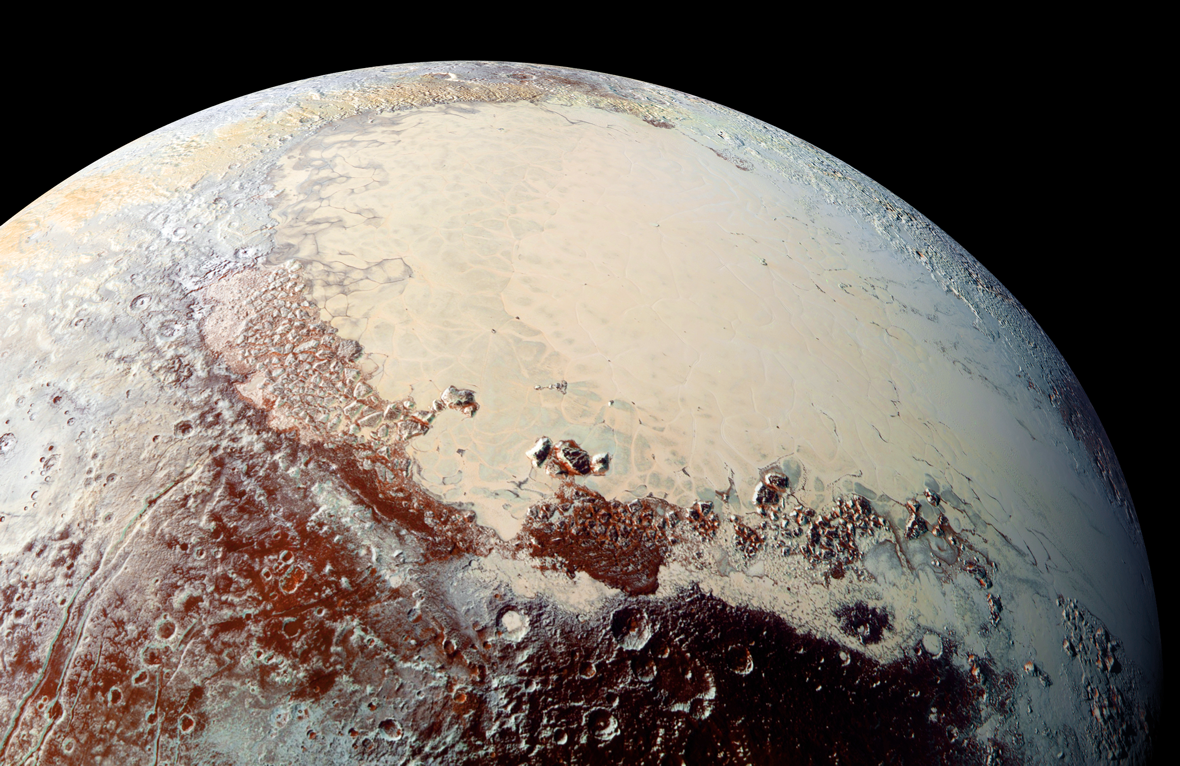
At Pluto's extreme temperatures (-230°C), nitrogen ice behaves completely differently than water ice. It becomes soft, malleable, and highly buoyant, slowly churning in giant solid-state convection cells warmed by Pluto's faint internal radioactive core.
The massive surface polygons visible from orbit where warm ice rises up, spreads out, and sinks back down.
A slow, relentless cosmic crawl that actively erases impact craters, leaving a completely smooth terrain profile.
Cryo Sync
Fluid Mapping. Analyzing the N 2 viscosity constant. New Horizons monitors the Glacial Buffer to track the plastic deformation of nitrogen ice across 134340's surface.
- 🧊 State: Plastic Nitrogen Solid-State Sync.
- 🔄 Convection: 500,000-Year Cellular Buffer.
- 🌡️ Thermal: $-235°C$ Viscosity Protocol.
Heart Sync
Basin Mapping. Analyzing the $Ra$ convection constant. New Horizons monitors the Nitrogen Buffer to track the active resurfacing of the Sputnik Planitia interface.
- 🤍 Feature: 1,000 km Nitrogen Ice Reservoir.
- 🔄 Refresh: Constant Solid-State Overturn.
- 🛡️ Youth: Zero-Crater Surface Protocol.
Churn Sync
Thermal Mapping. Analyzing the Ra convection constant. New Horizons monitors the Plastic Buffer to track the solid-state overturn of nitrogen ice in the 134340 basin.
- 🌀 Cells: 20-40 km Polygonal Sync.
- 🔄 Refresh: 500,000-Year Overturn Buffer.
- 🛡️ Youth: Continuous Crater-Erasure Protocol.
GLACIOLOGY / FLUID DYNAMICS
SOLID-STATE CONVECTION
In the massive basin of Sputnik Planitia, nitrogen ice accumulates to depths of several kilometers. Radioactive decay in Pluto's rocky core generates a steady, low-level thermal flux. This heat warms the bottom layer of the nitrogen ice, causing it to become buoyant and rise through the cooler, denser ice above. As this "blob" of warm ice reaches the surface, it spreads out, cools, and then sinks back down, creating massive, distinct polygonal cells across the surface.
CRYOGEOLOGY / SURFACE EVOLUTION
THE POLYGONAL TERRAIN
The convection cells mentioned previously are not merely abstract movements; they manifest as massive, slightly elevated polygons across the surface. The center of each cell is slightly warmer and thus higher in elevation, while the edges—where the cooled ice sinks back down—create deep, dark, and narrow troughs. These troughs often accumulate different materials, such as darker atmospheric tholins, which highlight the boundary between cells like a natural map.

- Horizon -

Pluto
Pluto vs Moon Size
Charon Tidal Lock

Nitrogen Ice Flow

Atmospheric Freeze
Orbital Overlap (Neptune)

Weight on Pluto

Sun Brightness (Pluto Time)

Pluto Year Converter

Binary System Calc

Life on Pluto?

Signal Delay (Comms)

3D Pluto
Sources
SOLID-STATE CONVECTION
In **Sputnik Planitia**, the nitrogen ice is miles deep. Internal heat from Pluto's core causes the bottom layer to warm up, rise, cool, and sink back down in giant cells.
CONVECTION DATAGLACIAL SPEED
Nitrogen ice is highly "plastic." It flows through valleys and around mountains made of water-ice (which acts like hard rock at these temperatures).
GLACIAL FLOWSURFACE RENEWAL
Because the ice is constantly flowing and "churning," the surface of Pluto’s heart has zero impact craters, making it one of the youngest surfaces in the solar system.
SURFACE AGE