PHYSICS / 2026
High-altitude methane condenses in the cold troposphere into ice crystals.
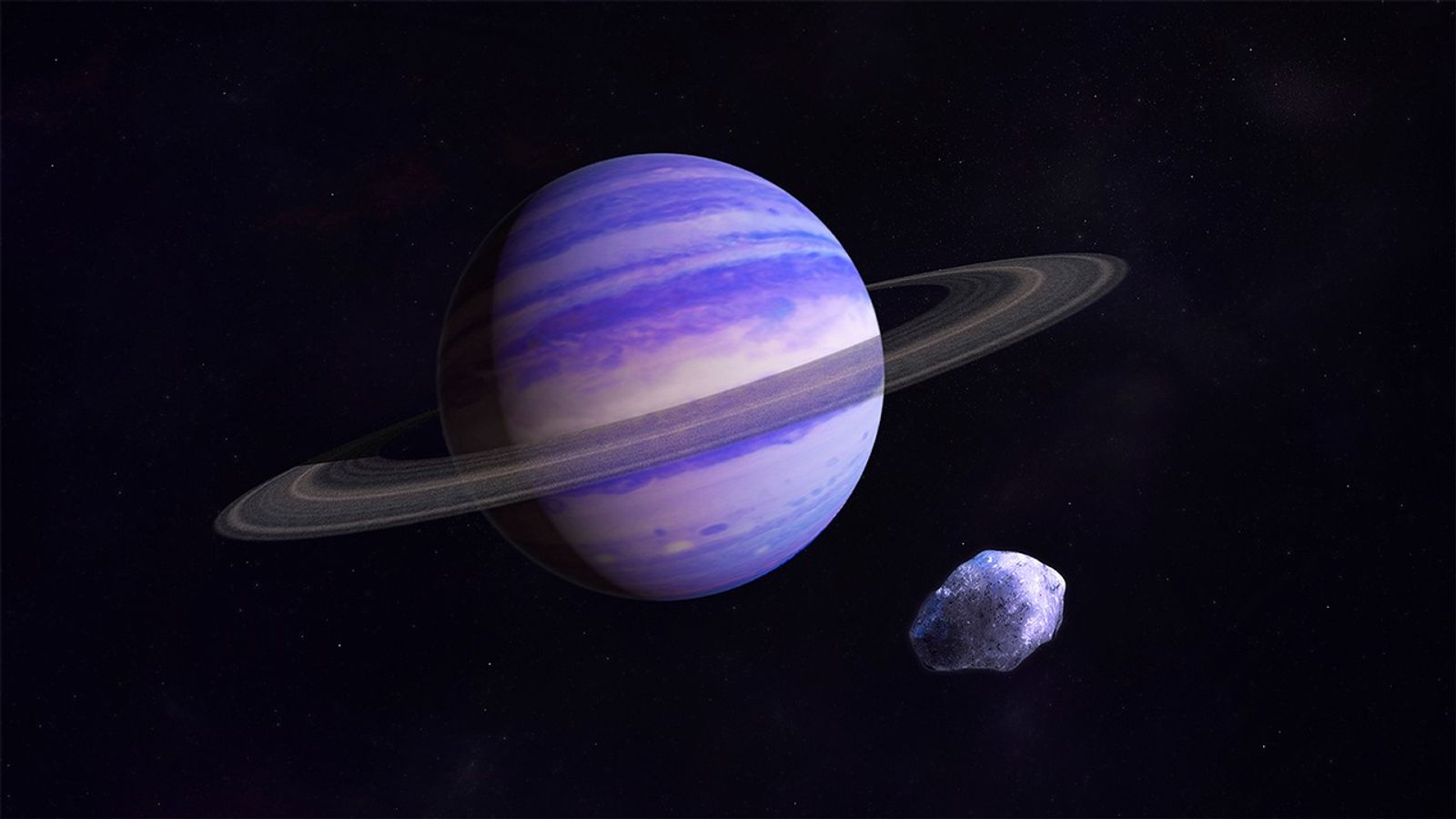
Neptune's atmosphere is a massive heat engine driven by internal energy. As methane-rich gas rises from the interior into the frigid upper troposphere, it undergoes rapid phase changes. At these extreme altitudes, temperatures drop low enough for methane to transition from a vapor state to microscopic ice crystals. These crystals then aggregate to form high-altitude, wispy cloud layers that scatter sunlight, contributing to the planet's distinct blue albedo.
PHYSICS / 2026
The high-altitude methane crystals act as scattering centers for incident solar radiation. Because these particles are situated in the upper troposphere, they effectively scatter shorter-wavelength blue light while absorbing longer-wavelength red light—a phenomenon governed by Mie scattering theory. This radiative interaction is the primary driver of Neptune's high geometric albedo, ensuring that the planet reflects a significant portion of the sunlight it receives, which is crucial given its vast distance from the Sun.
PHYSICS / 2026
The condensation cycle is sustained by a potent internal heat source. Unlike Uranus, Neptune radiates more energy into space than it receives from the Sun, a disparity driven by internal gravitational contraction and potentially ongoing radioactive decay. This significant heat flux drives powerful convective currents that transport methane-rich parcels of gas from the warm, deep interior up to the cold tropospheric condensation levels. This vertical mixing is the essential "pump" that maintains the atmospheric cloud structure and enables the active weather systems observed on the planet.
PHYSICS / 2026
Neptune’s atmosphere exhibits a extreme pressure gradient, transitioning from the thin, upper exosphere to the crushing pressures of the deep interior. At the 1-bar pressure level—defined as the "surface" for planetary reference—the atmosphere is composed primarily of hydrogen and helium. As altitude decreases toward the core, the pressure increases exponentially, leading to a transition where supercritical fluids and potentially metallic hydrogen exist. This density profile is essential for modeling the planet's gravitational moments and rotational dynamics, influencing how we interpret the zonal wind structures observed at the cloud tops.
PHYSICS / 2026
Neptune's magnetic field presents a significant puzzle in magnetohydrodynamics. Unlike Jupiter and Saturn, which generate their fields in deep metallic hydrogen cores, Neptune's dynamo likely operates in a thinner, outer shell of ionically conductive water, ammonia, and methane ice. This "thin-shell" dynamo produces the planet’s distinct offset, tilted magnetic field—centered far from the geometric core and angled roughly 47 degrees from the rotational axis. The interaction between these conductive fluids and the planet's rapid rotation creates a highly dynamic and non-dipolar magnetic environment that shapes the local space environment.
PHYSICS / 2026
Triton, Neptune's largest moon, operates under a unique set of physical constraints. Its retrograde orbit—moving opposite to the planet's rotation—suggests it was captured rather than formed *in situ*. This orbital path induces severe tidal forces, creating continuous gravitational flexing of the moon's interior. This tidal dissipation acts as a significant heating mechanism, maintaining internal heat long after the moon's formation. The resulting geophysical activity is expressed as cryovolcanism on the surface, offering a rare look at active, tidal-driven geology in the outer solar system.
PHYSICS / 2026
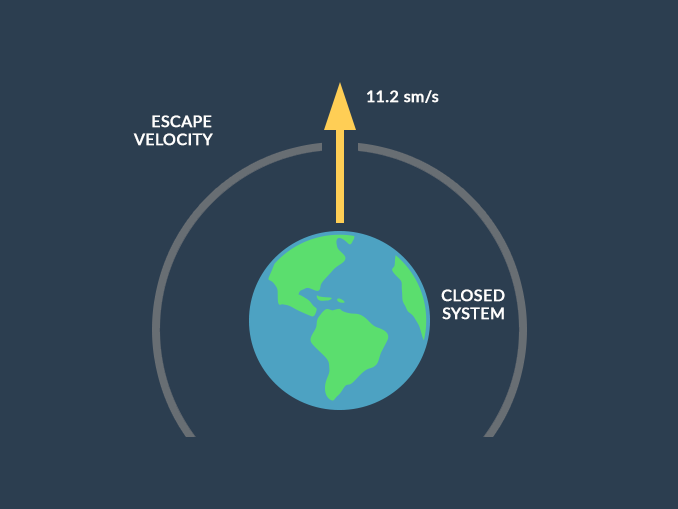
The uppermost layers of Neptune’s atmosphere—the thermosphere and exosphere—exist in a state of constant attrition. High-energy particles from the solar wind collide with the sparse, ionized gas in these outer regions, stripping away neutral particles through a process called solar wind stripping. Additionally, ion outflow carries atmospheric constituents away into the interplanetary medium. While Neptune’s magnetosphere acts as a primary buffer, the asymmetrical and tilted nature of the field allows for localized "leaks," where solar plasma can penetrate closer to the atmosphere, accelerating the loss of light elements like hydrogen.
ATMOSPHERE / 2026
Methane absorbs red light, giving Neptune its distinct blue appearance.
DATA SHEET
PHYSICS / 2026
High-altitude methane condenses in the cold troposphere into ice crystals.
ANALYSIS
DYNAMICS / 2026
Extreme wind speeds fragment methane clouds into long, streaky features.
SIMULATION
Stay updated with the latest astronomical discoveries, space mission updates, and community events from HORIZONS. It is an honor to have you join our journey through the stars.