Law of Harmonies
KEPLER'S THIRD LAW
LAW OF HARMONIES RELATIONSHIP
The Law of Harmonies
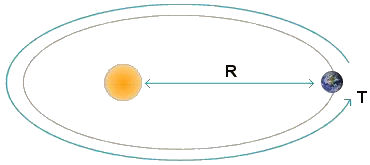
Kepler's Third Law relates the time a planet takes to orbit the Sun (orbital period) to its average distance from the Sun. It states that the square of the orbital period is directly proportional to the cube of the semi-major axis of its orbit.
The square of the period (T) is equal to the cube of the average orbital radius (a).
This ratio remains consistent for every object orbiting the same central gravitational body.
The Harmonic Law
Music of the Spheres. Kepler's Third Law, also known as the Harmonic Law, connects a planet's distance from the Sun directly to the time it takes to complete an orbit.
Orbital Harmony: Published in 1619, this mathematical breakthrough proved that planets closer to the Sun move much faster than those residing in the outer solar system.
- 🎵 Links orbital period with distance.
- 🌌 Unifies the entire planetary system.
The Formula
Squaring and Cubing. The law states that the square of a planet's orbital period (T squared) is directly proportional to the cube of the semi-major axis of its orbit (a cubed).
Mathematical Ratio: Expressed simply as T squared equals a cubed when using Earth units, allowing astronomers to calculate unknown distances instantly.
- 📊 Period squared matches axis cubed.
- 🧮 Universal mathematical constant.
Orbital Period (T)
The Mercurian Year vs. Neptune. The variable T represents the time a planet takes to complete one full revolution around the Sun.
Time Scale: While Mercury completes its circuit in 88 Earth days, distant Neptune requires over 164 Earth years to finish a single orbital cycle.
- ⏱️ Measures duration of one planetary year.
- ⏳ Varies dramatically across distances.
Semi-Major Axis (a)
Average Orbital Radius. The variable a represents the semi-major axis, which effectively acts as the average distance from the planet to the Sun.
Elliptical Scale: Because orbits are elliptical rather than circular, this measurement averages out the closest perihelion and farthest aphelion points.
- 📏 Represents average solar distance.
- 📐 Core dimension of elliptical geometry.
Standard Units
Simplifying the Math. When period is measured in Earth years and distance is measured in Astronomical Units (AU), the mathematical equation simplifies cleanly to 1.
The Earth Benchmark: Since Earth's period is 1 year and its distance is 1 AU, 1 squared equals 1 cubed, creating an intuitive baseline for the solar system.
- 🌍 Earth equals 1 year and 1 AU.
- 🌐 Standardized cosmic scaling.
Orbital Velocity
Slower Outer Worlds. Because of the gravitational pull weakening with distance, planets further from the Sun travel at significantly slower speeds.
Drastic Differences: Mercury races through space at nearly 47 km/s, while distant Neptune creeps along at a mere 5.4 km/s, directly satisfying Kepler's Third Law.
- 🚀 Inner planets move at high speeds.
- 🪐 Outer planets experience sluggish motion.
Harmonices Mundi
The 1619 Masterpiece. Johannes Kepler published his third law in his seminal work *Harmonices Mundi* (The Harmony of the World) after years of tireless calculation.
A Personal Triumph: Kepler believed he had uncovered the literal musical intervals of the cosmos, assigning specific notes to planetary orbital speeds.
- 📜 Published in 1619 text.
- 🎼 Rooted in geometric mysticism.
Newton's Upgrade
Adding Stellar Mass. Sir Isaac Newton later generalized Kepler's Third Law using his law of gravitation, proving that the combined mass of the two bodies factors into the equation.
Universal Application: This upgrade allowed astronomers to apply Kepler's harmonic rules beyond our solar system to calculate the masses of distant binary star systems.
- 🍎 Incorporates central star mass.
- ⚖️ Derived from universal gravitation.
Exoplanet Hunting
Distant Worlds. Modern astronomers use Kepler's Third Law as an essential tool when discovering and confirming planets orbiting distant stars across our galaxy.
Determining Distance: By measuring how long an exoplanet takes to transit its host star, scientists instantly calculate its exact orbital distance using the harmonic ratio.
- 🔭 Core tool for exoplanet research.
- ✨ Maps alien stellar systems.
Harmonic Summary
Cosmic Clockwork. Kepler's Third Law provides the ultimate mathematical link tying together the rhythm of planetary orbits across space and time.
Enduring Legacy: By proving that orbital period scales predictably with distance, Kepler unlocked the reliable clockwork architecture of our solar system.
- 🌟 Predictable cosmic clockwork.
- 📌 Connects distance to time eternally.
ORBITAL MECHANICS / HARMONIC LAW
THE LAW OF HARMONIES
This law states that the square of the orbital period of a planet is directly proportional to the cube of the semi-major axis of its orbit. It means that planets farther from the Sun take disproportionately longer to complete their orbits compared to those closer to the Sun.