Law of Equal Areas
KEPLER'S SECOND LAW
LAW OF EQUAL AREAS DYNAMICS
The Law of Equal Areas
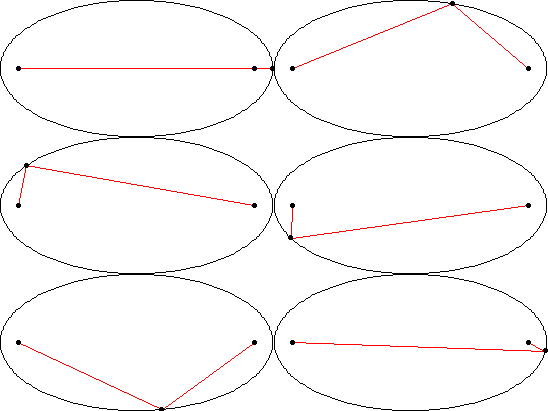
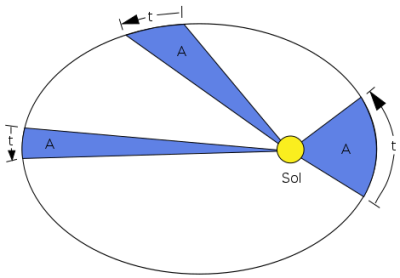
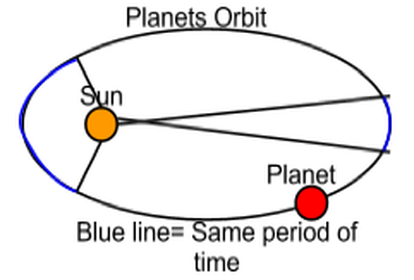
Kepler's Second Law states that a line segment joining a planet and the Sun sweeps out equal areas during equal intervals of time. This implies that a planet moves faster when it is closer to the Sun (perihelion) and slower when it is farther away (aphelion).
The area swept out by the radius vector is constant for any equivalent time segment along the orbit.
Planets accelerate near perihelion and decelerate toward aphelion to maintain constant area sweep rates.
ORBITAL MECHANICS / DYNAMICS
THE LAW OF EQUAL AREAS
Kepler’s Second Law states that a line segment joining a planet and the Sun sweeps out equal areas during equal intervals of time. This is not just a geometric observation; it is a direct consequence of the conservation of angular momentum. It explains why a planet's orbital speed is not constant.