Law of Equal Areas
KEPLER'S SECOND LAW
LAW OF EQUAL AREAS DYNAMICS
The Law of Equal Areas
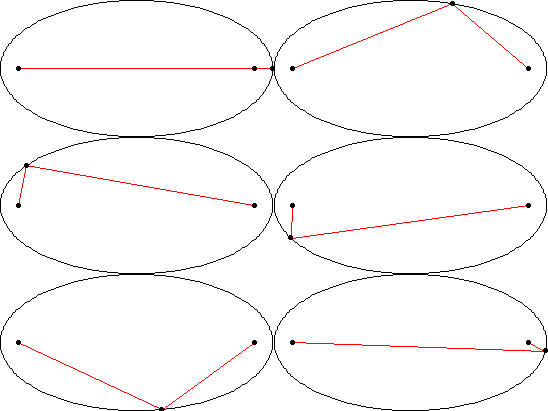
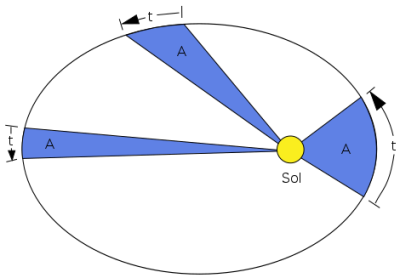
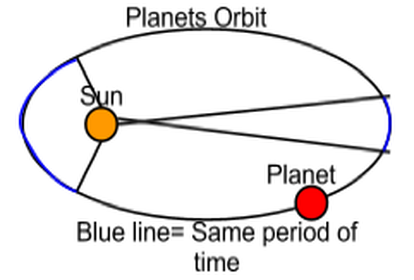
Kepler's Second Law states that a line segment joining a planet and the Sun sweeps out equal areas during equal intervals of time. This implies that a planet moves faster when it is closer to the Sun (perihelion) and slower when it is farther away (aphelion).
The area swept out by the radius vector is constant for any equivalent time segment along the orbit.
Planets accelerate near perihelion and decelerate toward aphelion to maintain constant area sweep rates.
Law of Equal Areas
Dynamic Orbital Speed. Kepler's Second Law reveals that planets do not travel at a constant speed along their elliptical orbits; their velocity shifts continuously.
The Sweeping Principle: A line segment joining a planet and the Sun sweeps out equal areas during equal intervals of time, dictating how fast or slow a world travels.
- 📐 Sweeps equal areas in equal time.
- 🌌 Proves orbital speed is never uniform.
Time and Area
Geometric Balance. If you measure the exact surface area swept out by an imaginary line between the Sun and a planet over a 30-day window, that area remains identical anywhere in the orbit.
Shape Adjustment: To cover the exact same area when closer to the Sun (where the wedge is short and wide) versus farther away (where it is long and narrow), the planet must speed up or slow down.
- ⏱️ Time intervals dictate swept surface.
- 🍕 Triangular wedges maintain equal area.
Perihelion Burst
Closest Approach. When a planet reaches perihelion—its closest point to the Sun along the ellipse—it experiences its strongest gravitational pull and highest orbital speed.
Rapid Travel: Because the planet is physically closer to the focus, the sweeping radius is shorter, forcing the body to race across space rapidly to cover the required sector area.
- ⚡ Maximum velocity at closest solar point.
- 🔥 Intense gravitational acceleration.
Aphelion Drift
Farthest Reach. Conversely, when a planet reaches aphelion—its maximum distance from the Sun—gravity weakens and its orbital velocity drops to its slowest point.
Leisurely Arc: Because the distance from the focus is long, a very narrow, stretched-out sector covers the required surface area, allowing the planet to drift sluggishly along its path.
- 🌙 Minimum velocity at furthest solar point.
- 🔭 Sluggish orbital coasting phase.
Angular Momentum
The Physical Driver. Kepler's Second Law is actually the geometric expression of a deeper physical principle: the conservation of angular momentum in a central force field.
Ice Skater Analogy: Just as an ice skater spins faster by pulling their arms inward, a planet speeds up as it pulls closer to the Sun and slows down when it extends outward.
- ⛸️ Mirrors ice skater spin physics.
- 🔄 Conserves momentum across orbit.
Earth's Speed Shift
Our Home Planet. Earth itself obeys the Second Law strictly; our planet travels slightly faster in January than it does in July.
Calendar Impact: Because Earth moves faster near perihelion in early January, the Northern Hemisphere winter is slightly shorter than its summer season.
- 🌍 Earth speeds up in January.
- 📅 Alters seasonal length slightly.
Historical Discovery
Published in 1609. Johannes Kepler published his second law alongside the first law in his monumental treatise *Astronomia Nova*.
An Empirical Breakthrough: Before this discovery, astronomers assumed uniform circular motion. Kepler's tedious calculations of Mars proved that speed fluctuates in precise mathematical harmony with distance.
- 📜 Featured in *Astronomia Nova*.
- 🔭 Derived from Mars observational records.
Vector Sectors
Mathematical Mapping. The Second Law establishes that sector areas swept by position vectors remain invariant over equal time steps ($dA/dt = \text{constant}$).
Spatial Geometry: This elegant mathematical constancy allows astrophysicists to compute orbital positions precisely without needing complex real-time calculus simulations.
- 📊 Constant areal velocity rate.
- 🧮 Simplifies orbital calculations.
Universal Scope
Beyond the Major Planets. Kepler's Second Law applies universally to all eccentric orbital systems, including highly elongated comet trajectories and artificial satellites.
Cometary Speed: Periodic comets like Halley's spend decades creeping slowly through the outer solar system, then whip past the Sun in a brilliant, hyper-fast burst before heading back out.
- ☄️ Explains extreme comet speed shifts.
- 🛰️ Governs elliptical satellite tracks.
Core Summary
The Enduring Principle. Kepler's Second Law captures the dynamic rhythm of the cosmos, ensuring that orbital velocity adapts seamlessly to solar proximity.
Summary Statement: Planets speed up when close to the sun and slow down when far away, sweeping out equal areas in equal times across every orbital journey.
- 🌟 Speed varies with distance.
- 📌 Equal areas swept in equal time.
ORBITAL MECHANICS / DYNAMICS
THE LAW OF EQUAL AREAS
Kepler’s Second Law states that a line segment joining a planet and the Sun sweeps out equal areas during equal intervals of time. This is not just a geometric observation; it is a direct consequence of the conservation of angular momentum. It explains why a planet's orbital speed is not constant.