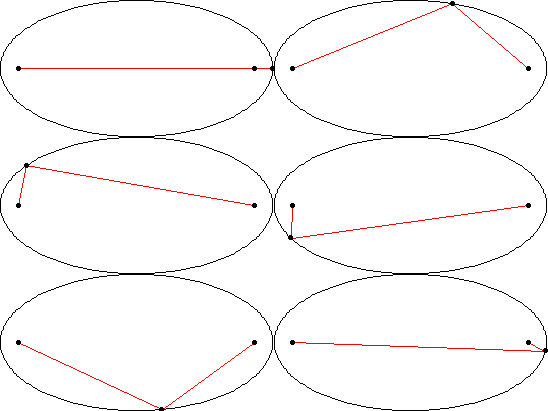
Law of Ellipses
KEPLER'S FIRST LAW
LAW OF ELLIPSES GEOMETRY
The Law of Ellipses
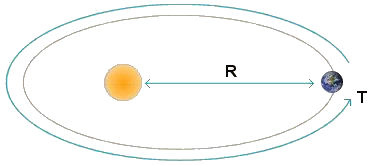
Kepler's First Law states that the orbit of every planet is an ellipse with the Sun at one of the two foci. This challenged the ancient belief that planets moved in perfect circles, establishing the foundation for modern celestial mechanics.
Planets traverse an oval path rather than a circle, varying their distance from the Sun throughout the year.
The Sun occupies one of the two focal points, not the geometric center of the orbital ellipse.
PHYSICS / ORBITAL MECHANICS
Kepler's First Law (KEPLER'S FIRST LAW)
Among Kepler's laws of planetary motion, the first law, also known as the "Law of Elliptical Orbits", explains that all planets travel in elliptical paths centered on the Sun. In this, the Sun is located at one focus of the ellipse. This is a fundamental law that differs from circular orbits and causes the speed of planets to vary at different positions.
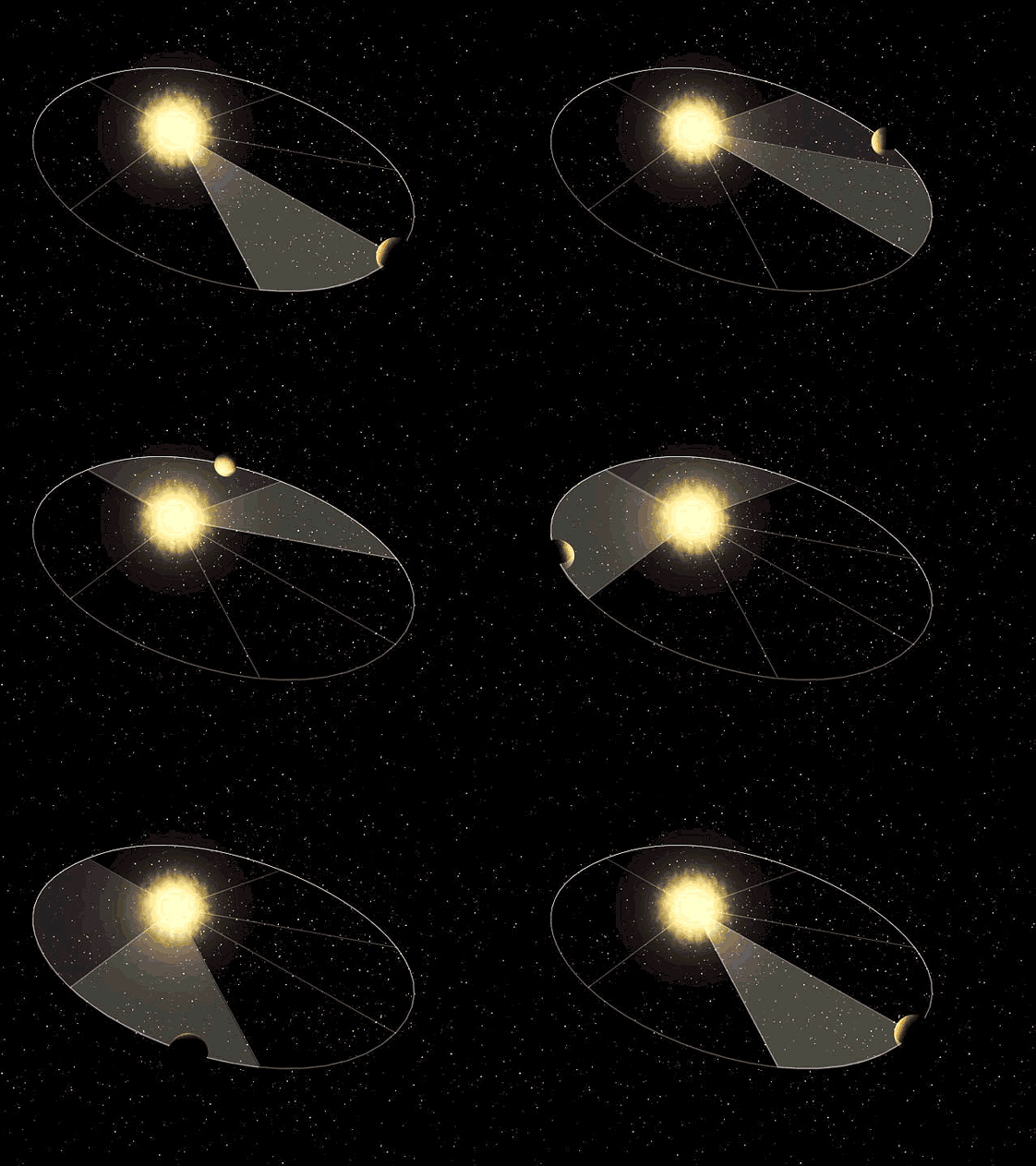
PHYSICS / ORBITAL CONCEPTS
Two Foci (FOCI)
A circle has only one center. But an ellipse has two focal points like centers. These are called foci. According to Kepler's first law, when planets travel in elliptical orbits, the Sun is located at only one of these two foci. The other focus has no planet or star and is empty space.
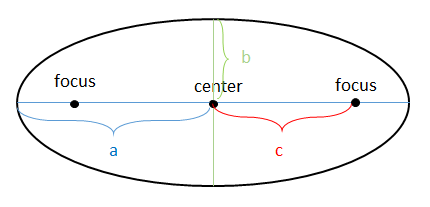
PHYSICS / ORBITAL CONCEPTS
Semi-Major Axis (SEMI-MAJOR AXIS)
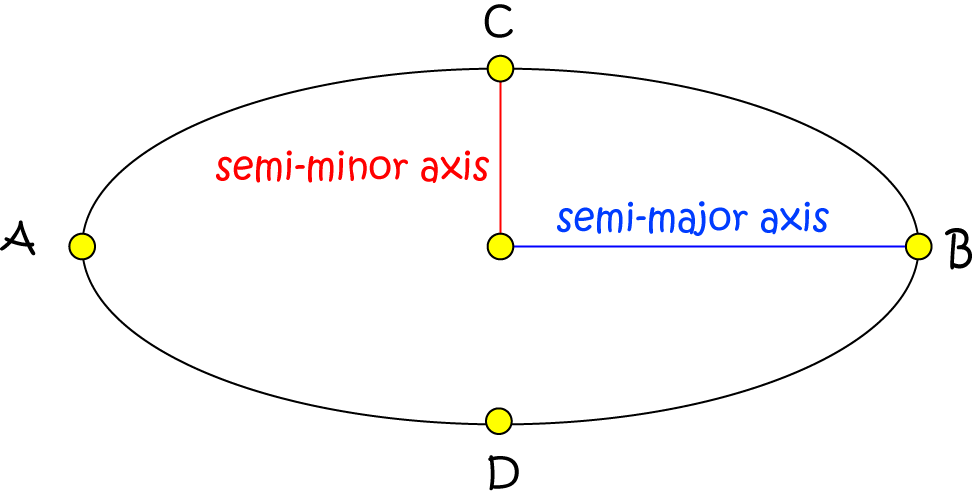
The semi-major axis is the longest radius of an ellipse. Simply put, it is the distance from the center of a planet's orbital path to the farthest point on the ellipse. In astronomy, this value is essential to determine the size of a planet's orbit and to measure the average distance between a planet and the Sun.
Question
If the perihelion (Perihelion - closest distance) of a certain planet's orbit is 1 AU and the aphelion (Aphelion - farthest distance) is 3 AU, find the semi-major axis of that orbit.
Solution Steps
- Step 1: Write the correct basic formula for finding the semi-major axis.
a = (rp + ra) / 2 - Step 2: Identify the data.
(rp = 1 AU and ra = 3 AU) - Step 3: Substitute those values into the formula and get the final answer.
Solving
Formula used:
a = (rp + ra) / 2
1. Substituting values:
a = (1 AU + 3 AU) / 2
2. Simplification:
a = 4 AU / 2
Answer: a = 2 AU
(That is, the length of the semi-major axis of the orbit is 2 astronomical units.)
PHYSICS / ORBITAL CONCEPTS
Semi-Minor Axis (SEMI-MINOR AXIS)
The semi-minor axis is the shortest radius of an ellipse. It measures the distance from the center of the ellipse to its shortest side. The semi-major axis represents the long side of the orbit, while the semi-minor axis represents the width or shortest distance of the orbit. This is important when determining the flatness (Eccentricity) of the ellipse.
Question
If the semi-minor axis of a certain artificial satellite's orbit is 4 AU and its orbital eccentricity is 0.6, find the semi-major axis of that orbit.
Solution Steps
- Step 1: Write the formula for finding the semi-major axis using b and e².
a = b / √(1 - e2) - Step 2: Calculate the square of the eccentricity (e2).
(0.6 × 0.6 = 0.36) - Step 3: Substitute the values into the formula, find the square root of (1 - e2) and then divide to get the final answer.
Solving
Formula used:
a = b / √(1 - e2)
1. Substituting values and finding e2:
a = 4 / √(1 - 0.62)
a = 4 / √(1 - 0.36)
2. Subtraction and removing square root:
a = 4 / √(0.64)
a = 4 / 0.8
Answer: a = 5 AU
(That is, the length of the semi-major axis of the orbit is 5 astronomical units.)
Question
If the perihelion (Perihelion - closest distance) of a planet's orbit is 2 AU and the aphelion (Aphelion - farthest distance) is 8 AU, find the semi-minor axis of that orbit.
Solution Steps
- Step 1: Write the correct basic formula for finding the semi-minor axis.
b = √(rp × ra) - Step 2: Identify the data.
(rp = 2 AU and ra = 8 AU) - Step 3: Substitute the values into the formula, multiply, and take the square root of the final value.
Solving
.Formula used:
b = √(rp × ra)
1. Substituting values:
b = √(2 × 8)
2. Multiplication:
b = √(16)
Answer: b = 4 AU
(That is, the length of the semi-minor axis of the orbit is 4 astronomical units.)
PHYSICS / ORBITAL CONCEPTS
Eccentricity (ECCENTRICITY)
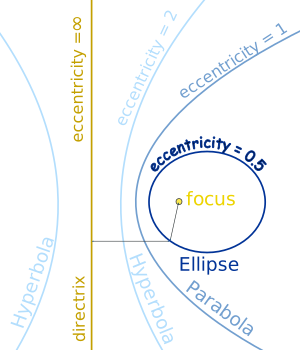
Eccentricity is the measure that determines how circular or how elongated (squashed) an ellipse is. It is symbolized by the letter 'e'. If the eccentricity of an orbit is 0, it is a perfect circle. When the value is greater than 0 and less than 1, it takes an elliptical shape. This value is essential to understand the nature of the orbital paths of planets.
Question
If the perihelion (Perihelion) of a planet's orbit is 2 AU and the aphelion (Aphelion) is 8 AU, find its eccentricity (Eccentricity - e) directly without finding other values of the orbit.
Solution Steps
- Step 1: Write the formula for finding eccentricity using only rp and ra.
e = (ra - rp) / (ra + rp) - Step 2: Substitute the data and simplify the numerator (subtraction) and denominator (addition) separately.
- Step 3: Convert the resulting fraction to a decimal value and obtain the final answer.
Solving
Formula used:
e = (ra - rp) / (ra + rp)
1. Substituting values:
e = (8 - 2) / (8 + 2)
2. Simplifying numerator and denominator:
e = 6 / 10
Answer: e = 0.6
(The eccentricity is obtained as 0.6 by directly dividing the orbital data.)
Question
If the semi-major axis (Semi-major axis) of a planet's orbit is 5 AU and its semi-minor axis (Semi-minor axis) is 4 AU, find the eccentricity (Eccentricity - e) of this orbit.
Solution Steps
- Step 1: Write the basic formula for finding eccentricity using a and b.
e = √(1 - (b2 / a2)) - Step 2: Calculate the squares of the values (a2 and b2) separately.
(42 = 16 and 52 = 25) - Step 3: Convert the fraction to a decimal, subtract from 1, and take the square root of the resulting value to obtain the eccentricity (e).
Solving
Formula used:
e = √(1 - (b2 / a2))
1. Substituting values and squaring:
e = √(1 - (42 / 52))
e = √(1 - (16 / 25))
2. Simplifying the fraction and subtraction:
e = √(1 - 0.64)
e = √(0.36)
Answer: e = 0.6
(The eccentricity of the orbit is 0.6. No units.)
PHYSICS / ORBITAL MECHANICS
Perihelion (PERIHELION)
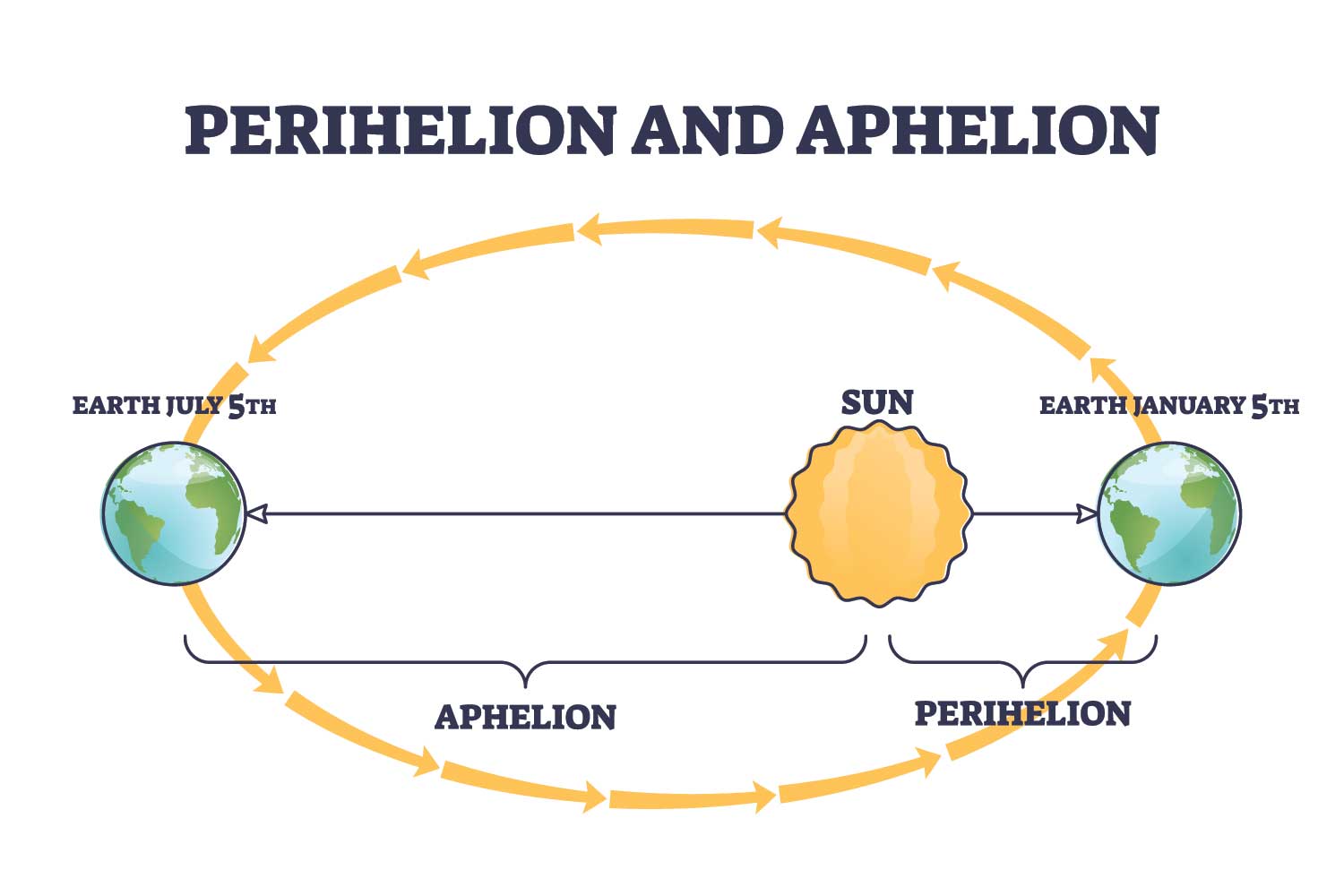
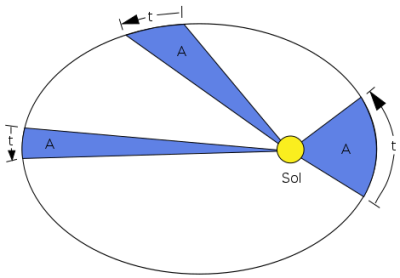
Perihelion is the point in the orbital path of an object traveling in an elliptical orbit around the Sun where it comes closest to the Sun. According to Kepler's second law, at this point the planet is at the closest distance to the Sun, so its orbital speed reaches its maximum value. The Earth passes this point at the beginning of January every year.
Question
If the semi-major axis (Semi-major axis) of a planet's orbit is 5 AU and its eccentricity (Eccentricity) is 0.6, find the perihelion (Perihelion - closest distance) of that orbit.
Solution Steps
- Step 1: Write the basic formula for finding perihelion using a and e.
rp = a(1 - e) - Step 2: First simplify the part inside the brackets.
(1 - 0.6 = 0.4) - Step 3: Multiply the resulting value by the semi-major axis (a) and obtain the final answer.
Solving
Formula used:
rp = a(1 - e)
1. Substituting values:
rp = 5 × (1 - 0.6)
2. Simplifying the bracket and multiplication:
rp = 5 × 0.4
Answer: rp = 2 AU
(That is, the perihelion of the orbit or the closest distance is 2 astronomical units.)
PHYSICS / ORBITAL MECHANICS
Aphelion (APHELION)
Aphelion is the point in the orbital path of an object traveling in an elliptical orbit around the Sun where it is farthest from the Sun. At this point, the distance from the Sun is maximum, so the orbital speed of a planet reaches its minimum value. The Earth passes this point at the beginning of July every year.
Question
If the semi-major axis (Semi-major axis) of a planet's orbit is 5 AU and its eccentricity (Eccentricity) is 0.6, find the aphelion (Aphelion - farthest distance) of that orbit.
Solution Steps
- Step 1: Write the basic formula for finding aphelion using a and e.
ra = a(1 + e) - Step 2: First add the part inside the brackets and simplify.
(1 + 0.6 = 1.6) - Step 3: Multiply the resulting value by the semi-major axis (a) and obtain the final answer.
Solving
Formula used:
ra = a(1 + e)
1. Substituting values:
ra = 5 × (1 + 0.6)
2. Simplifying the bracket and multiplication:
ra = 5 × 1.6
Answer: ra = 8 AU
(That is, the aphelion of the orbit or the farthest distance is 8 astronomical units.)
PHYSICS / ORBITAL MECHANICS
Distance from Center to Focus (DISTANCE TO FOCUS)
The distance from the center of an ellipse to one focus is denoted as 'c'. This distance is determined by the length of the semi-major axis (a) and the eccentricity (e). Mathematically, it can be expressed as c = ae. This value determines how flat the ellipse is.
Question
If the semi-major axis (Semi-major axis) of a planet's orbit is 5 AU and its eccentricity (Eccentricity) is 0.6, find the distance from the center to the focus (Distance from center to focus - ae) of the orbit.
Solution Steps
- Step 1: Write the basic formula for finding the distance from the center to the focus.
c = a × e - Step 2: Substitute the given data into the formula.
(a = 5 AU and e = 0.6) - Step 3: Multiply the two values and obtain the final distance.
Solving
Formula used:
c = a × e
1. Substituting values:
c = 5 × 0.6
2. Multiplication and simplification:
c = 3.0 AU
Answer: c = 3 AU
(That is, the distance from the center of the orbit to the focus is 3 astronomical units.)
PHYSICS / ORBITAL MECHANICS
Ratio of Aphelion to Perihelion (RATIO OF APHELION TO PERIHELION)
The ratio between aphelion distance and perihelion distance is used to measure the elliptical nature of a planet's orbit. Perihelion distance (rp) = a(1 - e) and aphelion distance (ra) = a(1 + e). Here a is the semi-major axis and e is the eccentricity. The ratio of these two distances is as follows:

Main Question (Super Question)
The ratio between the maximum distance (Aphelion) and minimum distance (Perihelion) from the Sun for a newly discovered asteroid traveling in an elliptical orbit around the Sun is 3:1. If the longest diameter (Major axis) of this asteroid's complete orbital path is 80 astronomical units (80 AU), calculate the following values according to Kepler's first law.
Values to find:
- Eccentricity of the orbit (e)
- Perihelion distance or closest distance (rp)
- Aphelion distance or farthest distance (ra)
- Semi-major axis of the orbit (a)
- Semi-minor axis of the orbit (b)
Tips:
* Major Axis = 2a
* Aphelion : Perihelion = ra : rp
Step-by-Step Solving
(4) Finding the semi-major axis (a) of the orbit:
The longest diameter (Major Axis) of the orbit is directly 2a.
2a = 80 AU
a = 80 / 2 = 40 AU
(1) Finding the eccentricity (e) of the orbit:
Direct formula when the ratio of distances is given: e = (ra - rp) / (ra + rp)
Since the ratio is 3:1, we can substitute ra = 3 and rp = 1:
e = (3 - 1) / (3 + 1)
e = 2 / 4
e = 0.5
(2) Finding the perihelion distance (rp):
Substitute into the basic formula: rp = a(1 - e)
rp = 40 × (1 - 0.5)
rp = 40 × 0.5
rp = 20 AU
(3) Finding the aphelion distance (ra):
Substitute into the basic formula: ra = a(1 + e)
ra = 40 × (1 + 0.5)
ra = 40 × 1.5
ra = 60 AU
(Verification: ra : rp = 60 : 20 = 3 : 1, so the answer is correct!)
(5) Finding the semi-minor axis (b) of the orbit:
The easiest method using rp and ra: b = √(rp × ra)
b = √(20 × 60)
b = √(1200)
b = √(400 × 3) = 20√3 AU
b ≈ 34.64 AU
Final answers at a glance:
[ e = 0.5 ] | [ rp = 20 AU ] | [ ra = 60 AU ] | [ a = 40 AU ] | [ b ≈ 34.64 AU ]
- Orbits -
Join Our Newsletter
Stay updated with the latest astronomical discoveries, space mission updates, and community events from HORIZONS. It is an honor to have you join our journey through the stars.