Carbon Dating Caluculator
ULTRA CARBON DATING
C-14 DECAY • RADIOMETRIC AGE
1.00
± 86 y
5644 – 5816 BP
RADIOCARBON DATING • ARCHAEOLOGICAL MATRIX 2026
Radiocarbon Basics
Isotopic Decay. Carbon-14 is a radioactive isotope created continuously in Earth upper atmosphere by cosmic ray bombardment interacting with atmospheric nitrogen.
Core Principle: Living organisms constantly absorb carbon from the atmosphere, maintaining a steady ratio of Carbon-14 to stable Carbon-12 until death stops intake.
- ⚛️ Cosmic ray creation.
- 🌿 Equilibrium in living tissue.
Half-Life Decay
Predictable Decline. Carbon-14 has an accepted half-life of roughly 5,730 years. As time passes, the radioactive atoms decay back into nitrogen-14 at a strictly steady rate.
Measurement: By measuring how much Carbon-14 remains relative to stable carbon isotopes, scientists calculate how long ago the organism died.
- ⏳ 5,730 year half-life.
- 📉 Exponential decay curve.
AMS Technology
Ultra-Precise Counts. Traditional methods required large samples to count radioactive decays. Accelerator Mass Spectrometry (AMS) counts individual carbon atoms directly.
Advantage: Allows dating of tiny samples like single seeds, small bone fragments, or delicate textile threads.
- 🔬 Atom-by-atom counting.
- 🤏 Micro-sample capability.
Calibration Curves
Historical Corrections. Atmospheric carbon-14 levels have not been constant throughout history due to solar activity shifts and Earth magnetic field changes.
Tree Rings: Dendrochronology provides exact calendar-year matches by cross-referencing ancient tree ring sequences, creating calibration curves like IntCal.
- 🌲 Tree ring cross-checks.
- 📊 Atmospheric correction charts.
Temporal Limits
The 50,000 Year Wall. After roughly 8 to 10 half-lives (about 50,000 years), the amount of remaining Carbon-14 drops below detectable thresholds using current laboratory equipment.
Alternatives: For older dinosaur fossils or ancient rock layers, scientists must switch to different radiometric methods like potassium-argon or uranium-lead dating.
- 🧱 50,000 year threshold.
- ⛏️ Deep geologic alternatives.
Contamination Control
Sample Purity. Ancient organic remains can easily be contaminated by modern rootlets, humic acids from soil, or handling oils, which completely skew date outcomes.
Pretreatment: Laboratories use rigorous chemical extraction protocols to strip away foreign contaminants before running the final isotope analysis.
- 🧪 Chemical washing steps.
- 🛡️ Foreign carbon removal.
Bomb Carbon Peak
Nuclear Legacy. Mid-20th-century thermonuclear weapons testing doubled atmospheric carbon-14 levels, creating a distinct global marker known as the bomb spike.
Forensics: This spike is actively used in modern forensic science and ecology to date recent organic tissues, wildlife trade items, and vintage spirits.
- 💥 1960s nuclear spike.
- 🕵️ Modern forensic testing.
Historical Impact
Chronological Foundation. Carbon dating revolutionized archaeology by providing an absolute numerical timeline for human history, moving past relative stratification guesses.
Legacy: From dating ancient manuscripts to tracing human migration out of caves, radiocarbon analysis remains a cornerstone of historical discovery.
- 📜 Absolute timelines.
- 🏺 Artifact verification.
RADIOMETRIC DATING / ARCHAEOLOGY
THE CLOCK IN THE BONES
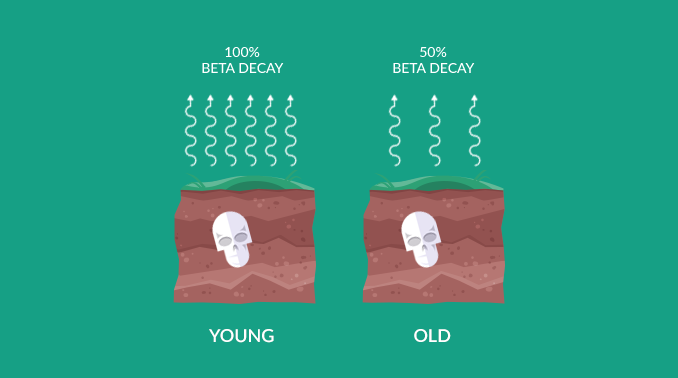
Carbon dating is a scientific method used to find the age of ancient organic materials like wood, bone, and cloth. By measuring how much radioactive carbon isotope remains inside a sample, scientists can calculate roughly when the living organism stopped absorbing carbon from the atmosphere.

RADIOMETRIC DATING / DECAY MATHEMATICS
THE HALF-LIFE EQUATION
Because radioactive Carbon-14 decays at a strictly constant rate, scientists can measure how much remains relative to stable Carbon-12. By applying exponential decay formulas, they trace backward to find out when the specimen's clock started ticking.

RADIOMETRIC DATING / LIMITS & CALIBRATION
THE CEILING OF TIME
While carbon dating is revolutionary for archaeology, it cannot date everything. Because Carbon-14 decays completely away after several dozen half-lives, the technique reaches a hard limit when looking back at dinosaur fossils or ancient rock layers millions of years old.

Recommended Tools
View AllLoading recommended tools...
Dive Deep
Photosynthesis Yield

Cell Doubling

Human Lung Capacity
Carbon Dating
Earth Quake Energy
Soil Porosity

Genetic Cross
Water Evaporation Rate
<
Ocean Pressure At Depth

Wind Chill Factor

Glacier Melt Volme
