
Trojan Logic
TROJAN ORBITAL LOGIC
LAGRANGIAN CO-ORBITAL RESONANCE MAPPING
Lagrangian L4 & L5 Balance
Trojan asteroids are captured inside stable gravitational nodes located 60 degrees ahead (L4) and 60 degrees behind (L5) a planet's orbital path. At these points, the competing gravitational pulls of the Sun and the planet perfectly balance out with centrifugal forces.
Asteroids maintain a permanent safe cushion ahead of or behind the host planet along its flight path.
Objects complete exactly one orbital lap around the Sun in the same duration as their host world without colliding.
Trojan Sync
Lagrange Point Mapping. Analyzing the stable gravitational pockets at the L4 and L5 orbital nodes. New Horizons monitors the Trojan Constant to track asteroids trapped in the 60 degree sync.
- 🛡️ L4 Node: Leading Greek Camp Heroics.
- ⚔️ L5 Node: Trailing Trojan Camp Defense.
- ⚖️ Balance: Sun-Planet Gravity Lock.
Resonance Sync
Geometric Orbital Mapping. Analyzing the 1:1 synchronous period between planetary bodies and Trojan clusters. New Horizons monitors the Resonance Constant to track stable Lagrange geometry.
- 🔄 Ratio: Perfect 1:1 Period Match.
- 📐 Geometry: 60 Degree Equilateral Lock.
- 💎 Stability: Tadpole Libration Paths.
Greek Sync
L4 Leading Node Mapping. Analyzing the 60 degree scout position of the Greek Camp heroes. New Horizons monitors the Hellenic Constant to track the stable lead of Achilles and Agamemnon.
- ⚔️ Achilles: The First Discovered Trojan.
- 🛰️ Position: 60 Degree Leading Arc.
- 📜 History: The Iliad Naming Convention.
Trojan Sync
L5 Trailing Node Mapping. Analyzing the 60 degree defensive position of the Trojan Camp heroes. New Horizons monitors the Trojan Constant to track the loyal shadow of Priam and Hector.
- 🏹 Hector: The Greatest Defender.
- 🛰️ Position: 60 Degree Trailing Arc.
- 🛡️ Duty: The Loyal Orbital Guard.
Neighbor Sync
L4 Earth Trojan Mapping. Analyzing the elusive 60 degree lead of 2010 TK7 and 2020 XL5. New Horizons monitors the Visibility Constant to track neighbors hidden by solar glare.
- 🔍 Discovery: 2010 TK7 & 2020 XL5.
- ☀️ Challenge: Severe Solar Interference.
- ⏳ Stability: Multi-Millennium Orbit Lock.
ORBITAL MECHANICS / THREE-BODY PROBLEM
THE LAGRANGIAN TRAP
In the "Three-Body Problem" of celestial mechanics, Lagrangian points ($L_1$ through $L_5$) are positions where the gravitational pull of two large bodies (like the Sun and Jupiter) perfectly balances the centripetal force required for a small object to move with them. The $L_4$ and $L_5$ points are special because they are dynamically stable. An asteroid that drifts near these points doesn't fly away; it is nudged back toward the center of the equilibrium, effectively trapping it in a "tadpole orbit" around the point for billions of years.

Sources
STABILITY POINTS
Trojan asteroids cluster at L4 (leading 60°) and L5 (trailing 60°). These are "gravity wells" where objects remain trapped.
LAGRANGE MATHJUPITER'S SWARM
Jupiter has the most Trojans, with over 10,000 cataloged. They are divided into the "Greeks" at L4 and "Trojans" at L5 .
LUCY MISSIONDYNAMIC BALANCE
If a Trojan is nudged, it orbits the Lagrange point in a "tadpole orbit," staying safely away from the planet's actual path.
ORBITAL DRIFT- Asteriods -
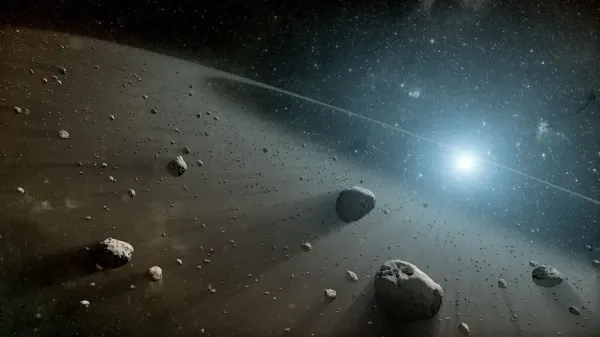
Asteroid
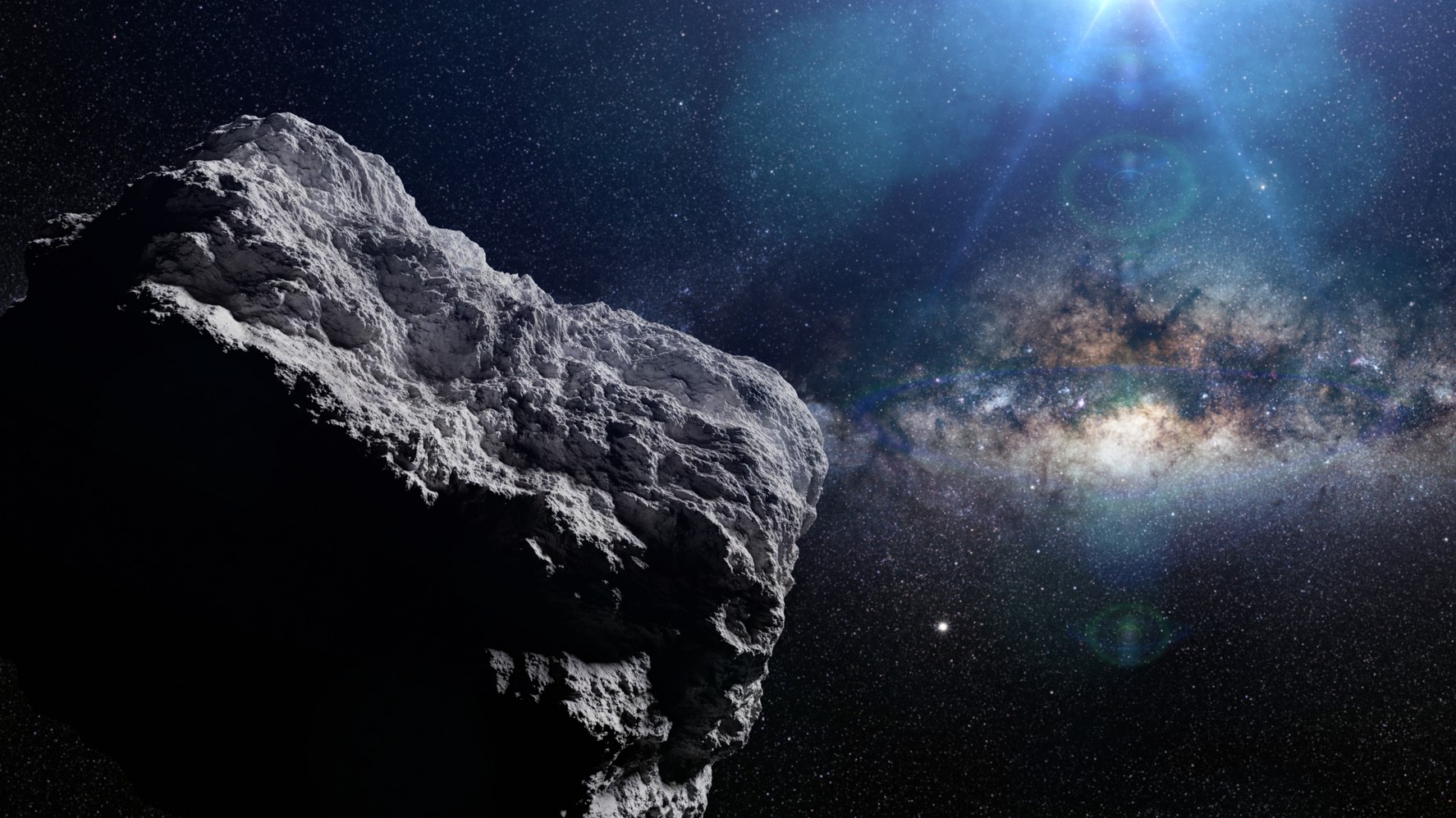
Asteroid Spacing

Space View Point

Ceres Gravity/Size

Mining Profit

Impact Energy

Trojan Logic

Ceres 3D Model
