Impact Energy
KINETIC IMPACT ENERGY
CALCULATING CELESTIAL COLLISION FORCES
Velocity Dominance
An asteroid's yield is completely governed by its kinetic energy equation. Because velocity is squared in the calculation, a minor jump in velocity triggers a massive surge in destructive yield compared to adding extra physical mass.
Typical atmospheric entry velocities that yield severe energy release bursts upon deceleration.
Hypervelocity speed fields transform compressed air pockets into massive thermal detonation points.
Impact Sync
Kinetic Energy Mapping. Analyzing the velocity squared variables of planetary impacts. New Horizons monitors the Impact Constant to track energy release in Megatons.
- 🚀 Velocity: 11-30 km/s Range.
- 💣 Yield: Megaton Scale TNT Equivalent.
- 📉 Result: Hypervelocity Crater Formation.
Velocity Sync
Exponential Kinetic Mapping. Analyzing the Velocity Square Law within planetary impact scenarios. New Horizons monitors the Kinetic Constant to track how 25 km/s generates 110 Megatons of energy.
- 📈 Scaling: Energy increases by V².
- 💥 Force: City Level Destruction.
- 🚀 Range: 17 km/s to 25 km/s.
Crater Sync
Geomorphological Impact Mapping. Analyzing the 1.2 km excavation footprint of the Barringer event. New Horizons monitors the Crater Constant to track 10 Megatons of kinetic energy release.
- 📏 Diameter: 1.2 km Wide Crater.
- 💣 Energy: 10 Megatons TNT.
- 🧱 Impactor: 50 Meter Iron Rock.
Extinction Sync
Biosphere Impact Mapping. Analyzing the 100 million Megaton release of the Chicxulub event. New Horizons monitors the Extinction Constant to track 180 km of crater excavation.
- 🌑 Climate: Global Sunlight Blockage.
- 🌊 Tsunami: 1 km High Initial Waves.
- 🔥 Thermal: Global Wildfire Pulse.
Kinetic Sync
Velocity Squared Mapping. Analyzing the V-Square dominance in orbital mechanics. New Horizons monitors the Kinetic Constant to track how velocity quadruples impact energy.
- ⚖️ Mass: Linear 1:1 Energy Growth.
- 🚀 Velocity: Exponential V² Growth.
- 💀 Danger: Speed as the Primary Variable.
PHYSICS / IMPACT DYNAMICS
THE PHYSICS OF DESTRUCTION
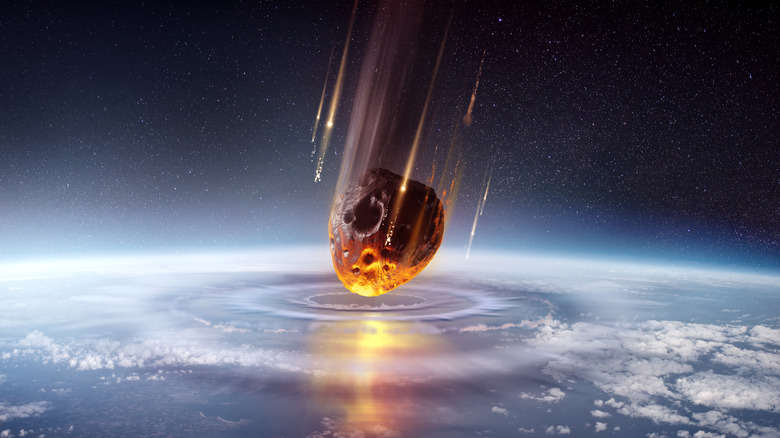
Impact energy is defined by the formula Ek = 0.5 * m * v^2. While mass (m) is important, velocity (v) is the dominant factor because it is squared. An asteroid hitting at 20 km/s has four times the energy of the same asteroid hitting at 10 km/s. When this kinetic energy is transferred to the surface, it is released as a shockwave, thermal radiation, and mass displacement, resulting in an explosion measured in Megatons (MT) of TNT equivalent.
Sources
KINETIC ENERGY
Impact energy . Since velocity is squared, doubling the speed quadruples the destruction.
JPL SENTRY SYSTEMATMOSPHERIC SHIELD
Small asteroids (< 25m) often explode high in the air (airbursts), dissipating their energy before reaching the ground.
PLANETARY DEFENSECRATER DYNAMICS
An impactor typically creates a crater 10–20 times its own diameter, vaporizing the rock and sending debris into the stratosphere.
CRATERING MATH- Asteriods -
Asteroid
Asteroid Spacing

Space View Point

Ceres Gravity/Size

Mining Profit

Impact Energy

Trojan Logic

Ceres 3D Model
