Space View Point
VISUAL OBSERVATION DECK
SPACECRAFT PERSPECTIVE MATRIX
Proximity Horizon
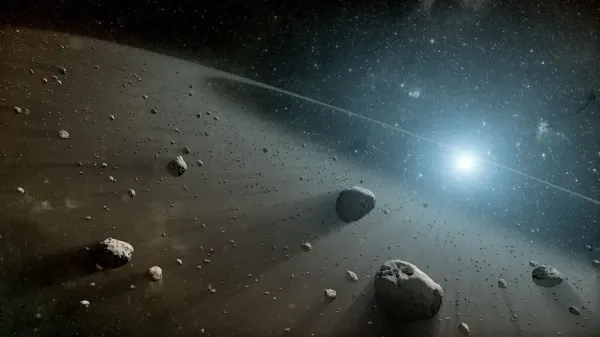
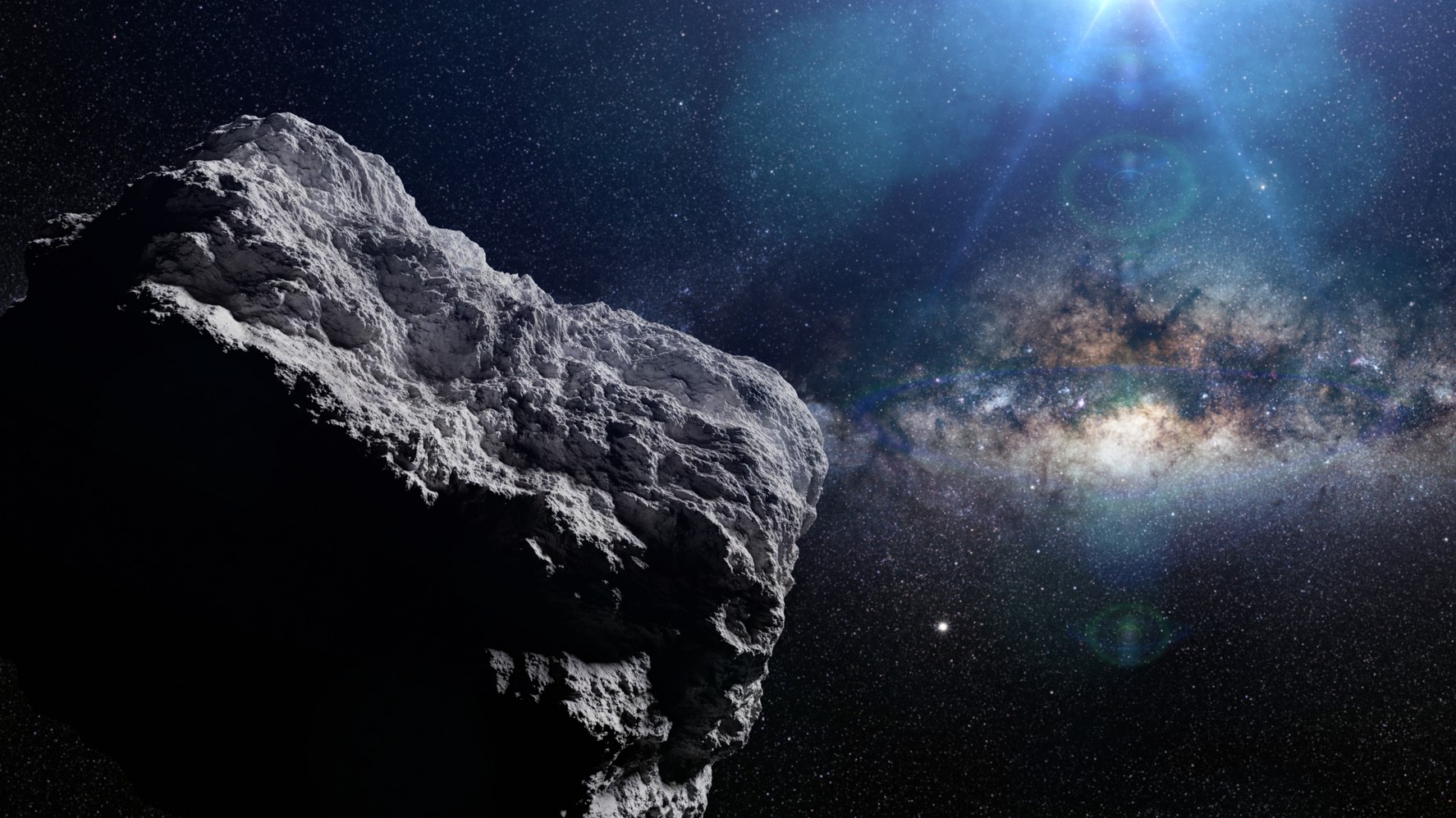
Contrary to science fiction, standing on an asteroid looking out into the belt reveals a vast, mostly empty horizon. The average distance between major fragments spans over a million kilometers, making neighboring objects look like distant stars.
The immense spatial distance keeping individual rocky bodies completely clear of each other.
Deep space robotic navigation vectors require deliberate aiming to ever cross paths with an object.
Space View
Orbital Torus Mapping. Analyzing the visual structure of the Mars Jupiter gap from a deep space vantage point. New Horizons monitors the Perspective Constant to track the belt's appearance as a shimmering kinetic ring.
- 🔭 Perspective: 1 AU Wide Shimmering Ring.
- 📏 Width: 2.2 to 3.2 AU Orbital Range.
- 🌀 Sync: Jupiter Resonance Lock.
Torus Sync
Main Belt Architecture Mapping. Analyzing the 12 year orbital resonance that governs the billion particle ring. New Horizons monitors the Torus Constant to track how Jupiter gravity maintains the gap between Mars and the outer system.
- 🛡️ Governor: Jupiter 12 Year Cycle.
- 📉 Feature: Kirkwood Resonance Gaps.
- 🌀 Structure: 1 AU Wide Kinetic Ring.
Gap Monitor
Kirkwood Resonance Mapping. Identifying the gravitationally cleared lanes within the 2.2 to 3.2 AU range. New Horizons monitors the Resonance Constant to track why specific orbital paths remain empty.
- 🌀 Force: Mean Motion Resonance.
- 📉 Logic: Jupiter Gravitational Shearing.
- 🛡️ Result: Orbital Stability Failure.
Trojan Sync
Lagrange Swarm Mapping. Analyzing the 60 degree stability zones sharing Jupiter's orbital path. New Horizons monitors the Trojan Constant to track the Greek and Trojan clusters locked in planetary sync.
- 📐 Offset: 60° Lead and Trail.
- 🛡️ Points: Lagrange L4 and L5.
- 🌀 Nature: Co-Orbital Kinetic Lock.
Scatter Sync
3D Volumetric Mapping. Analyzing the vertical displacement of the Mars Jupiter gap. New Horizons monitors the Scatter Constant to track why the belt behaves like a thick fuzzy cloud rather than a flat disc.
- 📐 Inclination: High Angle Deviations.
- ☁️ Nature: Fuzzy Torus Distribution.
- 📏 Thickness: 20 Million KM+ Depth.
OBSERVATIONAL ASTRONOMY / NAVIGATIONAL PERSPECTIVE
THE EXTERIOR VANTAGE
When positioned on an asteroid in the main belt, the "Space View" becomes an exercise in parallax and scale. Looking inward toward the Sun, the inner planets (Mars, Earth, Venus, Mercury) appear as fleeting, inner-system transients. You are situated at the "frontier," where the Sun is significantly dimmer and the outer gas giants, particularly Jupiter, dominate the gravitational and visual landscape. This perspective shifts the observer from an Earth-centric coordinate system to a Heliocentric Navigator mindset, where you track the motion of planetary bodies as they transit the background of fixed stars.

OPERATIONAL PHYSICS / SURVIVABILITY
THE HAZARDS OF DEEP SPACE
Operating sensors in the asteroid belt involves dealing with two primary "silent" killers: Galactic Cosmic Rays (GCRs) and Micro-meteoroid Flux. Unlike Earth, where the magnetic field and atmosphere shield sensitive optics and electronics, belt-based platforms are fully exposed. GCRs cause "bit-flips" in digital memory and cumulative degradation of CMOS sensor arrays, leading to increased noise and dead pixels in your imaging. Furthermore, the constant bombardment by sub-millimeter dust—the pulverized detritus of ancient collisions—acts as a slow-motion sandblasting process, etching lenses and degrading the performance of solar arrays over time.
Sources
ORBITAL BOUNDARIES
The belt begins around **2.2 AU** from the Sun and extends to **3.2 AU**, sitting firmly between Mars and Jupiter.
NASA ORBIT DATAVISUAL REALITY
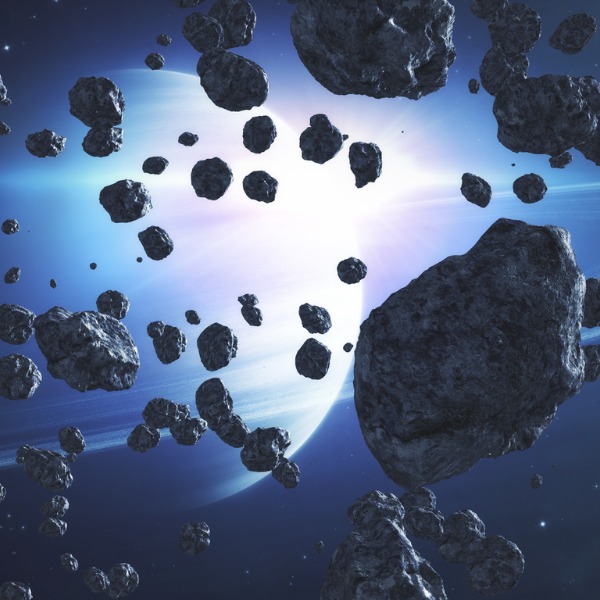
From a spacecraft's perspective, the belt looks like empty space. The average distance between major asteroids is ~1 million km.
MISSION VIEWCERES DOMINANCE
Ceres, the only dwarf planet in the inner solar system, is the "Queen" of the belt, containing 25% of its total mass.
DAWN MISSION